Portuguese
  Spanish


The idea of covering the plantation with solar panels seemed to doom the harvest, but it has become one of the fastest-growing bets in the field, with numbers that shock those who have not yet looked up
Agrivoltaic energy, the system that installs solar panels over the same land where crops are planted, has moved from being a laboratory experiment to a market that leaps from a few megawatts to several gigawatts in a single decade. The promise is straightforward and counterintuitive: to produce two products, food and electricity, from the same hectare, without one destroying the other.
Agrivoltaic energy works because the panels are raised well above the ground or spaced apart, allowing light and machinery to pass through. In hot and dry regions, partial shade reduces the water stress of plants and protects against hail, frost, and sunburn. The result is double income in the same area, with gains that strongly depend on the climate.
What it is, in practice, to plant under panels
The name comes from the combination of agriculture and photovoltaics. Instead of choosing between using land for food or for a solar plant, the producer installs solar panels on the farm and does both at the same time. The structures are high enough for a tractor to pass underneath, or they are vertical rows spaced between the crops.
-
Humanoid Robots in Texas Train Like Humans, Lift 25 kg, and Highlight the Billion-Dollar Race Among Startups, Automakers, Big Tech, and Logistics Giants

-
Sixth-Grader in Brazil Turns Pine Nut Shells into Biodegradable Cups that Decompose in Five Weeks
-
Chinese Robot Dog Equipped with Wheels Can Cross Rivers, Ice, and -30°C Cold, Aiding in Power Grid Inspections and Disaster Areas

-
Researchers Develop “Electronic Nose” to Detect Spoiled Food and Allergen Traces



The concept is not new. The first experimental potato plantation under solar modules dates back to 1981 in Germany. What has changed is the scale and the reduction in panel costs, which finally made the numbers work. Today shade has ceased to be the enemy of crops and has become a management tool, used intentionally to control temperature and soil water loss. Thus, solar energy in the field no longer competes with food and starts to coexist with it.
From 5 megawatts to 14 gigawatts in just over ten years
The scale leap is the data that best explains why the sector stopped being a curiosity. According to data compiled by Energia Cooperativa, a platform specialized in renewable energy, the global installed capacity went from just 5 megawatts-peak in 2012 to 2.8 gigawatts in 2020 and about 14 gigawatts today. It is a growth of almost three thousand times in just over a decade.
The same data from Energia Cooperativa shows why the bill matters to your wallet. In a system installed in Heggelbach, Germany, monitored between 2016 and 2018, land use efficiency increased by 60% to 84% compared to using the area for just one of the two purposes. In other words, the same land delivered nearly double the value.
The shade that protects instead of hindering
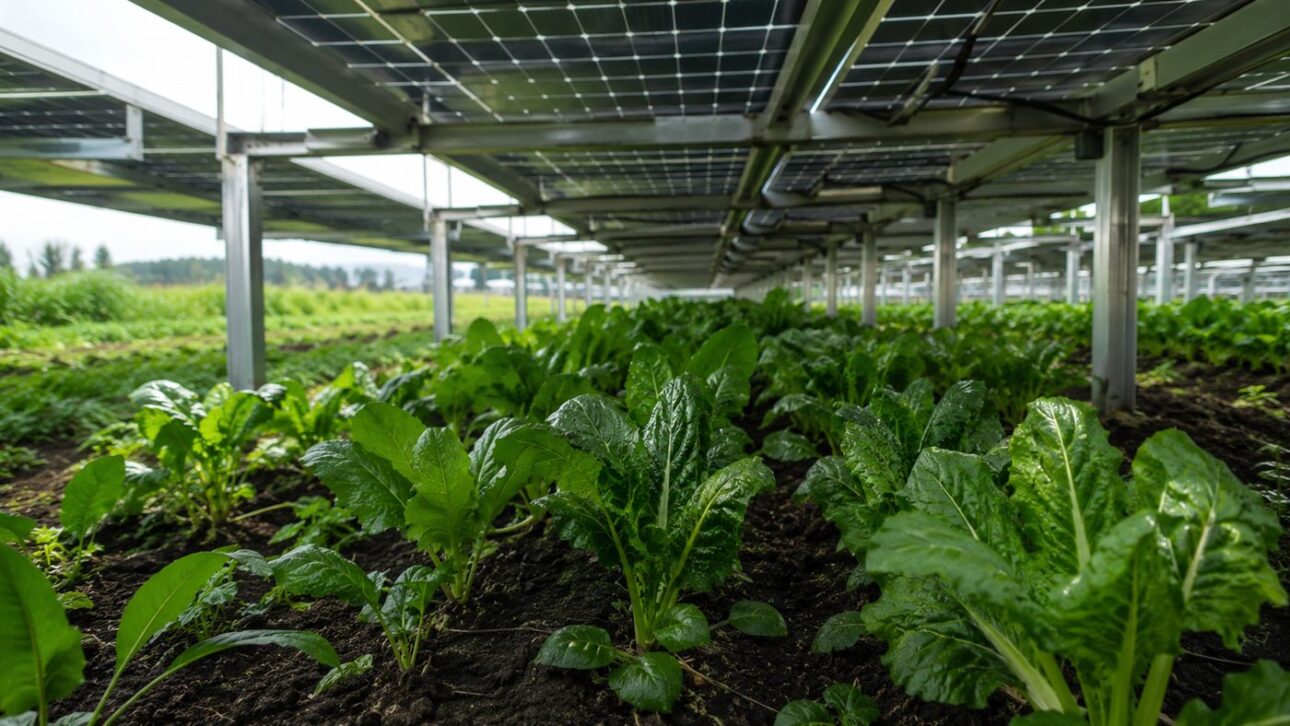
Intuition says that every plant wants full sun, and that’s why the idea of covering it sounds wrong. However, beyond a certain point, more light doesn’t mean more harvest; it means heat and evaporation. Under the panels, the environment stays cooler, the soil retains more moisture, and the crop suffers less from wind, hail, and erosion.
That’s why agrivoltaic energy performs better precisely where water is scarce. In Chile, rows of modules were used to protect crops from excessive radiation. In the Gobi Desert, China, the system advanced over berry crops. The panel becomes an umbrella that still generates money while shading, and this is the point that changed the minds of those who previously saw land waste.
The study that showed both sides of the account
The honest part of the story is that it doesn’t always work, and it was a recent scientific work that put numbers on this caveat. In a study from the University of Illinois published in the scientific journal PNAS, researchers Mengqi Jia and Kaiyu Guan simulated 15 years of cultivation with panels covering 33% of each tested area.
The result divided the map in two. Where there was abundant rain, the shade from the modules reduced photosynthesis and decreased production: corn dropped by 24% and soybeans fell by 16%. In the semi-arid environment, the same shade relieved heat and water stress, and soybeans managed to yield 6% more. The lesson is clear: the technology is not magical; it is climate-dependent.
Where agrivoltaic energy yields and where it doesn’t pay off
This contrast becomes a decision manual for the producer. In wet land with abundant rain, covering the crop tends to take away light that the plant would still use, and the loss in harvest may be greater than the gain from selling electricity. In these cases, it’s worth separating the areas.
In dry land, the calculation is reversed. The same structure that steals excess sun becomes protection against the heat that was already limiting production. Add to this the constant revenue from the sold energy, and the system starts to dilute the farmer’s risk, who no longer depends solely on the price of the sack. Diversifying income is, in the end, the strongest argument for agrivoltaic energy, because it protects the producer from a crop failure.
China that already builds 700-megawatt plants over crops
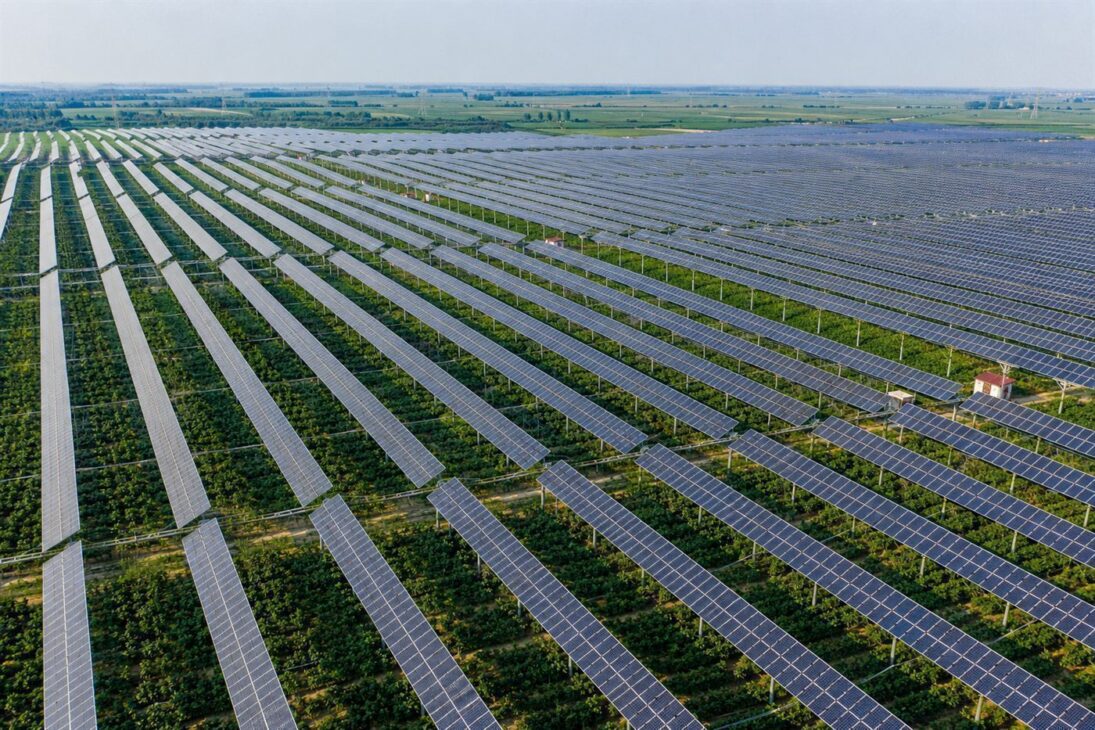
No country embodies the scale shift better than China. The largest agrivoltaic system in the world has 700 megawatts-peak and is installed over berry crops, according to Energia Cooperativa. In total, the country already has about 1.9 gigawatts of this configuration, leading by far.
Europe and Japan follow different paths, with long-term incentive and research programs. Germany, France, the United States, and South Korea maintain financing lines. In Latin America, still according to Energia Cooperativa data, Chile took the lead with the region’s first systems, still small, of 13 kilowatts, but which opened the continent’s door to the technology.
The German report that points to the conflict behind it all
Beneath the enthusiasm, there is a concrete dispute for land. The Fraunhofer Institute for Solar Energy Systems, one of the world’s reference centers on the subject, summarized the bet in a report dedicated to the topic. The central conclusion is that the technology can neutralize the conflict between using the soil for food or for energy in very populous countries.
This is the knot that agrivoltaic energy tries to untie, by combining food and energy production on the same piece of land. As the energy transition increasingly demands space to generate clean electricity, the fear grows that plants will encroach on food areas. Planting and generating in the same place is the way out to avoid having to choose.
What still hinders progress in Brazil and the world
If the numbers add up in so many places, why isn’t it everywhere yet? The bottleneck is regulatory. In many countries, including Germany itself, agrivoltaics is still not defined by law, which creates uncertainty about licensing, credit, and tariffs. Without clear rules, banks hesitate to finance and producers hesitate to invest.
There is also social acceptance, which varies from region to region, and the initial cost of elevated structures, which are more expensive than a panel close to the ground. Even so, this same system is cheaper than rooftop installations and eliminates the need to purchase a new area just for the plant, which rebalances the spreadsheet in the medium term.
A race that has barely begun
Today’s picture shows a technology that has proven the concept, gained scale in Asia, and now depends on regulation to become an actual agricultural policy. The installed capacity numbers keep rising, and studies are refining exactly where it pays off, separating marketing from what actually works in the field.
For a country with strong sun and giant agriculture like Brazil, the question is no longer if agrivoltaic energy will arrive but when and in which crops it will yield the most.
Would you plant under solar panels if it protected your crop and still paid a second bill at the end of the month?