Portuguese
  Spanish


In the Varela family, the odorless egg appears as a result of controlled feeding, cage-free hens, animal welfare certification, automatic nests, and weight classification in Serafina Corrêa, where the farm collects about 3,300 eggs per day and faces expansion limits due to external labor.
The odorless egg has become the main differentiator of a family farm in Serafina Corrêa, in Rio Grande do Sul. The Varela family’s production bets on cage-free hens, feed formulated on the property, nest automation, and quality control to meet consumers looking for a product with less odor and milder flavor.
The report conducted by the Vale Agrícola channel, presented by Larissa Chefer, was published on June 24, 2026. The material shows Nilmar, 62, and Andreia, 50, leading a production that collects about 3,300 eggs per day, supplies regional markets, and already sells almost everything they can produce.
Differential is linked to feeding and management
The family attributes the odorless egg to the birds’ feeding and the production model adopted on the farm. According to the report, the feed receives special attention and is mainly composed of corn, soybean meal, wheat bran, and a laying-focused nucleus.
-
From Selling Unsold Saplings to Creating Brazil’s Most Awarded Olive Oil Brand with 330 Accolades and a $12 Million Goal by 2026

-
China Builds 400-Hectare Irrigation System in Tanzania to Aid 1,000 Families Dependent on Rainfall

-
High School-Educated Farmer in India Converts 40 Hectares of Arid Land into Native Forest with 900 Species and Up to 40,000 Trees
-
After Two Years of Water Scarcity, Brazilian Farmer Finds Well on Her Land, Boosting Mango and Passion Fruit Production in Central Brazil




The central point of the strategy is to avoid by-products that could interfere with the egg’s quality. In the report, the family states that they do not use antibiotics, hormones, or chemical components in the process, positioning the product as a quality alternative within the regional market.
Farm moved away from the cage model
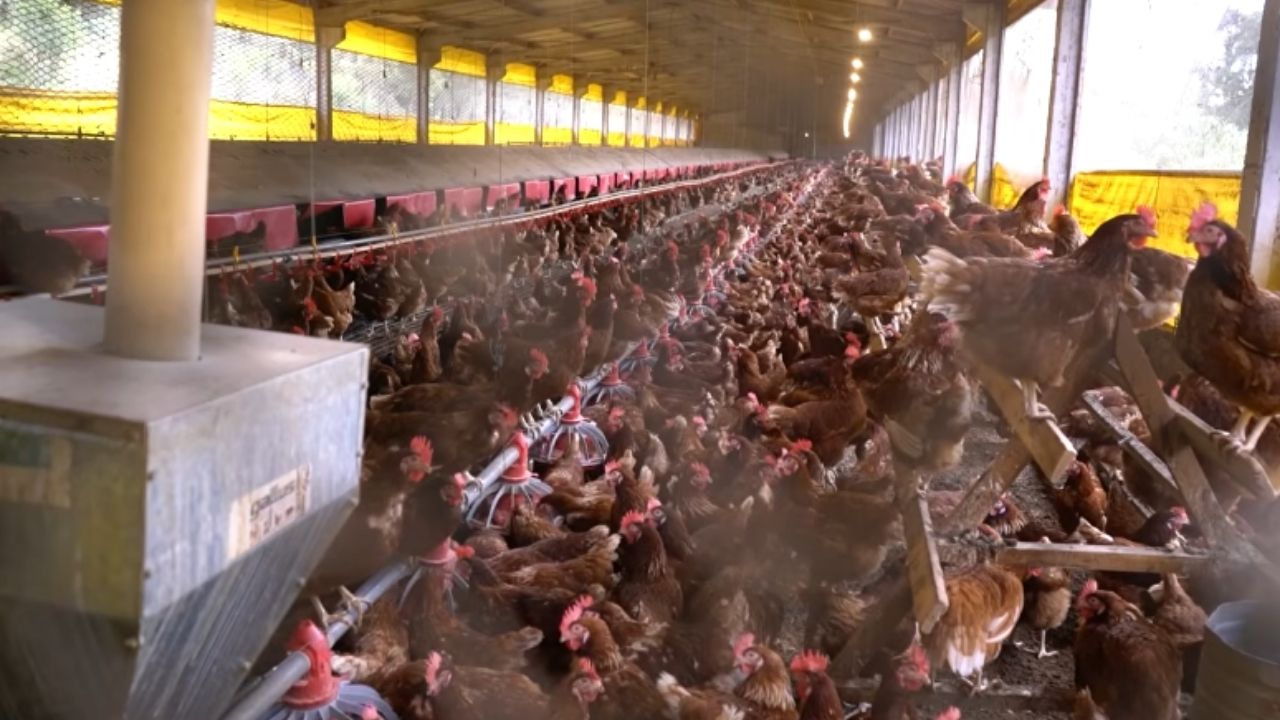
Before building the aviary in 2020, Nilmar and Andreia visited other businesses and evaluated the possibility of producing eggs using the caged chicken system. The decision changed after these visits when they opted for a production with free-range birds inside the barn.
The choice set the business on a different path from conventional production. The topic is not about animals as a curiosity, but about the production model, density, certification, automation, and consumer market. The focus is on how the farm structured a differentiated product and managed to generate demand.
Density was reduced in the aviary
One of the most relevant data points in the report is the production density. The farm operates with a maximum of seven birds per square meter, while the conventional system mentioned in the source can maintain 14 birds in the same space.
The aviary measures 12 by 80 meters and, within the welfare standard adopted by the family, would have the capacity for 7,000 chickens. At the time shown in the report, however, the structure was operating with half the aviary, mainly due to a lack of labor.
Certification added value to the product
The farm has international animal welfare certification, according to the transcript. The source mentions a certifier but does not provide complete details about the standard, audit, or technical scope of the certification.
Even without these details, the journalistic point is clear: the certification functions as an element of trust for the consumer and as a commercial differentiator. The odorless egg is not presented only as a sensory perception but as part of a production system with rules, management, and control.
Automation reduced dependence on manual collection
The farm uses automated nests that guide the eggs to the reception area. This system reduces the need for manual collection inside the aviary and helps maintain regularity in the operation.
According to the report, automation became necessary because labor is a bottleneck. The family itself states that today, an aviary with fully manual collection becomes unfeasible, as it is difficult to find enough workers for this type of routine.
Production reaches 3,300 eggs per day
Every day, the farm collects about 3,300 eggs. Most of the laying occurs in the morning, and the report states that floor laying does not reach 8%.
This number helps to size the business. It is not just a small-scale artisanal production, but a family agro-industry with a daily routine, classification, packaging, distribution, and presence in markets of different municipalities.
Eggs undergo classification
After leaving the aviary, the eggs arrive at the reception room, where the first evaluation takes place. The transcript mentions the process of candling, done by light, to check for cracks and determine if the egg is suitable for sale.
Next, the product is weighed and classified by size. The report mentions categories such as medium, large, extra, and jumbo, as well as different packaging formats, including cartons and sealed trays.
Sanitization separates conveyor and floor eggs
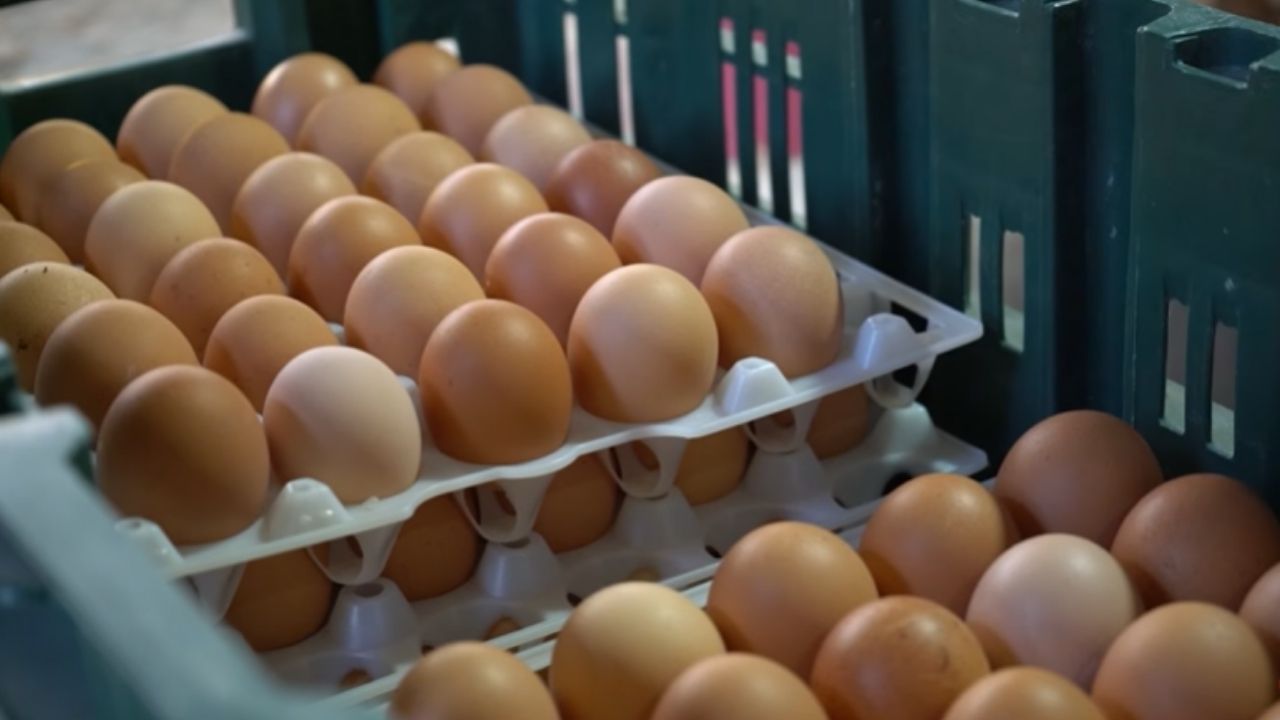
The farm differentiates between eggs from the conveyor and eggs laid on the floor. The white carton is used for conveyor eggs, while the blue identifies floor eggs, which require greater sanitization.
This care reinforces the logic of internal control. The quality of the odorless egg depends on a sequence of productive decisions, from feeding and dry bedding to collection, classification, packaging, and distribution.
Dry bedding and controlled environment become routine
The report shows that the aviary bedding needs to remain dry, as humidity is treated as a problem for production. When there is excess humidity, the tarps are closed to help control the environment.
There is also yellow lighting, described as a way to mimic the sun inside the barn. The goal is to maintain a more stable environment, favoring the laying routine and the functioning of the production system.
Regional market absorbs the production
The farm supplies markets in Serafina Corrêa, Guaporé, Lajeado, and neighboring municipalities. According to the report, the carton with 30 eggs is sold between R$ 18 and R$ 22, depending on the market.
The strongest point for the business is demand. The family states that many consumers seek the brand not only for the price but for the consumption experience, especially because of the less pronounced taste and smell.
Product stopped competing only on price
The report shows that the odorless egg helped the farm move away from a price-only competition. Some customers began specifically seeking that type of egg, maintaining loyalty since the first sales.
This change is important to understand the commercial differential. Instead of selling just a food commodity, the family began offering a product associated with perceived quality, controlled feeding, and certified system.
Lack of labor limits growth


Even with high demand, the family reports that they cannot fully occupy the aviary due to a lack of labor. According to the report, if the structure were complete, the production would also be sold.
This data prevents any simplistic reading of the topic. Growth exists, but it does not appear as an easy promise. The farm faces a real operational limit, and expansion depends on qualified people, stable routine, and the ability to maintain product standards.
Activity was conceived as a family business
Before the aviary, Nilmar and Andreia had a routine linked to dairy activity and other jobs. He was a teacher, and she worked as a production manager in a shoe factory, according to the transcript.
The move to the farm was associated with the desire to stay in the countryside and build their own business. The text should address this point without romanticizing difficulty: it is a productive, family, and business decision, not a story of hardship.
Farm shows strength of local agribusiness
The case of Serafina Corrêa shows how a family agribusiness can find space in the market when it combines differentiated product, automation, and process control. The production of 3,300 eggs per day shows relevant scale for regional service.
It also reveals that common foods can gain value when there is standardization, internal traceability, and sensory differentiation. In the case of the Varela family, the odorless egg became the most visible sign of an operation built around management, feed, and quality.
Production combines technology and differentiation
A automation of nests, formulated feeding, weight classification, humidity control, and packaging show that the farm does not rely solely on rhetoric. There is a set of practices that supports the product until it reaches the market.
The result is an operation that sells almost everything it can produce and still faces a limit on expansion due to a lack of labor. This is the most relevant point for the reader: the demand exists, but the production capacity needs to keep up with the promised standard.
A different egg became a market strategy
The odorless egg produced in Serafina Corrêa shows how a management choice can become a commercial strategy. By replacing cages with free-range chickens, reducing density, automating nests, and controlling feeding, the Varela family built a product that started to be sought after for the brand and the consumption experience.
Do you believe that consumers are willing to pay more for eggs with quality differentials, certification, and controlled production, or does price still speak louder at the time of purchase? Leave your opinion in the comments.