





 Portuguese
  English
  Spanish
  3 min of reading
  0 comments


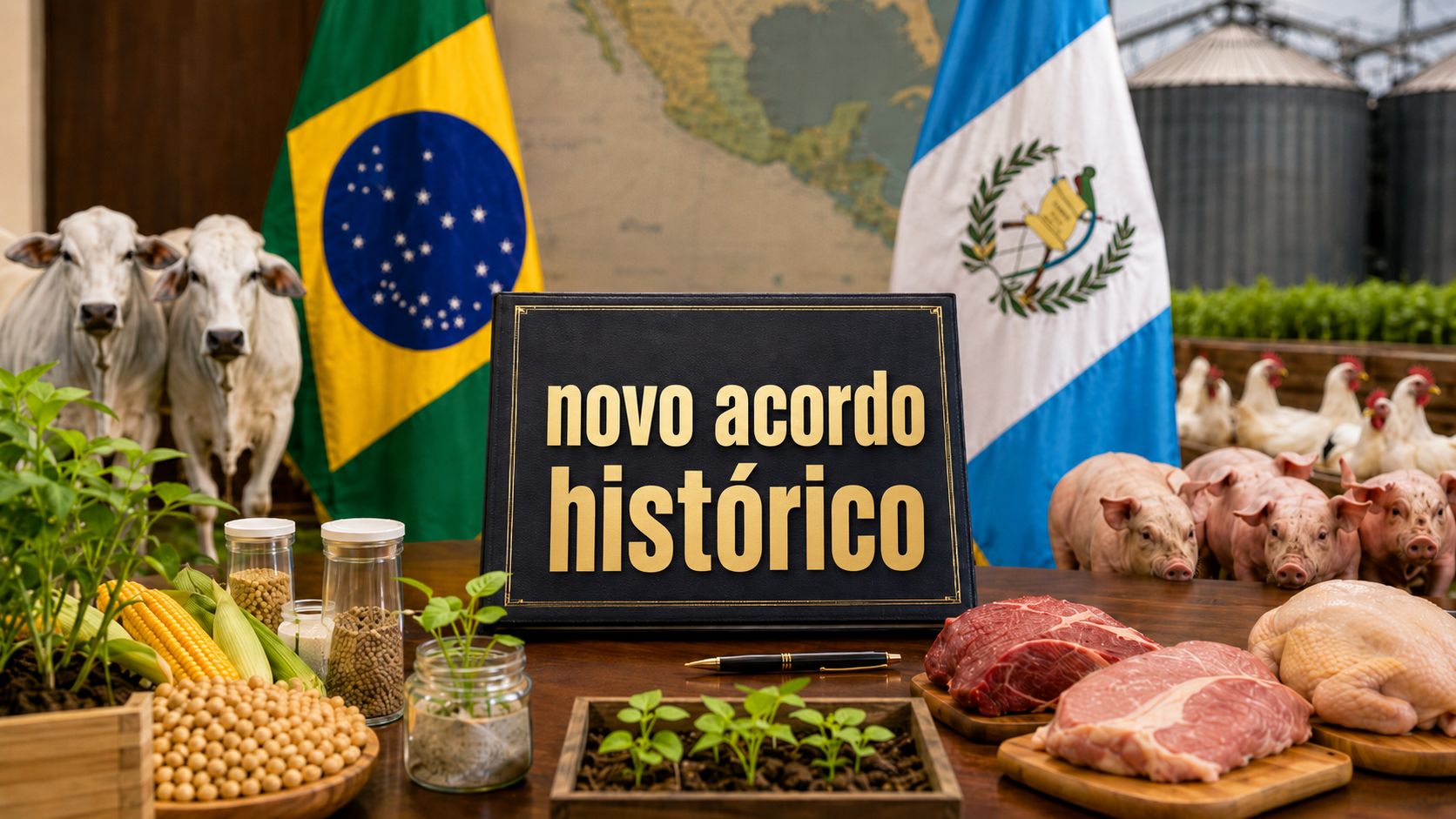
Mission of the Ministry of Agriculture and Livestock in Central America resulted in a memorandum with Guatemala, advances in technical cooperation with Honduras, and new commercial negotiations involving beef, poultry, pork, animal-origin flours, bioinputs, genetics, innovation, and food security.
Brazil, Guatemala, and Honduras advanced this week in an agenda of agriculture, livestock, and trade focusing on research, innovation, health, animal genetics, bioinputs, food security, and integrated technical and regional cooperation.
Brazil and Guatemala sign memorandum after 50 years of cooperation
The Ministry of Agriculture and Livestock and the Ministry of Agriculture, Livestock and Food of Guatemala signed, on Wednesday, the 3rd, a Memorandum of Understanding to expand bilateral cooperation in strategic areas of agricultural development.
The document marks the 50 years of cooperation between the countries and expands joint action in agricultural research, technological innovation, animal and plant health, genetic resources, bioinputs, regenerative agriculture, soil recovery, and technical training.
-
Half a million liters of fresh water extracted from the sea per day, 300 tons of feed, and 84 fans that renew all the air every 60 seconds keep 16,000 animals alive and even fattening inside the Becrux on its way to Indonesia.

-
Even after China surpassed Russia in the volume of fertilizers sold to Brazil in 2025, for the first time in history, Russia remains a strategic partner and has signed a new agribusiness cooperation plan with Brasília focusing on the input.
-
Innovation developed by researchers in Mato Grosso converts plant ash into sustainable fertilizer and could revolutionize agribusiness by combining circular economy, waste reduction, and intelligent use of agricultural residues.

-
German machine with 1,100 horsepower that transforms diesel into electricity and distributes it to each of the four wheels arrives in Brazilian agriculture through Bahia and promises to do the work of a tractor, a sprayer, and a harvester all by itself.



The agenda includes promoting investments and facilitating agricultural trade. The signing was part of the official mission of Mapa to Central America, led by Executive Secretary Cleber Soares.
Among the advances is the approval of six Brazilian beef processing plants for export to the Guatemalan market, a topic related to the expansion of commercial relations in the food sector.
Agriculture and livestock enter the center of the agenda
During the bilateral meeting, the delegations identified opportunities to expand cooperation between Brazilian and Guatemalan institutions. The topics include sustainable soil management, bioinputs, climate-resilient agriculture, and agroclimatic monitoring.
Technologies to increase agricultural productivity were also discussed. The memorandum provides for permanent coordination between the ministries, with a joint working group, exchange of specialists, technical missions, training, and projects of common interest.
Guatemala expressed interest in deepening cooperation with Brazil in fish and cattle genetic improvement. The presented objective was to develop livestock farming and expand technology transfer.
The Guatemalan government recognized Brazil’s experience in agricultural innovation and requested support for actions aimed at genetic improvement and strengthening the cattle herd.
The delegations also discussed expanding bilateral agricultural trade, including advances in sanitary processes for animal-origin products and opportunities to strengthen commercial relations.
Mission in Honduras expands regional front
On Thursday, the 4th, Mapa concluded an official mission in Honduras with advances in bilateral cooperation in agricultural research, technological innovation, rural development, and food security.
The program also resulted in steps to strengthen commercial relations between Brazil and Honduras. The mission was led by Cleber Soares and had Brazilian institutional support and from IICA.
The agenda began with a meeting with the Honduran Minister of Agriculture and Livestock, Moisés Molina. The authorities discussed agricultural planning, technological innovation, genetic improvement, and knowledge transfer.
The Brazilian delegation also met with representatives of the Dirección de Ciencia y Tecnología Agropecuaria, the main Honduran agricultural research institution. Institutional strengthening actions, human resource training, and modernization of innovation systems were discussed.
The discussions indicated opportunities for exchange in agricultural research, technical assistance, animal and plant health, and adaptation to climate change, with potential contributions from Embrapa and the National Institute of Meteorology.
In the commercial field, the mission advanced in negotiations on products of bilateral interest, highlighting animal-origin flours, poultry meat, and pork, within the agenda of expanding agricultural trade.
The conclusion took place at the Presidency of the Republic of Honduras, in a meeting that reaffirmed the governments’ interest in deepening technical and institutional dialogue. The meeting highlighted food security, innovation, rural development, and agricultural modernization.
The advancement of these agendas opens space for new insights on trade, technology, and food security in the region. Do you believe that cooperation between Brazil, Guatemala, and Honduras can strengthen local agriculture and livestock farming? Share your opinion and join the debate.
With information from Ministry of Agriculture and Livestock.







Be the first to react!