Portuguese
  Spanish


In Senador José Bento, in Minas, José Sirval grinds about 125 kilos of corn per day in a water mill he built himself, and he still uses his great-grandfather’s century-old monjolo. It is a portrait of an almost extinct rural tradition and artisanal cornmeal made as in the past.
In a time when everything is electric and automatic, there are those who still trust in the power of running water. This is the case of José Sirval, a rural producer who keeps a mill running powered by the current itself, without using a watt of energy from the grid. Next to the modern structure he built, an older piece continues to turn: the monjolo that belonged to his great-grandfather.
According to Tribuna Popular, from Brejo Mineiro, José Sirval’s water mill grinds about 125 kilos of corn per day. The highlight, however, is the century-old monjolo, a machine over 100 years old that has passed through generations of the family and remains active. In Senador José Bento, keeping this type of mill running has become a rarity.
How a Water Mill Works
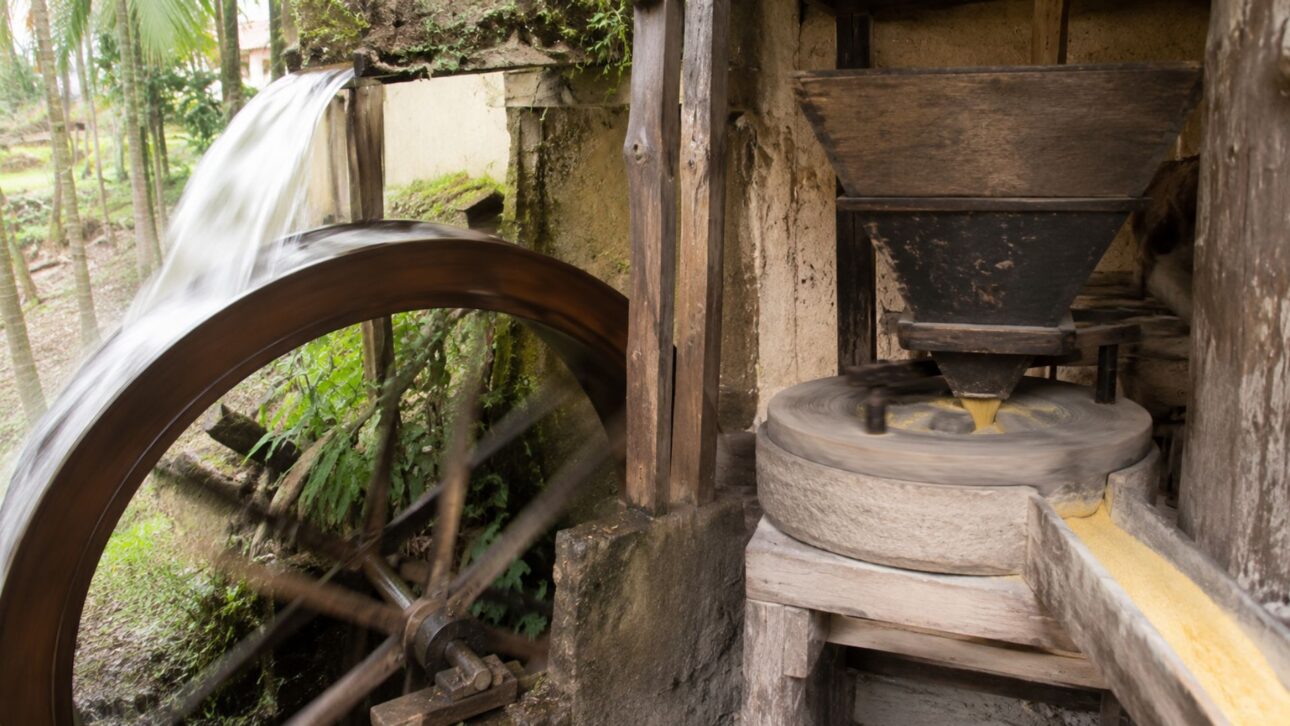
Water from a stream or reservoir is diverted by a chute to fall onto a wheel.
-
From Market Stall to Agribusiness: Patagonian Fruit Grower Owns 550 Hectares and Processes 18 Million Kilos of Pears and Apples Annually, Exporting Directly to Brazil

-
At 93, Brazilian Farmer Restores 56 Hectares of Forest and Revives Spring in the Amazon, Installs First Climate Tower in the Region
-
Brazilian Cheesemaker Wins European Award for Ant-Infused Cheese with Nutty Flavor Inspired by Indigenous Tradition

-
Brazilian Family’s Cheese, Started with One Cow in 1984, Named Best in the World, Beating 2,700 Competitors from 30 Countries


The weight and force of the water turn this wheel, and the movement is transmitted to a stone that grinds the grain.
In the case of the water mill, it is the current that does all the heavy work, without motor or fuel.
The corn enters from above, passes between the grinding stones, and exits on the other side already transformed into cornmeal.
The more constant the water, the more regular the grinding, which explains why these mills were located near rivers.
It is a machine that has worked for centuries on the same principle, only adjusted from generation to generation.
The Centenary Monjolo of the Great-Grandfather
Beside the water mill is the most sentimentally valuable piece of the property.
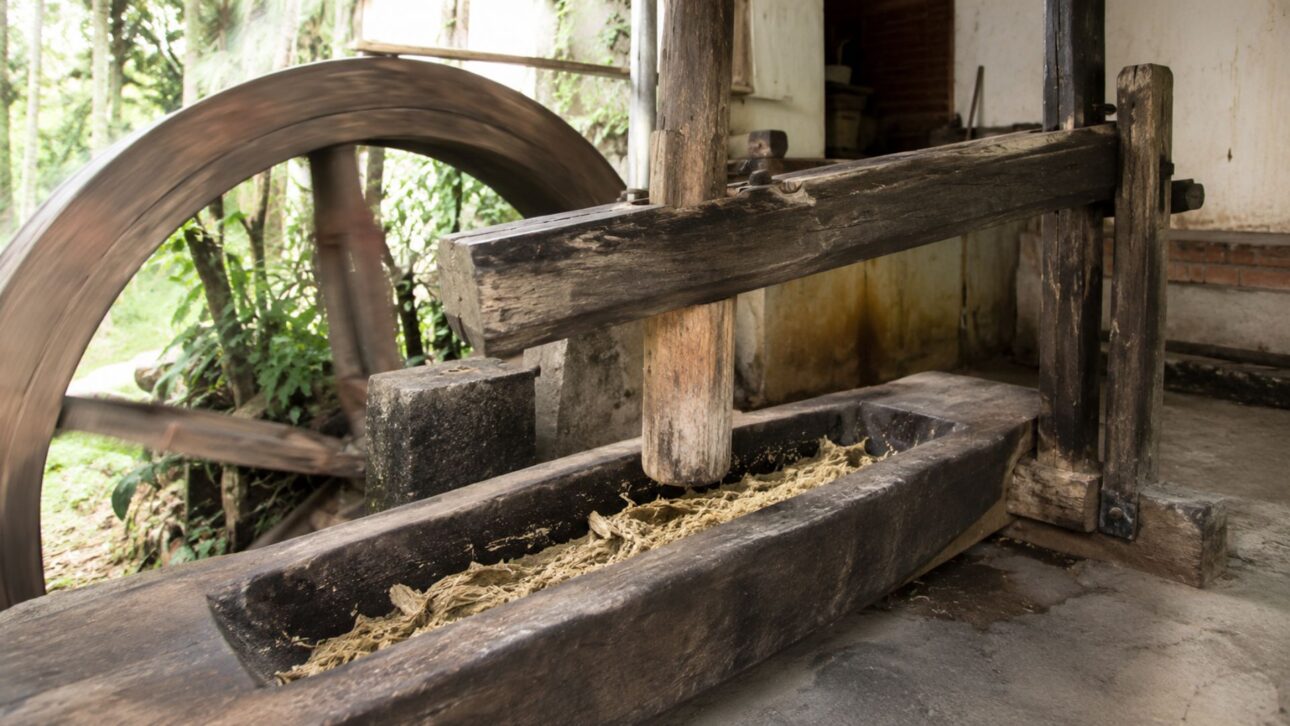
The monjolo is a type of water-powered pestle used to pound and break grains before fine grinding.
José Sirval’s centenary monjolo is over 100 years old and belonged to his great-grandfather, making it a living relic.
It works like a wooden seesaw: water fills a trough on one end, which descends and lifts the pestle on the other.
When the trough empties, the weight falls back and the pestle pounds the grain, in a rhythmic and noisy back-and-forth.
Keeping a centenary monjolo running requires knowing the wood, the water, and the exact point of each piece.
Few families in Brazil still keep and use a centenary monjolo like this.
125 kilos of corn per day: the artisanal cornmeal
The artisanal cornmeal made in the water mill is different from the industrial one sold in supermarkets.
Slowly ground on stone, the artisanal cornmeal preserves more flavor and texture than that produced on a large scale.
The 125 kilos of corn ground per day yield flour and cornmeal that supply the kitchen and the neighborhood.
For those who grew up eating real cornbread and porridge, the artisanal cornmeal has a taste that recalls childhood.
This quality differential is what gives market value to a product that seemed doomed to the past.
Not by chance, the artisanal cornmeal from the mill has become sought after again at fairs and direct sales.
A Nearly Extinct Rural Tradition
What José Sirval does was once common throughout the country’s interior.
Until the mid-20th century, water mills and monjolos were the heart of flour production on farms.
With the arrival of electricity and cheap industrial flour, this rural tradition gradually disappeared.
Many mills were abandoned, turned into ruins, or rusted by the riverside.
In small towns like Senador José Bento, keeping this rural tradition alive depends on a few stubborn producers.
Each mill that stops turning takes with it a piece of knowledge that no one wrote down anywhere.
That’s why the continuity of José Sirval’s work carries more weight than it seems.
Why José Sirval keeps the water mill alive
It’s not just a matter of economy or nostalgia.
For José Sirval, running the water mill is a way to honor his family’s own history.
The great-grandfather’s monjolo connects the present to a time when every grain depended on manual labor and water.
Keeping the mechanism running is also keeping alive the memory of those who came before.
There is also the pride of mastering a technique that few in the region still know how to operate.
In Senador José Bento, he has become a kind of guardian of knowledge that is at risk of disappearing.
The choice not to turn off the water mill is, deep down, a choice not to forget.
The value of preserving ancient techniques
The story gains relevance at a time when the world is discussing sustainability.
A water mill is, in practice, a machine powered by clean and renewable energy.
While the industry spends electricity and fuel, José Sirval’s mill uses only the water that already flows there.
Preserving this rural tradition has cultural, environmental, and even tourist value for small towns.
Old mills become attractions for those seeking rural tourism and traditional food.
Recovering and maintaining a water mill can be, for many municipalities, a way to generate income with their own history.
What seems like a thing of the past can actually be a bet on the future.
What the case of the water mill in Senador José Bento shows
José Sirval’s routine is a reminder that not all useful technology is new.
It shows that a water mill and a century-old monjolo still have a place in the 21st century.
But it’s worth keeping your feet on the ground.
It’s an artisanal and local production, which does not compete in volume with the industrial flour on the shelves.
Keeping the mill running depends on the producer’s health and the transmission of knowledge to future generations.
And, as a rural tradition of a small town, the case risks being lost if no one continues it.
Even so, few examples summarize so well the value of preserving rural tradition and artisanal cornmeal from the countryside.
From Senador José Bento, José Sirval’s water mill continues grinding corn and memory on the same wheel.
And you, do you still remember the taste of artisanal cornmeal ground in a real water mill? Comment here if someone in your family has ever run a water mill or a centennial pestle like this.