Portuguese
  Spanish


Federal initiative expands environmental recovery actions in the Caatinga, with a million-dollar call for proposals, focusing on Semi-arid communities and measures aimed at water, soil, sustainable production, and combating desertification in the country.
The Ministry of Environment and Climate Change established the Recaatingar Program, a national strategy aimed at the socio-productive recovery of degraded areas in the Caatinga.
The official goal is to recover 10 million hectares by 2045, with actions related to biodiversity conservation, climate change adaptation, water and food security, and income generation in the Brazilian Semi-arid region.
Ordinance GM/MMA No. 1,700, dated June 9, 2026, officially created the program and was published in the Official Gazette of the Union on June 10.
-
Indian Students from Jaipur Win Top Prize at World’s Largest Science Fair with EcoFog, an Affordable Mesh to Harvest Fog Water Without Energy

-
Italy Sinks Massive 11-Story Concrete Structures in the Ligurian Sea to Create a 6.2 km Barrier, Clearing the Way for 400-Meter Ships in Genoa

-
Wireless Charging Roads for Electric Vehicles: Detroit Implements Coil Technology, France Successfully Tests 300 kW Transfer Near Paris
-
Scientists Create Lab-Made Cell with Only 36 Genes That Eats, Grows, Copies DNA, and Divides, Raising the Question: Is This Life?




The signing took place during National Environment Week, held from June 8 to 11 at the National Library in Brasília, in a program related to World Environment Day and Green June.
According to the MMA, Recaatingar will be primarily directed to areas of family farming, agrarian reform settlements, indigenous territories, quilombola communities, and traditional peoples and communities.
The program is part of the national policy to combat desertification and seeks to organize public actions for areas most vulnerable to soil degradation and the effects of drought.
The national secretary for Traditional Peoples and Communities and Sustainable Rural Development of the ministry, Edel Moraes, stated that the initiative recognizes practices already developed in the territories.
“Recaatingar is an action plan resulting from PAB-Brasil, the result of recognizing ancestral practices already developed by traditional peoples and communities,” she said.
Recaatingar Program targets productive recovery of the Caatinga
Recaatingar adopts as one of its bases the concept of recaatingamento, a social technology aimed at environmental recovery and sustainable coexistence with the Semi-arid.
The approach brings together soil management practices, native vegetation recovery, agroforestry systems, and water conservation actions.
Among the planned measures are green fertilization, composting, direct planting, and the implementation of agroforestry systems that combine food production and Caatinga conservation.
According to the MMA, the proposal is to combine scientific knowledge and traditional wisdom in the recovery of degraded areas.
In the program’s design, environmental recovery is linked to the socio-productive inclusion of the communities living in the biome.
The actions must consider the reality of family farmers, indigenous peoples, traditional communities, and populations exposed to the effects of climate change.
The initiative is also part of the Brazilian Action Plan to Combat Desertification and Mitigate the Effects of Drought, the PAB-Brazil.
The plan brings together strategic objectives and actions aimed at combating desertification and aligns with international commitments assumed by Brazil in the United Nations Convention to Combat Desertification.
Recaatingar Call for Proposals foresees R$ 60 million for projects
In addition to creating the program, the government launched, on June 10, 2026, the Recaatingar Call for Proposals, a public call for R$ 60 million to support socio-productive recovery projects of degraded areas in the biome.
The ceremony took place at the Planalto Palace in Brasília.
The call for proposals gathers resources from the National Bank for Economic and Social Development and the Bank of the Northeast.
Of the total announced, R$ 30 million will be provided by BNDES and R$ 30 million by BNB, according to information released by the institutions.
The public call is linked to the new phase of Floresta Viva 2, an initiative aimed at ecological restoration with native species, productive restoration, and conservation of ecosystems in Brazilian biomes.
In the case of Recaatingar, the resources will be applied to projects located in the Caatinga coverage area.
The projects must cover priority municipalities in Alagoas, Bahia, Ceará, Minas Gerais, Paraíba, Pernambuco, Piauí, Rio Grande do Norte, and Sergipe.
The selection considers territories with environmental degradation and exposure to drought and desertification, according to the criteria defined in the call for proposals.
Who can submit projects in the call for proposals
The public call provides support for initiatives of ecological restoration, agroecological production, agroforestry systems, sustainable use of the Caatinga, and conservation of water resources.
Resources may also be allocated to actions of technical assistance, community training, seed and seedling production, recovery of natural water bodies, and prevention of forest fires.
According to BNDES, the expectation is to support between 15 and 25 projects.
The proposals may have a duration of up to 60 months and estimated values between R$ 2 million and R$ 4 million, with a minimum counterpart of 5% of the requested amount, financial or non-financial.
Non-profit private legal entities based in Brazil, such as civil associations, private foundations, and cooperatives, can participate.
The notice also admits legal entities of federal and state internal public law, except for the Union and entities dependent on federal budget transfers for maintenance.
The text of the notice provides for projects with areas between 50 and 100 hectares.
The selection should consider the technical capacity of the proposing institutions, the alignment of the proposals with the objectives of the call, and the expected benefits for environmental and productive recovery of the territories.
Water security and soil management in the Caatinga
Water security is one of the axes of Recaatingar.
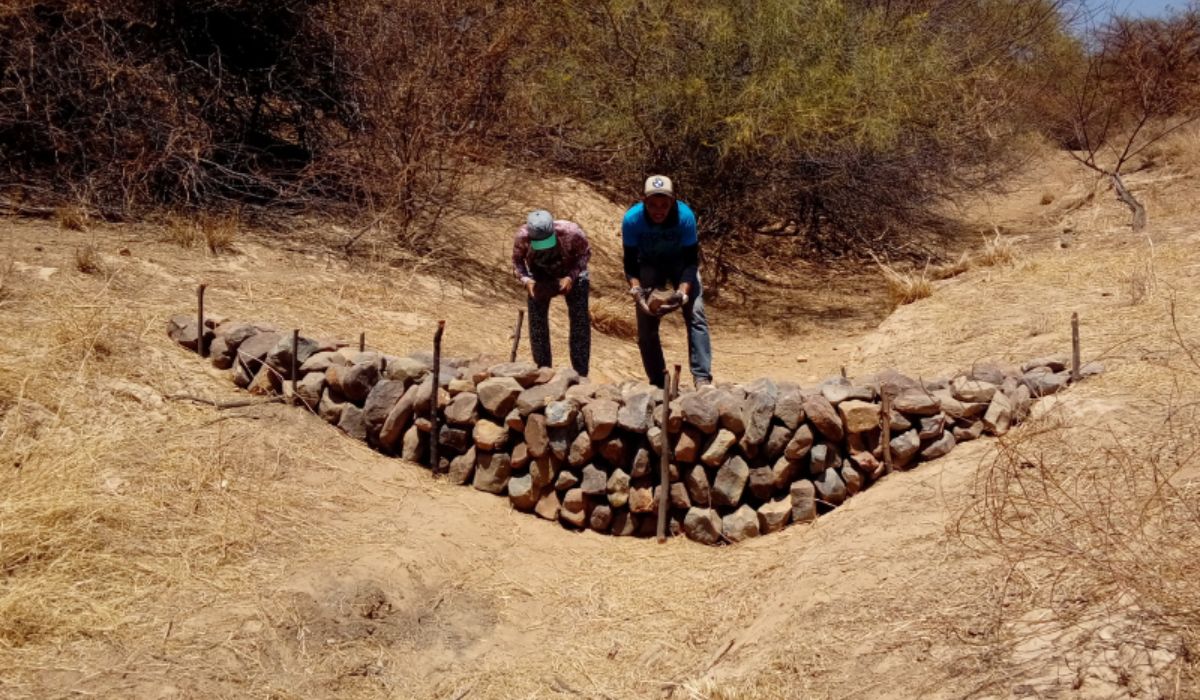
The actions will have micro-watersheds as preferential units for planning and execution, with provisions for water conservation and storage structures, such as cisterns, ponds, underground dams, and rainwater harvesting systems.
In the productive area, the program provides for sustainable soil management practices and encourages agroforestry systems.
The proposal is to associate the recovery of native vegetation, food production, biodiversity conservation, and the reduction of community vulnerability to extreme climate events.
According to Alexandre Pires, director of the Department for Combating Desertification and Mitigating the Effects of Droughts at MMA, the Brazilian Semi-arid region is in a context of susceptibility to desertification but also gathers experiences that can guide climate adaptation policies.
“The responses to droughts are to increase investments in adaptation and recovery of degraded lands in the Caatinga and Cerrado, to replenish agrobiodiversity, soil fertility, water sources, healthy food production, and social inclusion,” stated Pires.
Agroecology will be one of the guiding principles of the actions.
The program provides incentives for the diversification of productive systems, income generation, and the sustainable use of natural resources, with attention to family farmers, indigenous peoples, black population, traditional communities, and rural youth.
Management of Recaatingar will include government and civil society
The management of Recaatingar will be under the responsibility of a Management Committee with equal representation between government and civil society.
The board will bring together representatives from the MMA, the Brazilian Forest Service, the Chico Mendes Institute for Biodiversity Conservation, Ibama, and organizations appointed within the scope of the National Commission to Combat Desertification.
The implementation of actions may involve public resources, partnerships with the private sector, parliamentary amendments, and international cooperation.
The MMA reported that it will publish an operational manual with technical and financial criteria to guide the execution of projects in the territories.
The creation of the program occurs in the context of national policies to combat desertification and mitigate the effects of drought.
PAB-Brazil covers more than 1,600 municipalities in areas susceptible to desertification, equivalent to about 18% of the national territory.
The Caatinga is the only exclusively Brazilian biome and occupies about 10% of the national territory, according to the MMA.
The biome is home to approximately 28 million people and includes areas with different levels of degradation, which led the government to define socio-productive recovery as one of the axes of the environmental policy for the region.
With the goal of recovering 10 million hectares by 2045, Recaatingar will depend on the selection of projects, the execution capacity of the responsible institutions, and the coordination between the Union, public banks, local governments, and beneficiary communities.
The execution in the territories will indicate how the measures provided for in the program will be applied in practice.