Portuguese
  Spanish


Equipped with a single 16 MW turbine, the wind platform was launched in Zhuhai and heads to the Lufeng fields in the South China Sea. The energy will reach the oil platforms via submarine cables, replacing part of the diesel used in extraction and cutting carbon emissions.
China launched to sea the world’s first floating wind energy platform equipped with a single 16 MW turbine and a tensioned cable anchoring system, from the city of Zhuhai, in Guangdong province, in the south of the country. According to CGTN, a partner of TV BRICS, the wind platform heads to the Lufeng oil fields region in the South China Sea, where it will begin its operations.
The structure is of the TLP type, an acronym in English for tension leg platform, and is stabilized by cables kept under tension. With more than 307 meters in height and about 8 thousand tons, it is considered, still according to CGTN, the largest in the world among floating platforms of this type in terms of generation capacity per turbine.
The first floating wind platform in the world
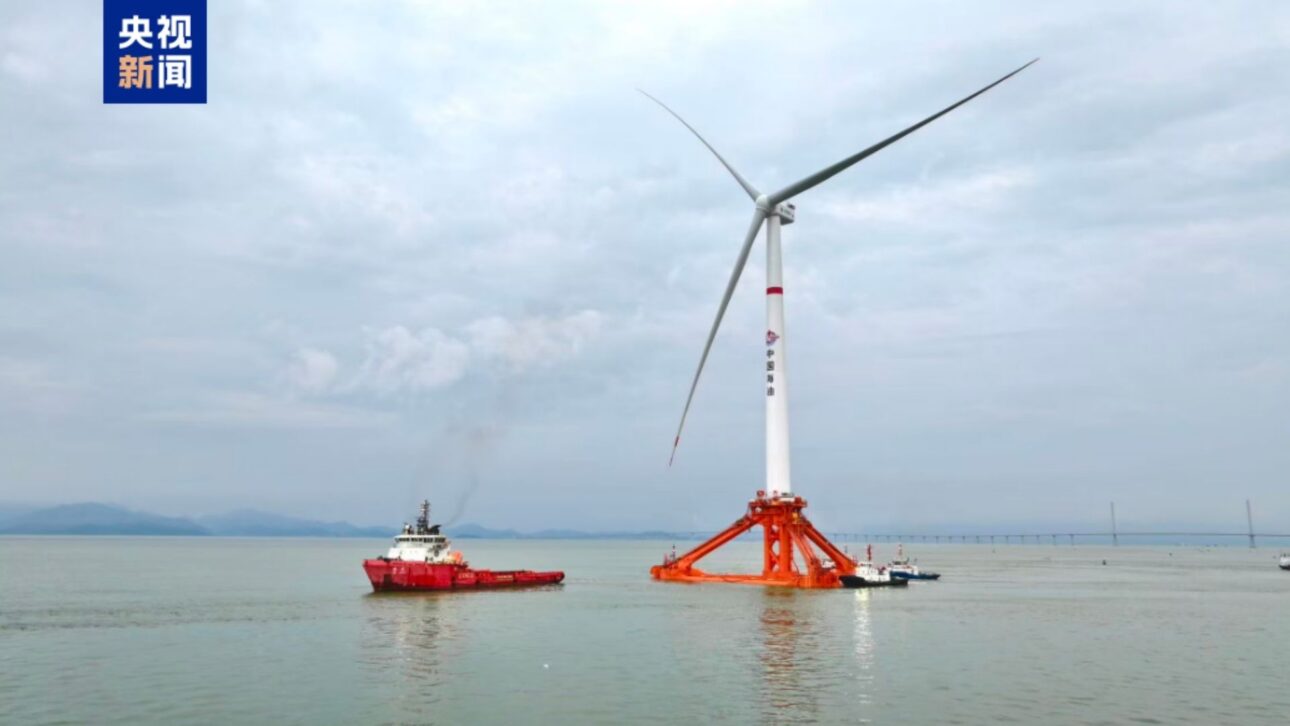
The wind platform was launched to sea from Zhuhai, in Guangdong province, in southern China, and is pointed out as the world’s first floating wind energy structure equipped with a single 16 MW turbine.
-
Japan Deploys Offshore Concrete Factory, Constructs Massive Caissons in 8 Days, Revolutionizing Port Construction with Industrial Efficiency

-
China Builds World’s Largest Power Grid, Generating Enough Energy to Supply 15 Times Brazil’s Needs, Surpassing the US, EU, and India Combined
-
Brazil’s First 3D-Printed House Built in 30 Hours with Two Operators and 20% Lower Costs

-
Parker Solar Probe Discovers High-Speed Dust Grains Near the Sun, Offering New Insights into Solar Corona’s Mysteries



According to CGTN, a partner of TV BRICS, the unit uses a tensioned cable anchoring system to remain stable in open sea.
The structure is of the TLP type, an acronym in English for tension leg platform, stabilized by cables kept under tension.
This design is what allows the wind platform to float stably in deep waters, where towers fixed to the sea floor are not viable.
307 meters and 8 thousand tons heading to Lufeng
With over 307 meters in height and about 8 thousand tons, the wind platform is considered, according to CGTN, the largest in the world among floating platforms of this type in terms of generation capacity per turbine. The dimensions place the structure among the largest equipment ever launched for offshore wind generation.
The unit is heading to the Lufeng oil fields region in the South China Sea, where it will begin its operations.
It is in this extraction hub that the wind platform is expected to fulfill its main function, which is to provide clean energy for the region’s oil and gas activities.
Wind instead of diesel on oil platforms
The energy generated by the wind platform will be transmitted via submarine cables to the oil and gas platforms in the Lufeng region, allowing the replacement of part of the fuel used in extraction operations with wind-sourced electricity.
In practice, the wind starts to power the platforms that previously depended largely on diesel oil.
The project combines offshore wind energy generation with oil and gas activities, which helps reduce carbon emissions in maritime fields.
This integration between the wind platform and oil extraction is the central point of the initiative, which seeks to decarbonize an operation traditionally powered by fossil fuel.
54 million kWh and the emissions cut
After becoming operational, the wind platform is expected to produce approximately 54 million kWh of electricity per year, according to CGTN.
This volume, still according to the source, will allow for a reduction in carbon dioxide emissions by about 35 thousand tons per year.
Besides the CO2 cut, the generated energy is expected to save approximately 15 thousand cubic meters of diesel oil per year in Lufeng operations.
These are projection numbers, linked to the unit’s operation start, that show the potential of the wind platform to reduce both fuel consumption and the carbon footprint of extraction.
Floating wind energy and the maritime economy
More than supplying the Lufeng fields, the project aims to boost the development of the floating wind energy industry, a sector still forming worldwide. The wind platform serves, in this sense, as a technological showcase of what China intends to expand in open sea renewable generation.
The initiative also seeks to strengthen the maritime economy and accelerate the transition to a more sustainable energy matrix, according to CGTN. By connecting the wind platform to the oil platforms, the country attempts to unite fossil fuel exploration with a clean source, in a model that can serve as a reference for other maritime fields.
China launched from Zhuhai what CGTN, a partner of TV BRICS, points out as the world’s first floating wind platform with a single 16 MW turbine, a structure over 307 meters and about 8,000 tons heading to the Lufeng oil fields in the South China Sea.
Once operational, the unit is expected to produce about 54 million kWh per year, which, according to the source, will allow for a reduction in CO2 emissions by around 35,000 tons and save approximately 15,000 cubic meters of diesel per year.
By transmitting the energy via submarine cables to the oil platforms, the wind platform attempts to replace part of the fossil fuel with wind and decarbonize the extraction, in a bid that also seeks to strengthen the maritime economy and the floating wind energy industry.
And you, what do you think of the floating wind platform that China launched to supply oil platforms with wind instead of diesel? Do you believe that combining wind energy and offshore oil extraction can help reduce carbon emissions? Share your opinion and exchange ideas with other readers about energy and energy transition.