Portuguese
  Spanish


The phenomenon at the end of June 2026 in Praia Grande exposed a giant strip of sand, went viral as a disaster omen, and forced experts to explain the difference between 80 km/h wind with spring tide and the retreat that precedes a real tsunami
The retreat of the sea in Praia Grande, on the coast of São Paulo, at the end of June 2026, produced the most shared images of the week and a collective scare: the beach dawned with a huge strip of sand exposed where there should be water, and the word tsunami dominated the networks. According to the Diário do Comércio, in an article from June 30, the supposed alert became the most talked about topic on the internet.
The response from experts came quickly and unanimously: there is no official alert or risk of a giant wave. The phenomenon is natural and was born from the combination of low tide, intense winds, and a high-pressure system over the South Atlantic, according to the Diário do Comércio, and understanding this mechanism is the best vaccine against panic next time.
The video that stopped the internet: the beach without sea
The images are indeed impressive. Instead of the usual surf, the videos show the ocean receded from the shore, with sandbanks stretching as far as the eye can see and bathers walking where one usually swims. For those who grew up hearing that a sea that disappears is a sea that returns in fury, the leap to a catastrophic conclusion was automatic.
-
China Launches World’s First 307-Meter Floating Wind Platform to Supply Oil Rigs, Aiming to Cut 35,000 Tons of CO2 Annually

-
Japan Deploys Offshore Concrete Factory, Constructs Massive Caissons in 8 Days, Revolutionizing Port Construction with Industrial Efficiency

-
China Builds World’s Largest Power Grid, Generating Enough Energy to Supply 15 Times Brazil’s Needs, Surpassing the US, EU, and India Combined
-
Brazil’s First 3D-Printed House Built in 30 Hours with Two Operators and 20% Lower Costs



The detail missing in the chains is the history. Similar episodes had already been recorded on the São Paulo coast in 2025, in places like Tupi beach and São Vicente, according to the Diário do Comércio, without any giant wave following. The receded sea of the Baixada was not unprecedented, it was a repeat.
What caused it: 80 km/h wind, high pressure, and full moon

The phenomenon’s recipe has three ingredients, according to the Diário do Comércio. The first is a high-pressure system stationed over the South Atlantic, which organizes stable weather and winds. The next ingredient is precisely these winds, intense and persistent, with gusts of up to 80 km/h at points along the coast, blowing from the Northeast quadrant in a direction parallel to the shore.
The third ingredient comes from the sky. The low tide coincided with the full moon phase, which amplifies the variation between high and low tide, according to the Diário do Comércio. Wind pushing the water away from the coast, atmospheric pressure helping, and astronomy pulling the tide gauge down: the result is the sea visibly farther away, with no earthquake involved.
Syzygy Tide: the technical name for what happened
The astronomical component has a baptismal name. According to the Correio Braziliense, it is the syzygy tide, which occurs when the Sun, Earth, and Moon are aligned, during the new moon and full moon phases, adding the gravitational pull of the two celestial bodies on the oceans.
During these windows of the lunar calendar, high tides become higher and low tides lower. When this alignment combines with constant winds blowing from the coast to the ocean, the sea’s retreat becomes dramatic enough to turn into a viral video, according to the Correio Braziliense, but it remains a tide table phenomenon, predictable and gradual.
Why it is not a sign of a tsunami
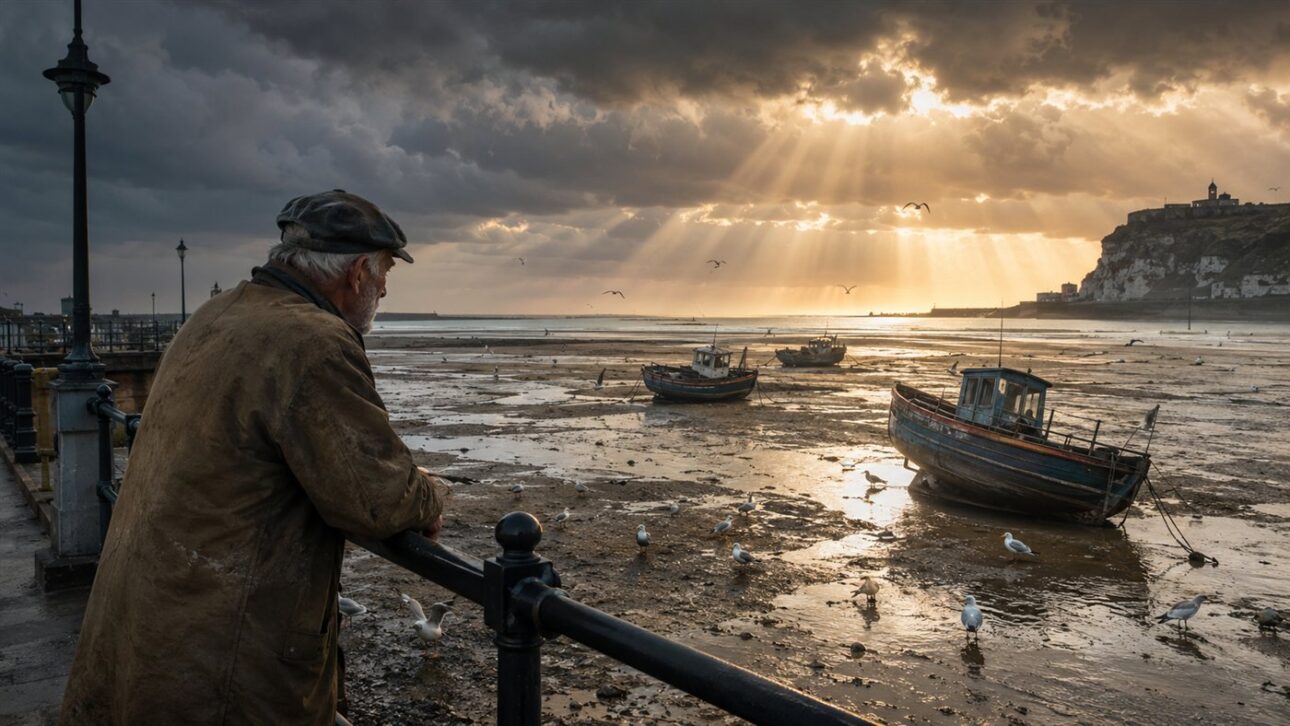
The technical comparison dismantles the rumor. According to the Correio Braziliense, the retreat that precedes a tsunami is caused by seismic disturbances, such as earthquakes or underwater volcanic eruptions, and is extremely rapid: the sea withdraws violently in a few minutes because a colossal volume of water has been displaced at the ocean’s bottom.
What was seen on the São Paulo beach was the opposite. The retreat happened gradually, over hours, following tide, wind, and pressure, with no associated seismic record, as explained by the Correio Braziliense and the Diário do Comércio. The speed is the fingerprint that separates the atmospheric phenomenon from the geological disaster: one fits in the tide table, the other triggers seismographs.
The real risk of a tsunami on the Brazilian coast
And the underlying fear, does it make sense? The Brazilian coast is on a passive continental margin, far from the major tectonic plate junctions that produce the submarine earthquakes of the Pacific and Indian Oceans, which is why the country does not deal with routine giant wave alerts.
The experts cited in the reports are straightforward: the episode poses no risk to the population and is considered normal, with known recurrence in the Baixada Santista, according to the Correio Braziliense. What is real in Brazil are the swell, strong winds, and tide variations, phenomena that require respect for civil defense warnings in each city, not end-of-the-world panic.
It is also worth noting the other side of the same coin: just as the wind pushed the water away this week, the reverse combination, wind blowing from the sea to the land on a high spring tide day, produces the swells that invade promenades and destroy kiosks on the São Paulo coast. The resident of Baixada knows both spectacles, and both come from the same physics.
The anatomy of the rumor: why the false alert went viral
The case is a textbook study on misinformation. There was a real and impressive image, a half-true popular knowledge (receding sea can precede a tsunami), and a vacuum of explanation in the first hours. In this vacuum, the most frightening interpretation won the sharing race, and the “tsunami alert” was born ready, without any official body having issued it.
The correct reading sequence is the reverse: look for who measured before believing who shouted. Municipal civil defenses, the captaincy, and monitoring services publish official warnings, and none of them treated the episode as an emergency, as recorded by the Diário do Comércio when debunking the existence of an alert.
There is a real cost to this type of digital panic that rarely gets accounted for: beachfront merchants reporting cancellations, residents calling emergency services en masse, and public attention diverted from real risks. Each disaster rumor that goes viral chips away at the credibility that official alerts will need on the day something serious actually happens, and that’s why debunking quickly matters as much as warning quickly.
The receding sea as a free oceanography lesson
After the scare, the learning remains. The receding sea on the São Paulo coast showed, on a spectacular scale, the forces that operate the coast every day: the gravity of the Moon and the Sun, the push of the wind, and the weight of the atmosphere on the water. It’s the kind of lesson that no classroom delivers with the same audience.
For the coastal resident, the practical guide is simple: slow and gradual retreat on a windy day and full moon is the tide doing its job; violent withdrawal of water in minutes, especially after news of an earthquake, is a case of running to higher ground immediately. Knowing the difference takes two minutes of reading and is worth more than a thousand frightened shares. Tell us in the comments: did you see the videos of the receding sea and come to believe the alert?