






 Portuguese
  Spanish


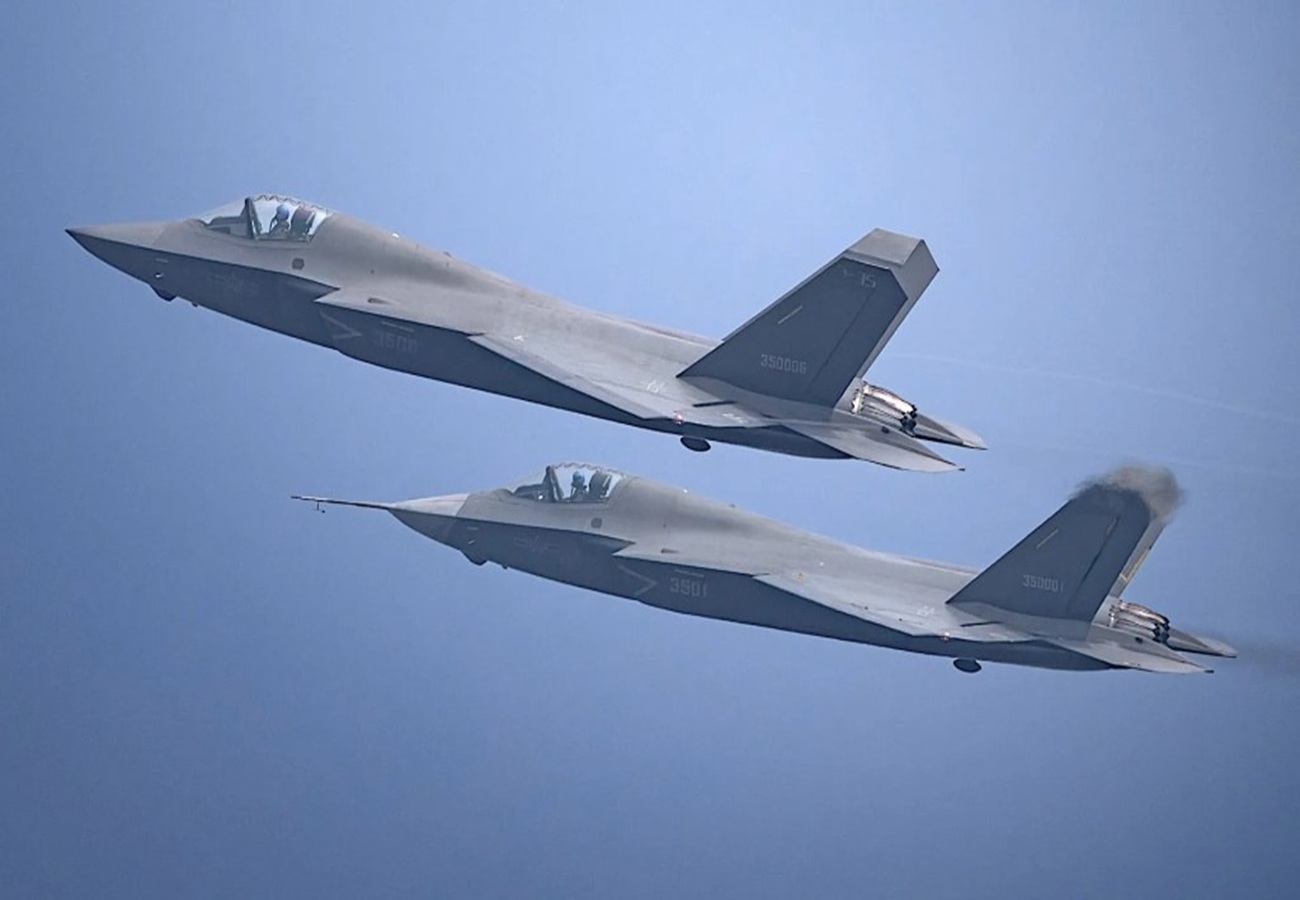


The Chinese Naval Aviation Program Took Another Significant Step with the Possible Beginning of Operation of the Stealth Fighter J-35. Images Released on Social Media Suggest That the Model Is Closer to Active Service and May Already Be Integrated into the Chinese Navy Shipborne Fleet. This Movement Reinforces the Country’s Plans to Modernize Its Naval Forces and Expand Its Air Power at Sea.
The most important indication of the entry into operation of the Chinese naval stealth fighter J-35 emerged with an image released recently.
The photo shows two examples of the jet flying in formation, with markings indicating possible active service by the People’s Liberation Army Navy (PLAN). The model has been seen as a key element in the advancement of the country’s shipborne aviation.
Image Suggests Mass Production
The new image, originally published on the Chinese microblog Weibo, shows the fighters with construction numbers 0011 and 0012.
-
NASA’s Plan to Dump ISS Debris in Ocean Sparks Environmental Concerns Among Scientists

-
14-Year-Old Invents Eco-Friendly Water Pump Using Recycled Materials to Aid Communities Without Water Access
-
Pigeons Trained to Detect Cancerous Changes in Medical Images Astonish Scientific Community

-
Plastic Waste from Beaches and Poor Communities in Kenya Transformed into School Desks, Replacing Wood in Classrooms and Turning Marine Litter into Durable Study Tables


This reinforces the hypothesis that they are initial low-rate production units, also known as LRIP. These numbers are not usually assigned to prototypes, which increases the possibility that these are aircraft already integrated into the PLAN.
Additionally, the aircraft appear with shark markings on the tail fins and national insignias, elements common among China’s naval aircraft.
The blue helmets worn by the pilots are also typical of the units operating aboard the aircraft carrier Liaoning. These details indicate a direct connection to the Navy.
From Prototype to Battlefield
The development of the J-35, the naval variant of the land-based FC-31 fighter, began with its first flight in October 2021.
The second prototype was seen in July 2022, already with low visibility tactical gray paint. There were reports of a third example sighted in September 2023, but the images did not allow for clear confirmation.
With the new image, it is clear that more units have been completed.
The presence of the numbers 0011 and 0012 may indicate that the model has moved beyond the testing phase and has entered a more advanced stage of production. This represents a milestone in China’s naval aviation program.
Experts Are Not Surprised
According to Andreas Rupprecht, an expert in Chinese aviation, the appearance of the J-35 in LRIP version is not entirely unexpected.
He recalls that the J-15B fighter, a modernized version of the J-15, also appeared suddenly at the end of last year. Shortly after, nearly two dozen units were identified in operation.
Therefore, the case of the J-35 follows a similar pattern.
China has adopted a discreet posture during the development of its shipborne fighters. Public revelation only occurs when the models are already in an advanced stage.
Other Parallel Projects
The emergence of the J-35 coincides with other advancements in Chinese military aviation. The two-seat stealth fighter J-20S seems to already be in service with the People’s Liberation Army Air Force (PLAAF). The J-35A, the land-based version of the naval J-35, is also advancing in its development.
Despite this, there are still questions regarding the engines used in each version.
It was expected that both models would be equipped with the WS-19, but this plan seems not to have materialized.
The PLAN’s naval variant may use the WS-21, an evolution of the WS-13, while the PLAAF’s land variant may already include the WS-19, identified by its darkened exhaust nozzles.
Technical Details Stand Out
The new image shows the two fighters with a bolted Luneburg ventral lens.
This radar reflector is used in stealth fighters when there is no need for low observability, such as during flights in civil airspace or to deceive foreign radars. This type of lens is different from the one used in the land-based J-35A, which has an extendable reflector.
Another important detail is that the aircraft have an almost finalized configuration. This includes all the expected elements for the production version, with clean lines and refined finishing.
The presence of these details reinforces the hypothesis that the fighters are ready for testing in real environments.
Carrier Tests May Be Underway
There are rumors that the J-35 is already being tested on the deck of the Type 003 Fujian aircraft carrier, although there are still no images to prove this. The ship is currently undergoing pre-service tests, and the arrival of new aircraft is part of the evaluation schedule.
Even without visual confirmation, experts consider it likely that tests will occur soon, if they haven’t already started. However, it would be surprising if the J-35 were the first aircraft to be tested on the new aircraft carrier, surpassing the J-15, which already has a proven track record.
China has land test sites with structures that simulate the deck of an aircraft carrier. These centers are used to train pilots and operators before actual missions.
With this, the J-35 may undergo an intensive preparation phase before operating at sea.
Expectations for Official Debut
Rumors are circulating that the J-35 may appear publicly in September during an event celebrating the 80th anniversary of Japan’s defeat in World War II.
If confirmed, the fighter could be presented as a symbol of technological advancement and military power of China.
Until then, what is known is that the model continues to gain ground in the shipborne aviation scene. The J-35 is expected to operate alongside other modern assets, such as the early warning aircraft KJ-600 and possible stealth combat drones.
Therefore, even without a formal declaration of operational capability, the new fighter already occupies a prominent position.
China is moving quickly to consolidate its presence at sea with modern equipment adapted for future naval warfare.







A China realmente aprendeu com sua história, e não pretende permitir que nenhum Pais colonialista se apodere novamente do seu quintal! Serve de modelo e exemplo neste sentido para toda a America do Sul, em especial o Brasil. Parabéns!