Portuguese
  Spanish


Created by Evan Budz, from 10th grade in Burlington, the underwater robot was awarded by Youth Science Canada on May 15, 2026 after competing at Regeneron ISEF in Phoenix, using holographic images and artificial intelligence to detect microplastics in real-time in the ocean with an embedded 3D holographic system.
The underwater robot created by Canadian student Evan Budz, from Burlington, Ontario, gained international recognition by transforming an idea inspired by sea turtles into a real-time microplastic detection platform. The recognition came on May 15, 2026, in a statement from Youth Science Canada, after participation in the Regeneron ISEF, held in Phoenix, Arizona.
Budz, a 10th-grade student, received the Gordon E. Moore Award of $50,000 for Positive Outcomes for Future Generations. The project uses a self-propelled robot, previously developed to swim like a sea turtle, now equipped with a 3D holographic camera, holographic images, and artificial intelligence to identify nearly invisible particles in the aquatic environment.
Sea turtle-inspired robot became a tool against microplastics
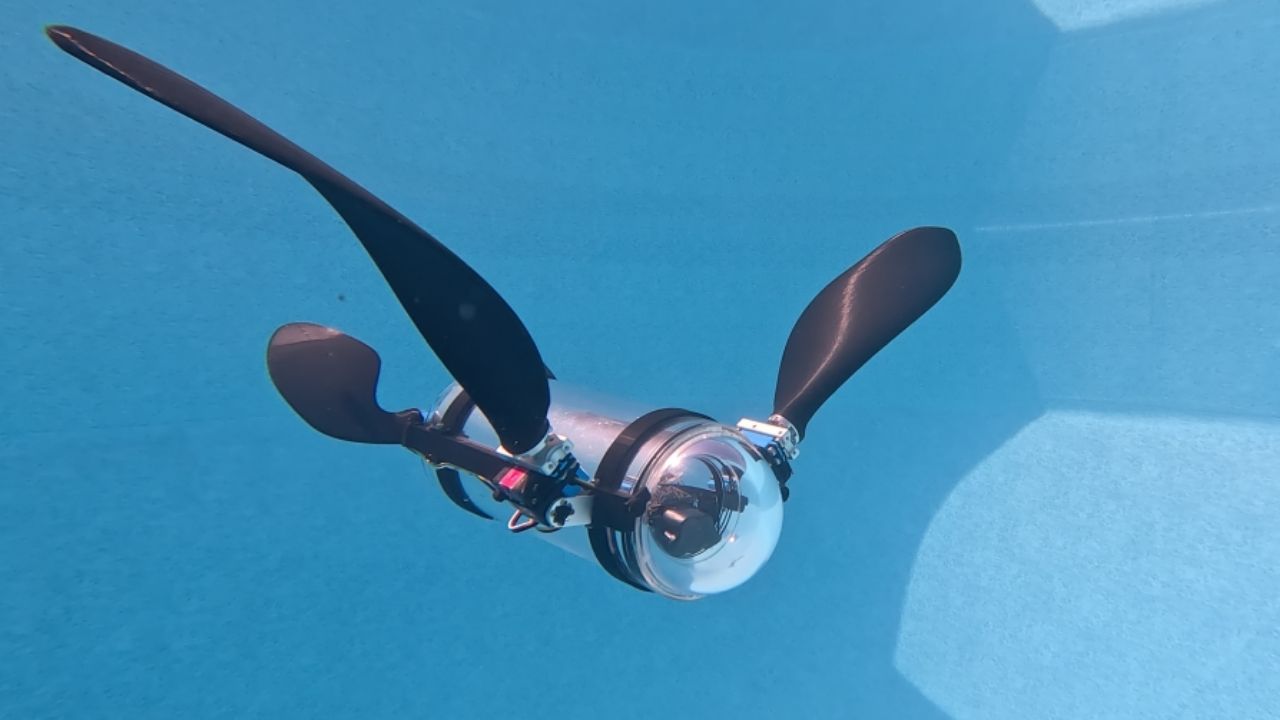
Evan Budz’s proposal draws attention because it starts from a bio-inspired robotics solution. The robot was designed to move similarly to a sea turtle, which brings the project closer to a displacement logic adapted to the underwater environment, rather than relying solely on a conventional mechanical format.
-
South Korea to Sink 20 Massive Concrete Coffers Off Busan Coast to Build 1.4 km Breakwater at Jinhae New Port, Part of $9.4 Billion Expansion to Rank Among World’s Top 3 Ports

-
Venice Deploys 78 Massive Steel Gates to Shield City from Extreme Adriatic Tides

-
China Uses 432 Robots to Move a 7,500-Ton Historic Building in Shanghai, Preserving Architecture While Creating Space for Underground Center
-
World Cup Ball Chip Uses Technology to Detect Invisible Touches, Confirms Offside, Secures Portugal’s Victory Over Croatia



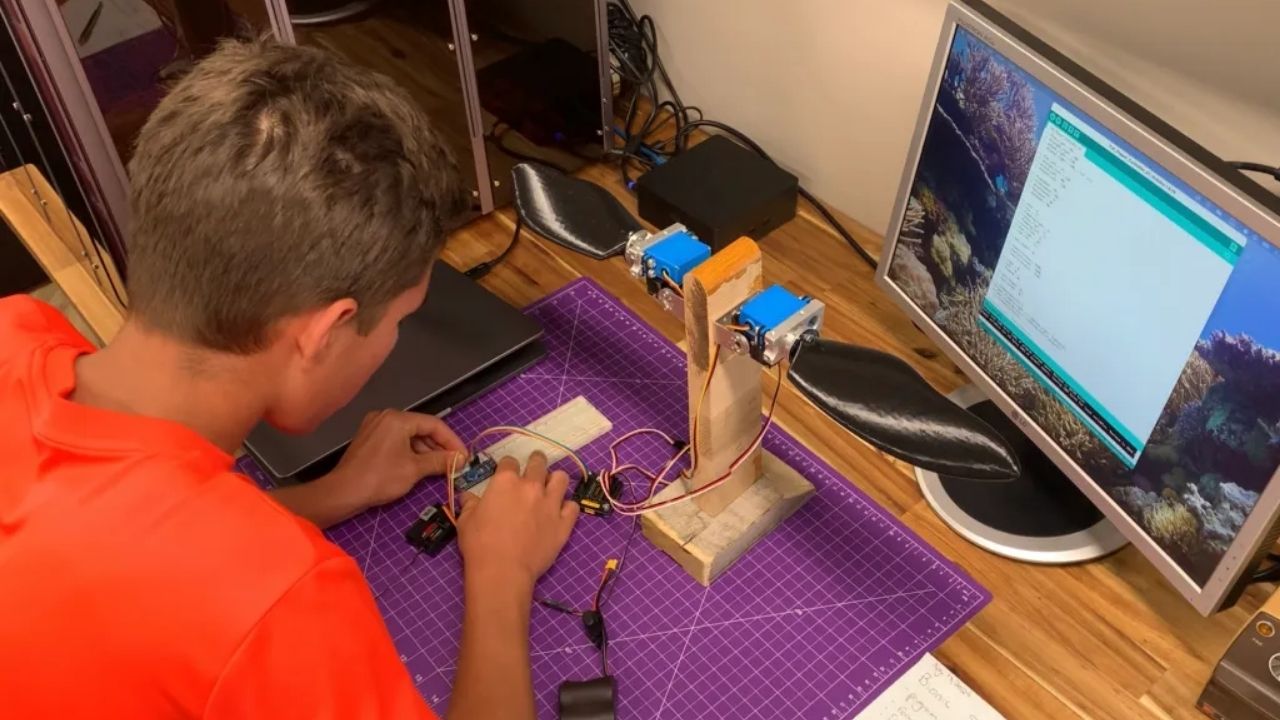
In the new stage presented at the fair, the student transformed this base into a microplastic detection platform. The innovation is not just in making the robot swim, but in using it as an active observer within the water, capable of analyzing the environment as it moves.
3D Holographic Camera Takes Detection into the Ocean
The strongest technical point of the project is the use of a 3D holographic camera system. According to Youth Science Canada, the technology was integrated into the robot to allow in situ detection of microplastics, meaning directly in the environment where these particles are present.
This detail changes the way the problem is observed. Instead of relying solely on later collections and external analyses, the project aims to reveal microplastics in real-time. For an almost invisible threat, seeing inside the water at the moment of detection is an essential part of the advancement proposed by the student.
Artificial Intelligence Helps Interpret Holographic Images
Artificial intelligence enters the project as a tool for reading and interpreting holographic images. The source informs that the system uses holographic images and AI to detect microplastics in real-time, connecting robotics, computer vision, and environmental engineering in one solution.
This combination helps explain why the work was recognized in the Environmental Engineering category. The robot was not awarded just for being a curious underwater machine, but for proposing a practical application for an environmental problem that requires increasingly precise detection methods.
US$ 50,000 Prize Won at the World’s Largest Youth Science Fair
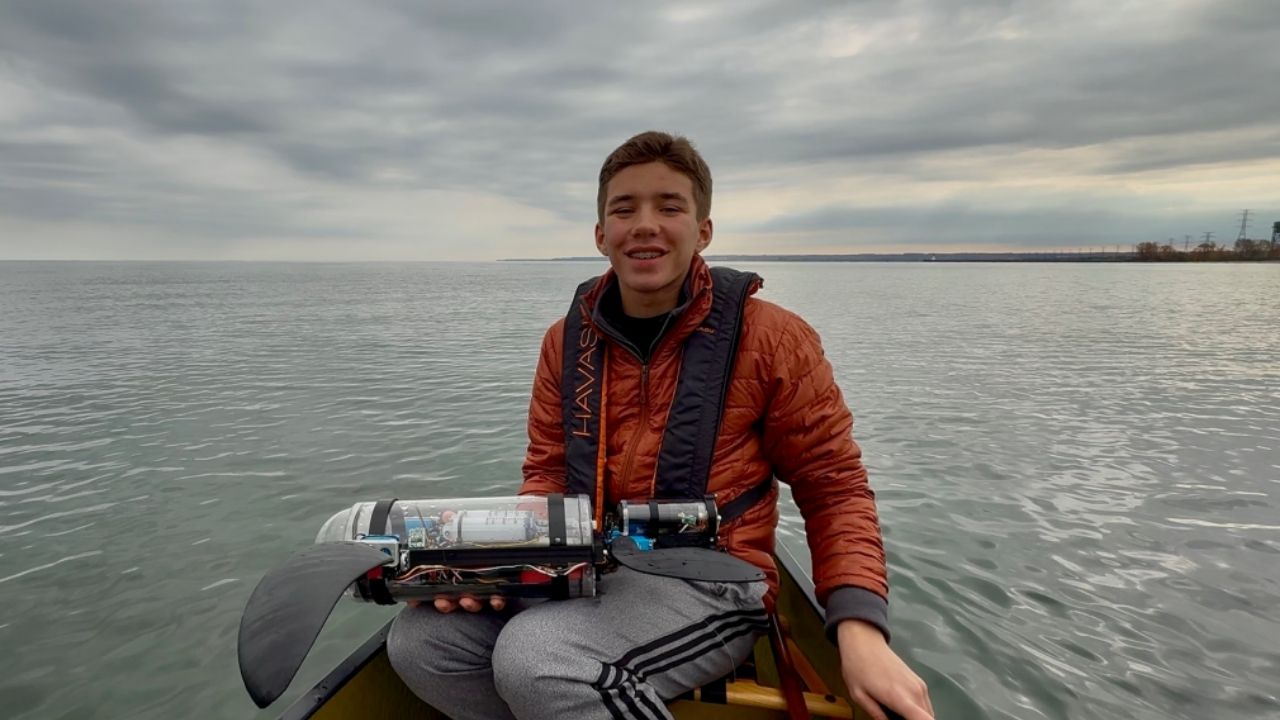
Evan Budz received the Gordon E. Moore Award of US$ 50,000 and was also recognized with the First Grand Award in Environmental Engineering. Additionally, the student received two Special Awards, according to the list released by Youth Science Canada.
The Regeneron ISEF 2026 took place in Phoenix, Arizona, from May 9 to 15. The competition brought together 1,727 finalists from 67 countries, regions, and territories, being presented by the source as the largest science competition for young people in the world. In this scenario, the Canadian robot managed to stand out among projects from very different areas of science and technology.
Canadian team left Phoenix with fifteen awards
Budz’s performance was part of a broader participation by Team Canada-ISEF, a delegation organized by Youth Science Canada. According to the entity, the eight Canadian finalists were recognized in the competition, and the team won six Grand Awards and eight Special Awards.
Among the winners mentioned by the organization were also Audrey Cowen, awarded in Microbiology, Matthew Shen, recognized in Computational Biology and Bioinformatics, Justin Guo, awarded in Environmental Engineering, Syd West, in Embedded Systems, and Imran Allarakhia, in Robotics and Intelligent Machines. The result shows that Budz’s robot did not appear isolated, but within a Canadian delegation with a strong presence in STEM areas.
Youth Science Canada highlighted curiosity and long-term research
Reni Barlow, executive director of Youth Science Canada, stated that each student started from an original question or idea and developed a project capable of being presented on any stage in the world. The statement was released in the entity’s communiqué on May 15, 2026.
Dr. Marc Roussel, president of the Team Canada-ISEF selection panel, also highlighted the variety of disciplines and the sophistication of the questions investigated by the students. According to him, the results reflect a sustained commitment to relevant scientific problems over the years.
Project connects young science, ocean, and almost invisible threat
Budz’s research gains strength because it unites three elements of high public interest: ocean, microplastics, and artificial intelligence. The robot functions as a bridge between environmental concern and a technological response created by a high school student.
The central point of the news is the international recognition of the project and the technical proposal presented: using an underwater robot with a 3D holographic camera and AI to detect microplastics in real-time.
Canadian robot opens debate on the future of ocean cleaning
The case of Evan Budz shows how young science projects can move beyond the school environment and address global issues. A robot that swims like a sea turtle may seem like an experimental idea at first glance, but its application in microplastics places the invention within an urgent discussion about environmental monitoring.
The question that remains is how far solutions like this can go: should AI robots become common tools for investigating ocean pollution, or are we still far from turning award-winning prototypes into widely used technologies? Leave your opinion in the comments.