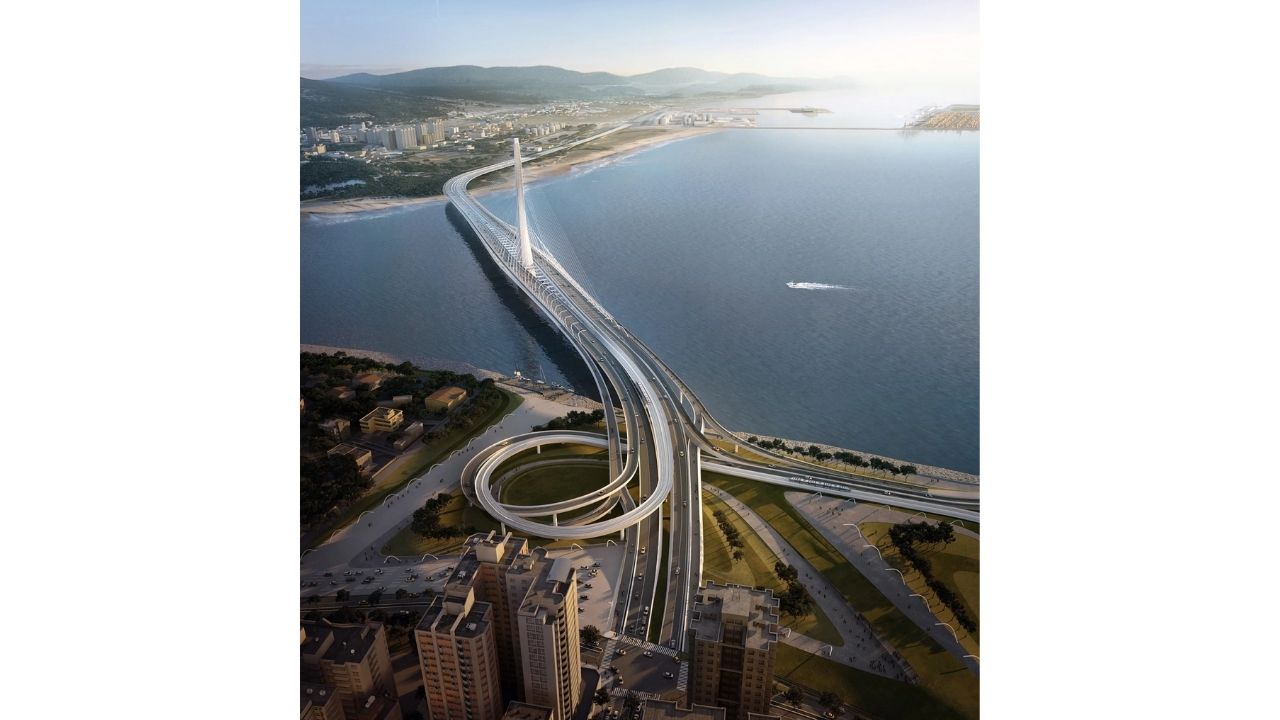
Inaugurated in May 2026, the Danjiang Bridge connects Bali to the Tamsui district in New Taipei, designed by Zaha Hadid Architects, with lanes for vehicles, paths for pedestrians and cyclists, as well as a seismic structure prepared to withstand tremors of magnitude 7 or higher in a region of active local plates.
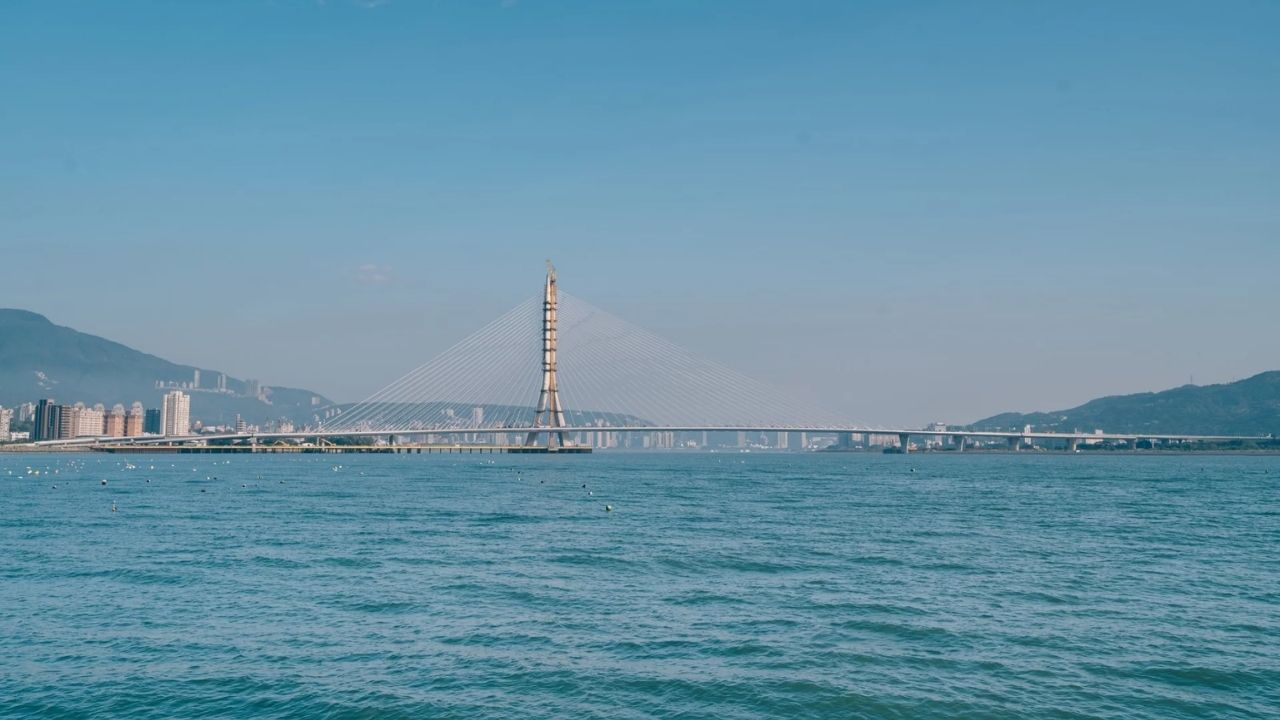
The Danjiang Bridge was officially inaugurated in Taiwan in May 2026, over the mouth of the Tamsui River, in the New Taipei region. With 914 meters in length and a single 200-meter mast, the structure was presented as the longest single-tower asymmetrical cable-stayed bridge in the world.
Designed by the Zaha Hadid Architects office, the project connects Bali to the Tamsui district and promises to reduce travel time between the two points by 25 minutes. Besides the traffic impact, the project draws attention for trying to balance engineering, landscape, and seismic resistance in one of the most tectonically sensitive regions on the planet.
The bridge that seemed impossible came to life in Taiwan
The Danjiang Bridge was described by its own construction team as a project that seemed “impossible,” mainly due to the combination of scale, asymmetrical design, and environmental demands at the Tamsui River estuary. Construction began in 2019 and faced delays before the official opening in 2026.
-
Engineering Feat in Brazil: 6.4 km Tunnel and Powerful Pumps Overcome 200-Meter Elevation to Save São Paulo’s Cantareira Water System

-
Engineering Students Build Off-Grid Tiny Home with Sustainable Features and Offer Free DIY Guide
-
Historic Brazilian Championship Stadium Demolished for New Supermarket and Shopping Center Development

-
Workers excavate one of the world’s longest railway tunnels beneath the Alps between France and Italy, stretching nearly 60 km, 600 meters deep, with an investment of 11 billion euros.


The project was initially scheduled to be completed in 2024 but faced delays associated with difficult weather conditions and labor shortages. Even so, the bridge was completed as an infrastructure milestone for Taiwan, combining urban function, sculptural architecture, and technical solutions for an area exposed to severe natural events.
A 200-meter mast supports the record-breaking structure
The most striking element of the bridge is the solitary 200-meter-high mast. Unlike bridges with multiple towers, the structure uses an asymmetrical design with cable stays, creating a cleaner silhouette over the Tamsui River and reducing the amount of physical interference in the estuary bed.
According to the architectural proposal, the use of a single mast also helps to decrease disturbance to the local aquatic ecosystem. In practice, the solution transforms the bridge into a less invasive engineering piece for the river, while preserving the visual strength of the project signed by Zaha Hadid Architects.
View of the sunset influenced the bridge design
The Tamsui River estuary region is known for attracting residents and tourists interested in the sunset view. Therefore, the bridge design was conceived to reduce visual obstruction from popular points near the river, an unusual detail in large infrastructure works.
The result is a bridge that was not designed just to solve displacements. It also interacts with the landscape, trying to avoid the structure imposing itself aggressively on a scenario already valued by the local population. This balance between mobility and visual preservation is one of the points that make the project different from a conventional bridge.
Crossing promises to reduce travel time by 25 minutes
The Danjiang Bridge connects Bali to the Tamsui district in New Taipei and was planned to facilitate circulation between the two areas. According to the information released about the project, the crossing is expected to reduce travel time by approximately 25 minutes, easing the commute for those who depend on this connection daily.
The main road is about 71 meters wide and includes lanes for vehicles, paths for pedestrians and cyclists. There is also a plan for a light rail line to operate later. Thus, the bridge functions not only as a road link but as a multimodal corridor, bringing together different forms of circulation in a single structure.
Earthquake Resistance Became a Central Part of Engineering
Taiwan is located in an area of intense tectonic activity, making seismic resistance an essential requirement for major constructions. In the case of the Danjiang Bridge, the structure was designed to withstand earthquakes of magnitude 7 or higher, according to the technical information released.
The bridge incorporates a complex seismic support system. Vertical forces are directed to the foundation through support pillars and anchoring cables, while horizontal and lateral forces are absorbed by hydraulic dampers, friction pendulum bearings, and synthetic rubber pads. This set was designed to dissipate energy and reduce damage during severe tremors.
Zaha Hadid Architects Signs a Work of Global Impact
The Zaha Hadid Architects office is known for projects with fluid forms, futuristic lines, and great visual impact. In the Danjiang Bridge, this language appears in the tapered mast and asymmetric composition, transforming a functional infrastructure into an architectural landmark.
Despite its sculptural appearance, the bridge is not limited to the visual aspect. The project combines traffic requirements, urban integration, landscape protection, environmental impact reduction, and seismic safety. It is precisely this combination that draws attention outside Taiwan, placing the bridge among the most talked-about engineering projects of 2026.
Budget, Delays, and Challenges Show the Weight of Construction
The construction of the bridge began in 2019 with a reported budget of around US$ 400 million. The source does not confirm the final cost of the work after the delays, so it is not possible to state precisely whether the value increased or by how much.
What is known is that the schedule was affected by practical challenges, including adverse weather and a shortage of workers. These factors help explain why a project scheduled for 2024 was only inaugurated in 2026. In projects of this magnitude, the challenge is not only in designing the structure but in executing each stage in a complex natural and urban environment.
A Bridge That Unites Mobility, Landscape, and Natural Risk
The Danjiang Bridge draws attention because it solves more than one problem at the same time. It shortens trips, creates new routes for pedestrians and cyclists, prepares space for light transport, and also seeks to preserve one of the most well-known views of the Tamsui River.
At the same time, the structure needs to face a condition that doesn’t appear in the photos: the seismic risk. In a region marked by active tectonic plates, building a record-breaking bridge requires more than aesthetic boldness. It requires calculation, redundancy, and systems capable of responding to extreme forces.
Danjiang Bridge places Taiwan in a new engineering showcase
The Danjiang Bridge shows how an infrastructure project can go beyond the basic function of connecting two points. In Taiwan, it was created with the mission to reduce travel, preserve the sunset view, minimize impact on the estuary, and withstand severe earthquakes.
The result is a 914-meter bridge that combines architecture, engineering, and natural risk in a single structure.
For you, should this type of project be a priority in large cities: more expensive and complex projects, but prepared for climate, landscape, and safety, or simpler and faster solutions to solve traffic? Leave your opinion in the comments.