Portuguese
  Spanish


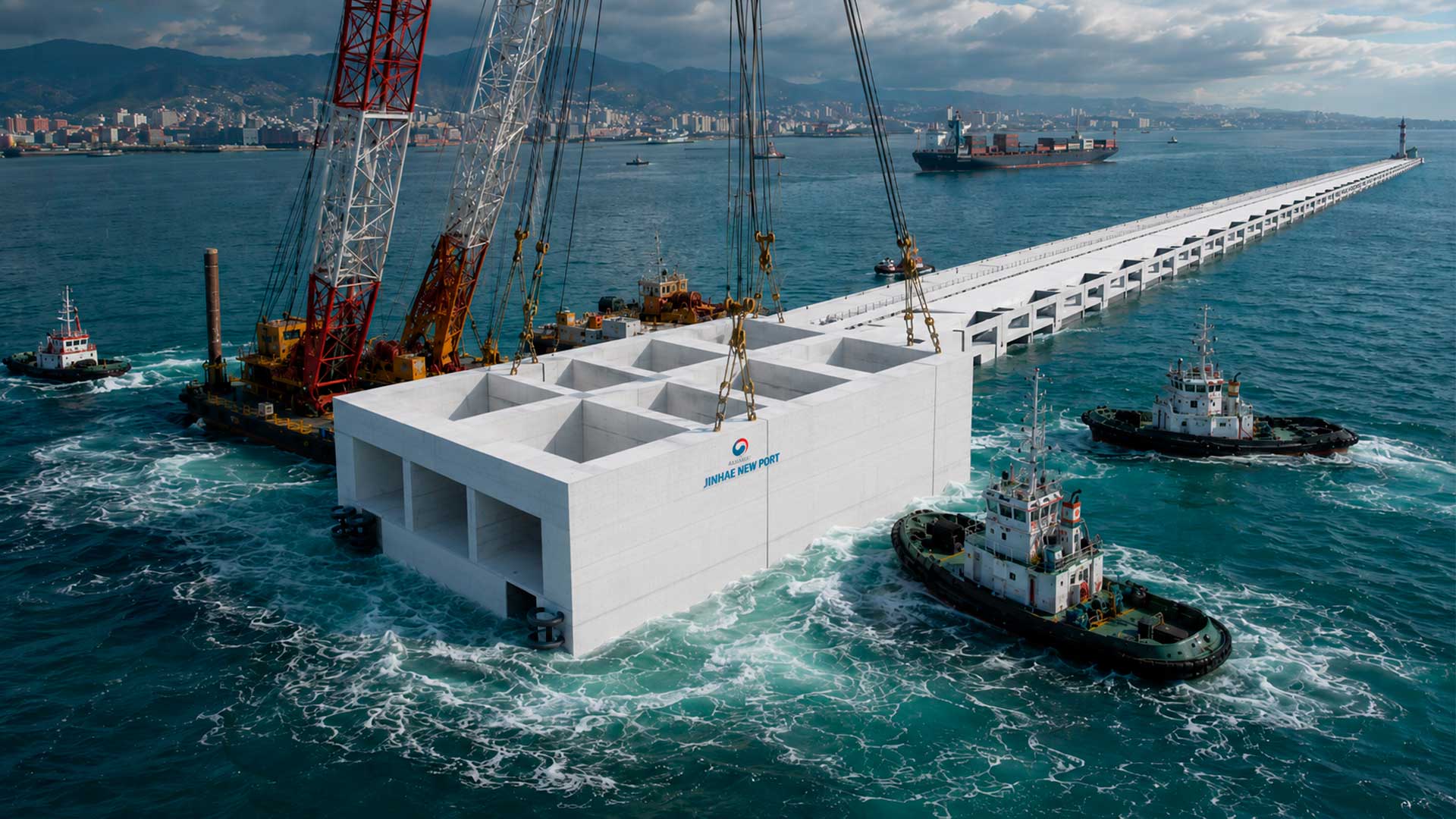

Giant structures will be positioned in the sea of Jinhae to protect the new expansion of Busan, in a project that combines concrete, heavy logistics, and competition for space in global container routes
South Korea is preparing one of the heaviest phases of the port expansion of Busan. The Jinhae New Port project involves the construction of a 1.4 km breakwater, supported by 20 concrete caissons each weighing 12,561 tons, manufactured to form the maritime protection base of the new complex.
The project is part of a larger plan to transform Busan into a mega-port by 2045.
The South Korean goal is to increase container handling capacity, accommodate larger ships, and compete for position among the world’s largest ports.
-
Venice Deploys 78 Massive Steel Gates to Shield City from Extreme Adriatic Tides

-
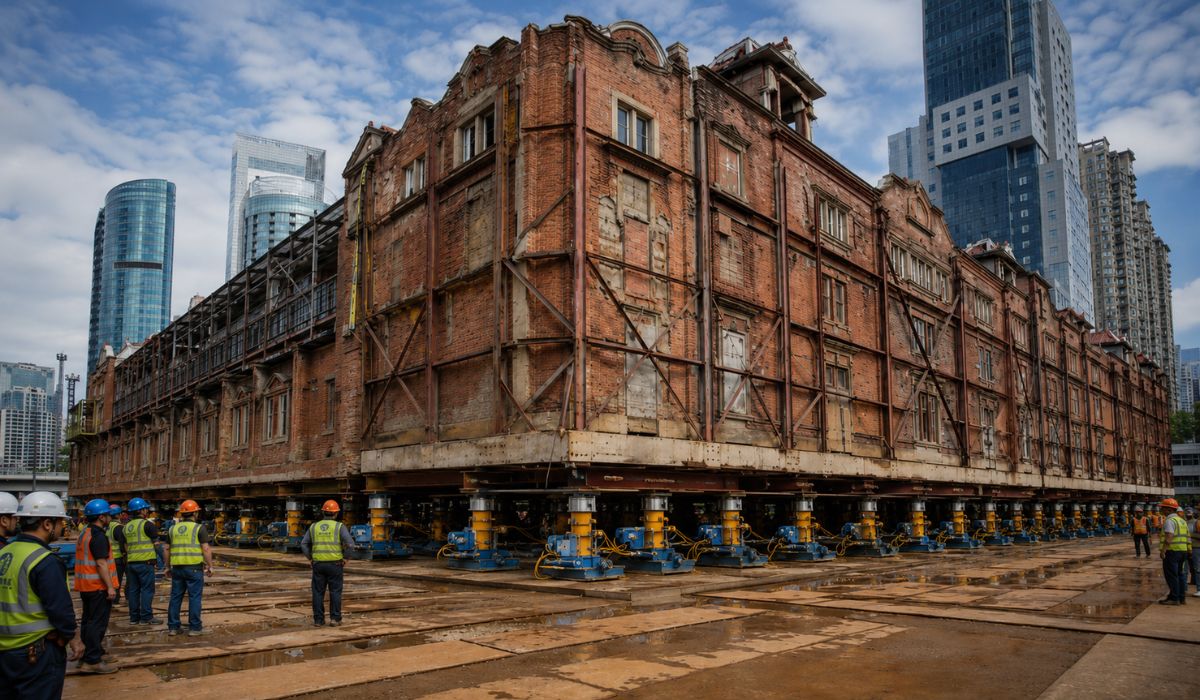
China Uses 432 Robots to Move a 7,500-Ton Historic Building in Shanghai, Preserving Architecture While Creating Space for Underground Center
-
World Cup Ball Chip Uses Technology to Detect Invisible Touches, Confirms Offside, Secures Portugal’s Victory Over Croatia

-
36-Meter Hydrogen-Powered Superyacht Arrives in Brazil to Debut German Engines and Showcase Future of Clean Navigation



The “caissons” mentioned in the project have no relation to funerals. In maritime engineering, the term refers to large hollow structures of reinforced concrete, manufactured on land, transported to the sea, and sunk in a planned location to serve as a base for breakwaters, docks, and piers.
1.4 km Breakwater will be the first defense of the new port in the sea of Busan
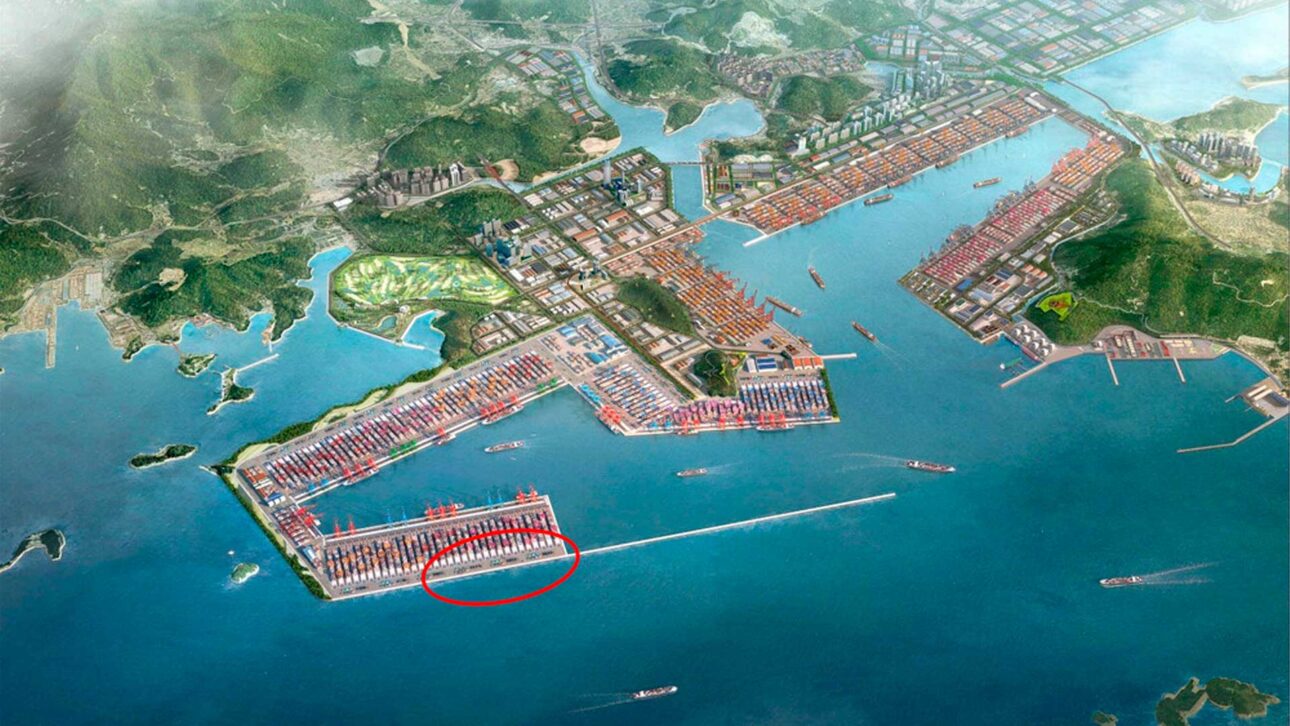
Hyundai E&C announced on April 30, 2024, that it received the contract to build the southern breakwater of Jinhae New Port in Busan, with 1,400 meters in length. The construction company stated that it plans to use BIM in the design phase and technologies of robotics and artificial intelligence during construction, mainly for risk control, productivity, and quality on site.
The breakwater is the piece that reduces the force of the waves before they reach the operational area of the port. Without this barrier, docking berths, cranes, container yards, and ships are more exposed to currents, swells, and stoppages.
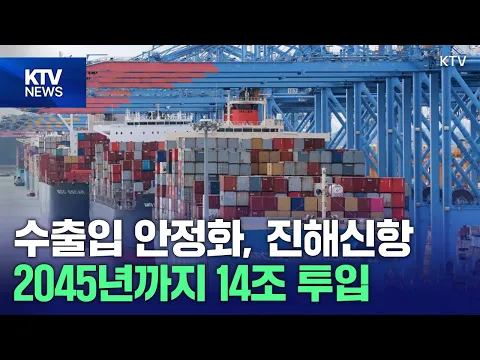

In the case of Jinhae, the function is even more strategic. The new port will be integrated into the expansion of Busan, currently the main maritime center of South Korea, in a region that already concentrates container routes linking Asia, North America, and Europe.
Each concrete block will weigh over 12.5 thousand tons before touching the seabed
According to Bygging-Uddemann, contracted to provide sliding form technology and transfer systems for the caissons, the Breakwater-Wharf 1–2 section of the project will have 20 units of 12,561 tons, with production set to begin in mid-2026. The company reported that the structures will be transferred to a floating dock by equipment designed for moving heavy maritime loads.
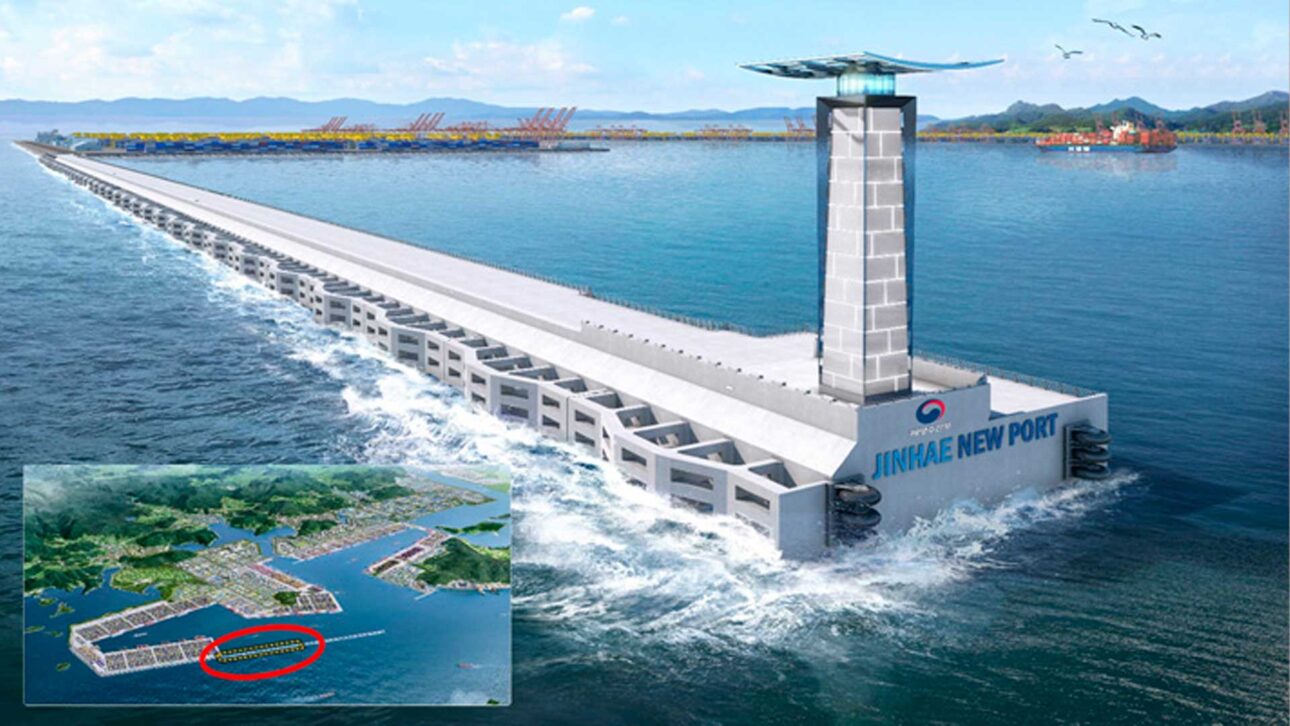
These caissons function as large reinforced concrete boxes. Once completed, they are moved, positioned in the sea, and filled with sand, soil, or other suitable material, gaining enough mass to remain at the bottom and resist wave action.
The scale helps explain the visual impact of the work. Each unit will have a weight comparable to that of thousands of compact cars combined. When aligned, these pieces will form part of the backbone of the breakwater that will protect the area of the new port.
This method is used in maritime works because it allows the manufacture of large modules in a more controlled environment before installation at sea. The operation, however, requires millimetric precision in stages of floating, towing, sinking, and leveling on the seabed.
Jinhae New Port is regarded as the largest port project in South Korean history

The Ministry of Oceans and Fisheries of South Korea reported on July 22, 2025, that it signed the fisheries compensation agreement related to Jinhae New Port, a necessary step for the start of government infrastructure works. In the same statement, the ministry described the project as the largest port development in the country’s history, with a total investment of 12.6 trillion won.
Compensation to local fishermen was a sensitive point because construction alters the fishing environment around the bay. In projects of this type, dredging, land reclamation, vessel traffic, and underwater works can change water circulation, turbidity, and traditional fishing activity areas.
There is also another figure mentioned in documents and announcements about the complete plan for Busan until 2045. The official portal Korea.net published in December 2024 that the government intends to invest 14 trillion won by 2045 to build Jinhae New Port and elevate Busan to the group of major global megaports.
The difference between 12.6 trillion and 14 trillion won appears because the numbers refer to different segments of the project. The first is linked to infrastructure development addressed by the ministry in 2025. The second appears in the broader long-term package to expand Busan until 2045.
The bet is to receive larger ships and reduce bottlenecks in global logistics
Invest Korea reported that Jinhae New Port is expected to be completed by 2045, with 21 berths, Busan’s total capacity increased to 39.66 million TEUs, and an 87% increase over the 21.2 million TEUs recorded in 2024. The project also foresees the capacity to receive ships of up to 30 thousand TEUs, above the largest container ships currently in commercial operation.
TEU is the unit used in maritime transport to measure 20-foot containers. In practice, the larger the capacity in TEUs, the greater the volume of cargo the port can absorb throughout the year, provided that yards, land access, cranes, and dispatch systems keep up with the growth.
The South Korean plan does not only aim at size. Busan is a transshipment port, where cargoes from different countries are redistributed to other routes. In this model, delays, terminal changes, and lack of berths can generate extra costs for shipowners and logistics operators.
Therefore, Jinhae appears as a response to the increase in ships and instability in global supply chains. With more berths, greater operational depth, and integration with Busan, South Korea is trying to maintain its position in a competition involving China, Singapore, Malaysia, Japan, and other Asian hubs.
The advance at sea also raises concerns about environmental impact in Jinhae Bay
The port expansion in Jinhae is not just a concrete work. A study published in 2025 in the scientific journal Water analyzed 17 years of water quality data in Jinhae Bay and pointed out that port works and dredging in the Busan New Port region were related to an increase in suspended solids, with peaks of 92 mg/L in some monitored areas.
Suspended solids are sediment particles that remain mixed in the water. In excess, they reduce transparency, alter light penetration, and can affect marine organisms, especially in areas with lower circulation.
The geography of Jinhae Bay itself requires care. The region has relatively shallow waters, surrounding islands, and limited exchange with the open sea, which can prolong the presence of sediments and pollutants in certain areas.
This does not mean that the project cannot advance, but it reinforces the need for environmental monitoring, sediment containment barriers, dredging planning, and compensation for fishermen. In projects of this scale, the cost of engineering is not only in concrete but also in coexisting with fishing, local navigation, and the limits of the coastal environment.
Busan wants to grow without losing time in the race of Asian megaports
The Jinhae New Port places South Korea in a competition that is not measured only in kilometers of docks. The competition involves depth, automation, rail and road connections, the capacity to receive giant ships, and speed to move containers without disrupting the logistics chain.
The 20 concrete caissons of 12.5 thousand tons are just a visible part of this plan. They draw attention due to their size but serve a simple and decisive function: to create a physical barrier so that the new port area operates more safely.
If the schedule progresses as planned, Jinhae is expected to change the logistics map of Busan over the next two decades. By 2045, South Korea wants the complex to not only be the largest port in the country but also to compete among the largest container centers in the world.
Do you think that giant projects like this justify the impacts on the sea when the goal is to expand global logistics? Leave your opinion in the comments and say whether the growth of megaports should weigh more on the economy or environmental protection.