Portuguese
  Spanish


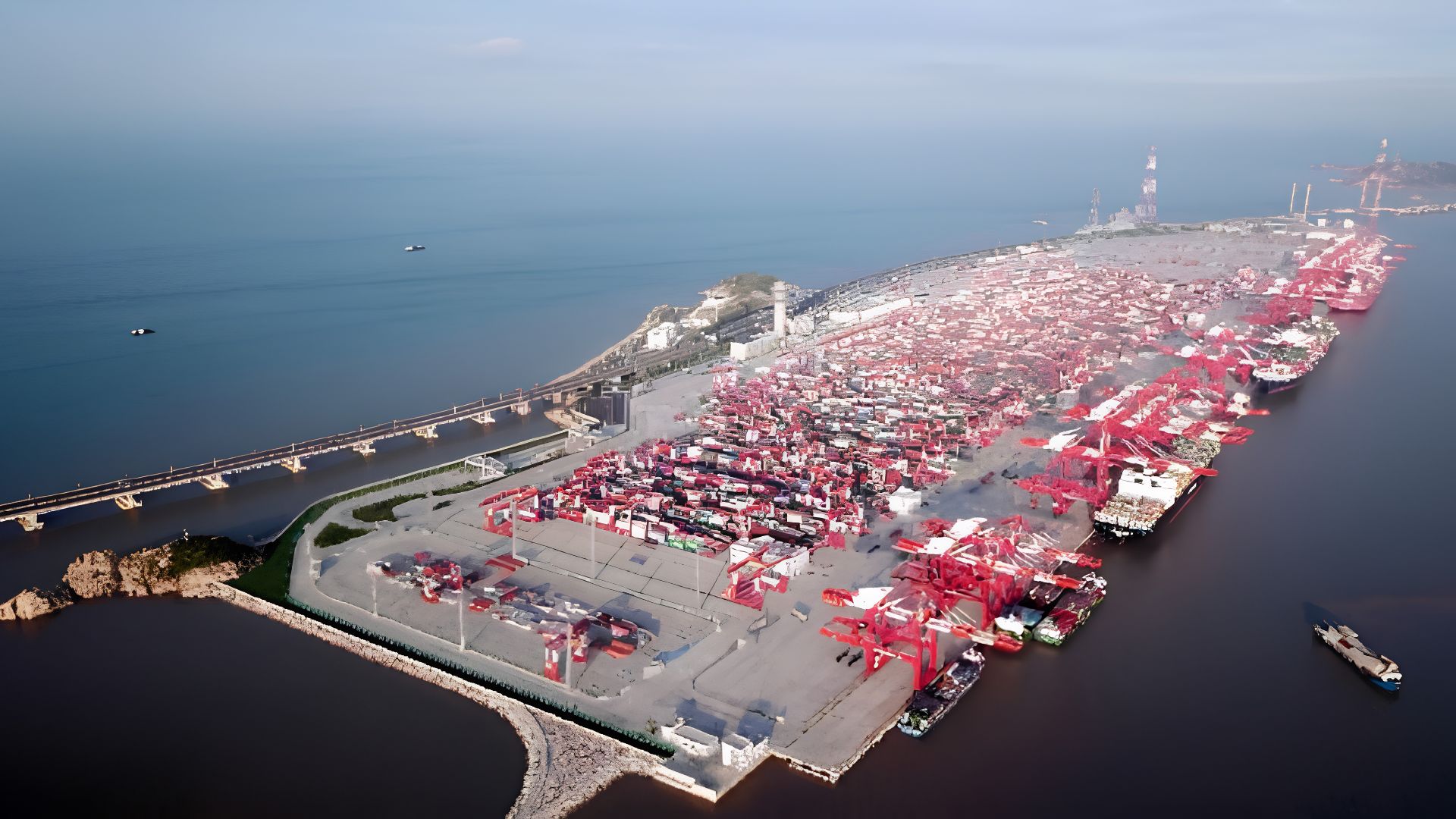


Yangshan Automated Port Uses Remote Cranes, Autonomous Vehicles, and Artificial Islands to Expand China’s Maritime Leadership.
China has transformed artificial islands in the sea into one of the most advanced port operations on the planet. The automated Yangshan terminal, connected to the Port of Shanghai, occupies about 2.23 million m², an area equivalent to approximately 312 football fields, and was designed to operate giant ships with virtually no visible drivers or operators in much of the logistical operation.
The structure is part of phase 4 of the Yangshan Port, built in deep waters in Hangzhou Bay. The terminal uses 26 remotely controlled cranes, about 130 electric autonomous vehicles, and dozens of automated systems to transport containers between ships, storage areas, and logistics zones. According to data linked to the Shanghai International Port Group, the annual capacity of the area has been expanded to up to 8 million TEUs, a unit used in maritime transport to measure 20-foot containers.
The project is part of China’s strategy to keep Shanghai as the world’s largest container port. Today, the complex directly competes for global logistics leadership with maritime hubs like Singapore, Ningbo-Zhoushan, and Shenzhen, in a race that involves automation, operational intelligence, and capacity to accommodate increasingly larger ships.
-
Brazil’s Port of Santos to Receive New $1.1 Billion Container Terminal, Tecon Santos 10, Set to Begin Operations in 2029

-
Ports without drivers and cabins already move containers like automated factories: robotic cranes, autonomous electric vehicles, and software transform giant terminals into 24-hour logistics machines.
-
About 300 American ports still breathe diesel from trucks, cranes, and locomotives, but they are now trying to electrify heavy machinery to clean the air for 31 million nearby residents.

-
A 220-meter giant powered in part by solar energy and lithium batteries has just unloaded nearly 5,000 Chinese cars at the Port of Itajaí. It is the first of ten Grimaldi super ships and the first in the world prepared to run on ammonia as fuel.


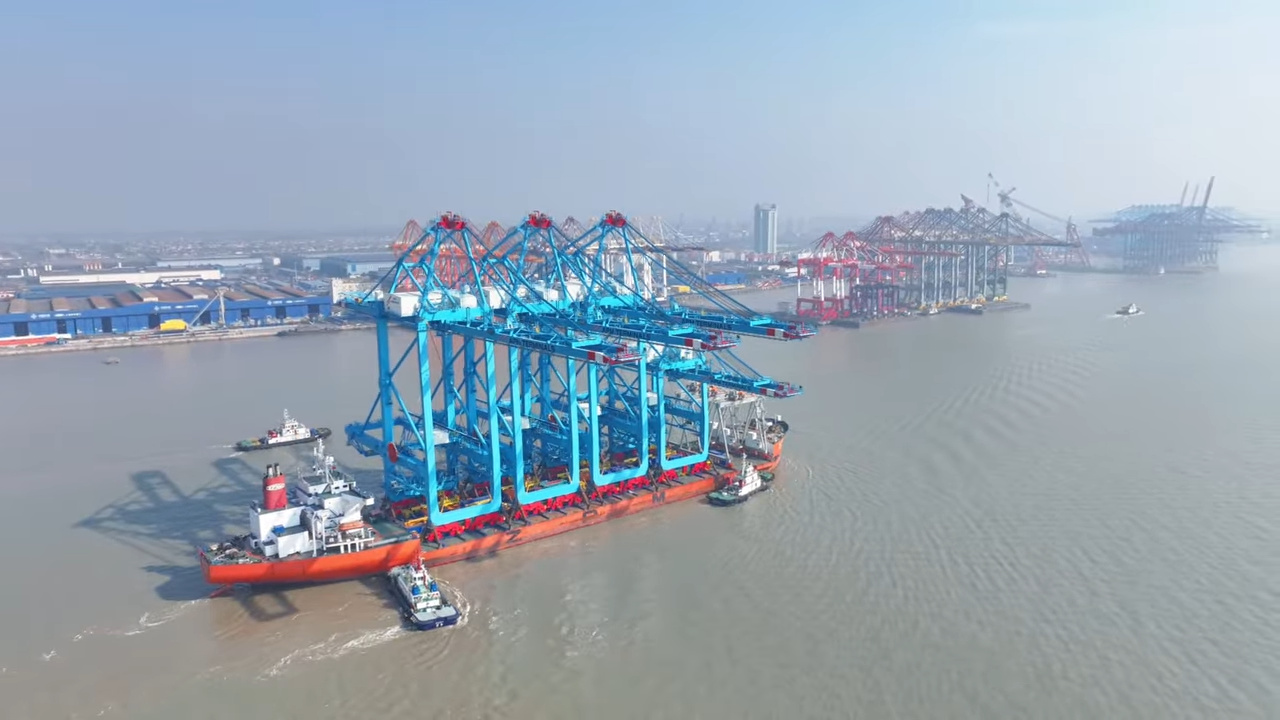


The terminal was built on islands in the sea to accommodate giant deep-water ships
Yangshan was not installed in a conventional port area near the coast. China decided to develop the project on islands located in the East China Sea because the region offers natural depth suitable for large modern vessels.
This is important because the largest container ships in the world exceed 400 meters in length and can carry more than 24,000 TEUs in a single trip. Many old ports need to perform constant dredging to operate vessels of this size.
In the case of Yangshan, the natural deep waters helped to reduce part of this problem. To connect the complex to the mainland, China built the Donghai Bridge, a structure approximately 32.5 km long that links the terminal directly to the Shanghai region.
Automation transformed the port into a kind of logistical factory at sea
The most impressive aspect of the terminal is its operational automation. Phase 4 was developed to operate with minimal human intervention in the main cargo handling areas.


The ship-to-shore cranes operate remotely, while automatically guided vehicles transport driverless containers between the ships and the internal yards. The equipment uses integrated digital systems capable of coordinating cargo movement in real time.
In practice, the operation resembles more an automated industrial line than a traditional port. The electric AGVs continuously circulate through the terminal transporting containers between different areas without the need for an operator inside the vehicles.
This model reduces operational time and increases efficiency on a large scale.
The port was designed to accelerate cargo movement on a global scale
The growth of international trade has greatly increased the pressure on major seaports. The faster a ship can unload and leave the terminal, the greater the operational efficiency of shipping companies. Automation has become one of the main responses to this challenge.

Digital systems can organize berthing queues, container transport, and logistics distribution much faster than traditional operations dependent on conventional equipment and manual operators at all stages.
Moreover, Yangshan uses a large amount of automated electric equipment, reducing part of the fossil fuel consumption in the terminal’s internal operation.
Shanghai leads a gigantic logistical dispute among the largest ports on the planet
The growth of Yangshan occurs amid an intense dispute among the largest global maritime hubs. Shanghai currently holds the world’s top position in container movement, ahead of Singapore, Ningbo-Zhoushan, and Shenzhen. These ports move tens of millions of TEUs every year and function as vital centers of the international economy.
A large part of Chinese industrial exports passes through such structures. Electronic products, machinery, industrial equipment, automotive parts, and goods destined for markets worldwide depend directly on these maritime corridors.
Therefore, expanding logistical capacity has become a strategic priority for Beijing.
China has transformed maritime infrastructure into a global economic tool
In recent years, China has heavily invested in ports, logistic corridors, railways, and infrastructure related to international trade.

The goal is to reduce operational costs, increase export efficiency, and strengthen China’s position in global production chains. Yangshan represents exactly this model.
The terminal was not created just to receive ships. It functions as part of a much larger national strategy aimed at global maritime trade and Chinese economic expansion.
Large-scale automation also allows China to test advanced logistic technologies before expanding them to other sectors of the economy.
Automated ports are changing global logistics
Yangshan shows how major ports are transitioning from merely functioning as docking areas to becoming highly automated digital systems.
The new generation of terminals combines logistic intelligence, heavy automation, autonomous vehicles, and massive infrastructure to handle increasingly larger volumes of global trade.
This also increases pressure on other countries. Traditional ports need to accelerate modernization to avoid losing competitiveness against extremely efficient structures built mainly in Asia. Meanwhile, China continues to expand port capacity at a rapid pace.
And perhaps this is exactly what makes Yangshan one of the most impressive projects in the current maritime sector: it does not just look like a gigantic port, but a logistic machine built at sea to sustain global trade on an extreme scale.