Portuguese
  Spanish


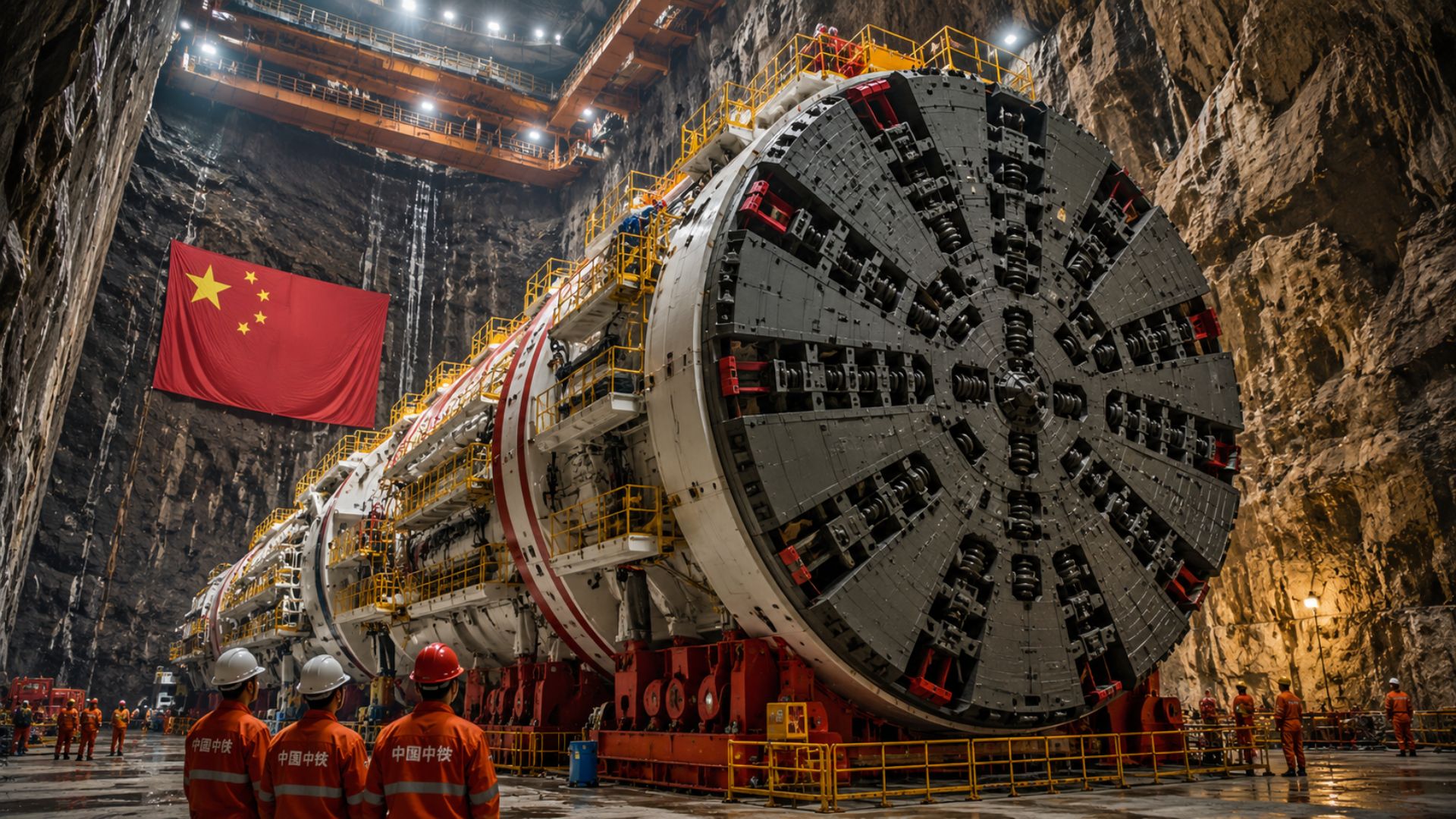


Named Steel Backbone, the machine drills downward like a giant drill and targets exactly what has always hindered deep mining: hard rock. Its conical cutting head was born from an unusual idea, the way a pencil is sharpened, and the target is deposits of gold, lithium, and tungsten a kilometer from the ground.
China has unveiled the world’s first machine capable of drilling vertical shafts in hard rock at more than a thousand meters deep, a colossus of about 500 tons and 8.1 meters wide that has been nicknamed the underground aircraft carrier due to its impressive scale. Developed by the state-owned China Railway Construction Corporation, CRCC, the equipment rolled off the production line on April 16, 2026, in the city of Changsha, and promises to revolutionize the way the world extracts minerals from the Earth’s deepest layers.
Named Gangtie Jiliang, which in English means something like steel backbone, the machine is technically classified as a full-face vertical tunneling machine for hard rock, or shaft boring machine. China developed the equipment to solve an old mining problem: safely and efficiently reaching mineral deposits that are more than a kilometer below the surface, where traditional techniques encounter extreme pressure, heat, and very hard rocks.
How the machine created by China works

Unlike conventional shaft boring methods, which tend to be slow and dangerous, the Gangtie Jiliang drills directly downward from the surface, with a massive circular cutting head that covers the entire diameter of the shaft, functioning like a giant electric drill. This approach represents a shift from horizontal excavation techniques and allows for the creation of vertical access routes to deep deposits more quickly and safely.
-
Engineering Feat in Brazil: 6.4 km Tunnel and Powerful Pumps Overcome 200-Meter Elevation to Save São Paulo’s Cantareira Water System

-
Engineering Students Build Off-Grid Tiny Home with Sustainable Features and Offer Free DIY Guide
-
Historic Brazilian Championship Stadium Demolished for New Supermarket and Shopping Center Development

-
Workers excavate one of the world’s longest railway tunnels beneath the Alps between France and Italy, stretching nearly 60 km, 600 meters deep, with an investment of 11 billion euros.


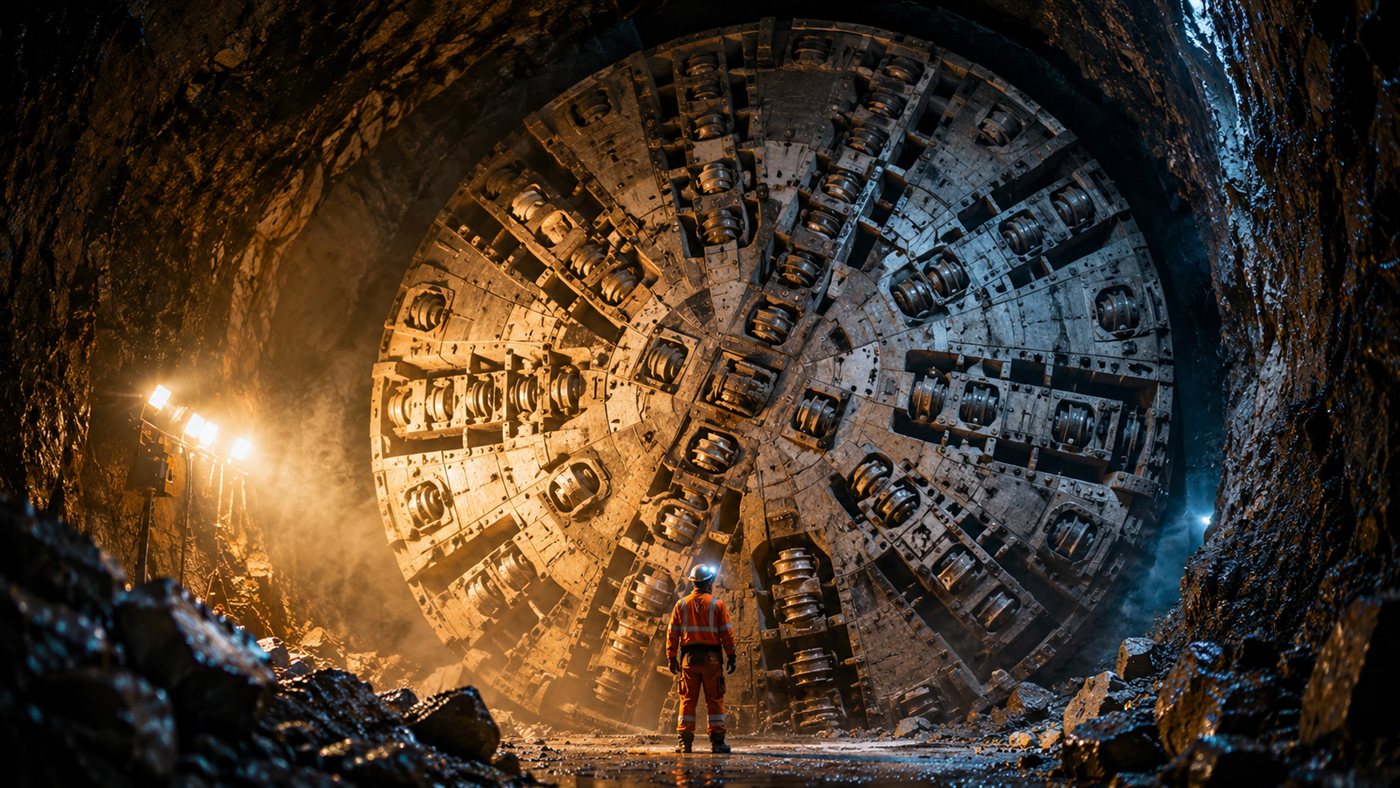
The machine was the result of work that began in 2021, when CRCC assembled a team dedicated to overcoming three central challenges: excavation, removal of rock debris, and support of the well walls. The equipment is a second generation, successor to a previous machine called Shuchang, and incorporates completely redesigned cutting heads, support systems, suspension platforms, and lifting mechanisms, totaling more than twenty patented technologies.
The inspiration that came from sharpening a pencil

One of the most curious details of the project is the machine’s cutting head. To adapt to the characteristics of vertical excavation, researchers in China developed a conical cutting head with automatic alignment correction. The solution to increase the rock-breaking force came from an everyday observation: the way a pencil is sharpened with a sharpener.
According to Ke Wei, one of the designers of the excavation system, the team previously assumed that the equipment reached maximum breaking force when the cutting tools were perpendicular to the rock. But the experience of sharpening a pencil suggested otherwise: by tilting the blade at a smaller angle, cutting becomes easier. Applying this principle, engineers discovered that angling the cutting tools resulted in greater force against hard rocks, a finding that helped make the machine feasible.
Why deep mining is so difficult
The main motivation behind China’s machine is the gradual depletion of easily accessible mineral deposits near the surface. As these deposits become scarcer, mining needs to go deeper, where the richest layers are. The problem is that mining at great depths has always presented enormous technical and financial challenges, such as the colossal pressure of the underground, intense heat, and the hardness of the rocks.
It is precisely to face these difficulties that the Gangtie Jiliang was built, maintaining continuous and stable drilling where traditional methods failed. Geologists point out that the deeper layers of the crust tend to concentrate minerals in larger quantities, and the machine paves the way to explore deposits of strategic minerals such as antimony, gold, zinc, tungsten, and lithium, the latter essential for batteries and the global energy transition.
Where the machine is already in operation
Gangtie Jiliang was not just limited to the testing field. After being validated in a ventilation shaft connected to a highway in Sichuan province, the machine was effectively deployed in an iron ore project of the Ansteel group, one of China’s largest steelmakers, in the city of Anshan, in Liaoning province, northeastern China. Its mission is to pave the way to the ore hidden more than a kilometer deep.
China presents the equipment as a milestone that fills an international gap, placing the country among the world leaders in ultra-deep shaft opening technology. According to the project’s chief engineer, Ding Zhangfei, the development of the machine required overcoming various technical obstacles, resulting in several registered patents. The achievement is treated as a success of a large-scale national research and development project.
What changes for global mining
The arrival of a machine capable of opening vertical shafts in hard rock over a thousand meters deep can alter the dynamics of major underground works and mineral exploration worldwide. The promise is to offer a safer and faster method to reach deep layers without the need to open large craters on the surface, which reduces environmental impact and increases the feasibility of projects previously considered unviable due to technical barriers.
However, it is important to remain grounded amid the enthusiasm. The machine is recent and is in its first real operations, so its long-term performance is yet to be proven in practice. If it confirms consistent results in Liaoning, the technology tends to influence similar projects in other countries and pave the way for a new standard of resource extraction at great depths, in a strategic sector that drives the global economy.
The vertical shaft opening machine developed by China is an example of how heavy engineering is being pushed to extremes to ensure access to increasingly deep mineral resources. Weighing 500 tons, with a cutting head inspired by pencil sharpeners and the ability to drill hard rock at a kilometer depth, Gangtie Jiliang symbolizes the technological race for the underground. It remains to be seen if the promise of revolutionizing deep mining will be confirmed in the coming years.
Do you believe that machines like this one from China will truly revolutionize deep mining and the search for strategic minerals like lithium? Do you think Brazil, with its enormous mineral potential, should invest in similar technologies? Leave your comment, share your thoughts on this technological race for the underground, and share the article with those interested in mining, engineering, and innovation.