






 Portuguese
  Spanish


Relocation programs in 2026 are paying residents to occupy emptied cities, islands, and villages, with houses for €1, subsidies of up to €84,000, cash bonuses, tax benefits, and free infrastructure to try to reverse decades of urban exodus, population aging, and demographic collapse in regions of Italy, Ireland, Greece, Spain, and the United States.
According to International Living, in 2026 there are active relocation incentive programs in dozens of municipalities and regions around the world, with packages combining houses for symbolic prices, cash subsidies, tax benefits, and free infrastructure to attract residents to places emptied by urban exodus in recent decades. The phenomenon began in Italy, where about 6,000 villages with fewer than 5,000 inhabitants are at risk of disappearing, according to the Italian National Institute of Statistics. The response from some mayors was radical: to announce houses for €1 for anyone who committed to renovating and living there.
What seemed like a curiosity of Sicilian municipalities in crisis has transformed into a global movement. Today, cities and regions offer from US$10,000 to €84,000 to attract residents, digital nomads, and families willing to repopulate communities that have lost people, services, and a future.
Cities that pay to receive residents emerge as a direct response to demographic collapse
In 2026, a city in Oklahoma pays US$10,000 for remote workers who move there. Ireland offers up to €84,000 for those who buy and renovate an abandoned house on its coastal islands. Greece pays €500 per month for five years to anyone who moves to Antikythera, an island with only 24 inhabitants.
-
Crab Trapped in Plastic Bottle for 62 Days Near Okinawa Highlights Little-Known Impact of Marine Pollution on Small Animals

-
Esperanza’s Bamboo Barrier in Oaxaca Redirects River and Reduces Erosion by 85% in Five Years

-
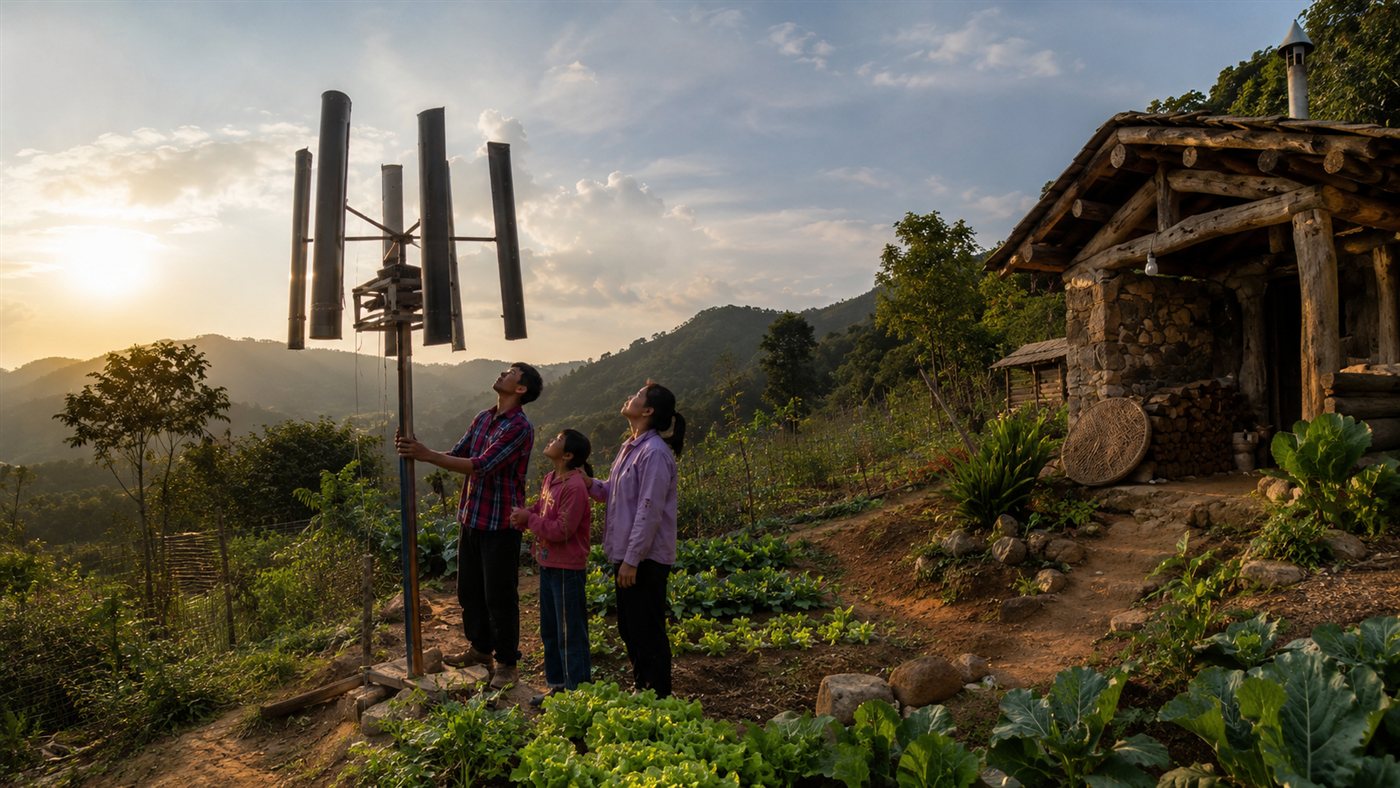
Family Builds Homemade Wind Turbine to Power Off-Grid Home, Video Reaches 555,000 Views on Ngô Thị Huyền’s Channel
-
Indian Brand Creates Sneakers from Recycled PET Bottles and Discarded Tires, Repurposing Over 1 Million Bottles and Raising $4 Million for Expansion





Spanish Extremadura pays up to €15,000 for digital nomads. Italian Molise offers between €700 and €900 per month for three years to families who agree to live in small villages. What unites all these offers is the same cause: places that have understood that demographic collapse does not have to be treated as an inevitable destiny.
These regions have come to see population loss as an incentive problem. If young people, families, and remote professionals do not arrive spontaneously, local governments are trying to buy the decision to move with public money, cheap housing, and concrete benefits.
Italy put the €1 house model and subsidies to repopulate villages on the map
Italy has one of the most severe demographic combinations in Western Europe. The birth rate is 1.24 children per woman, well below the 2.1 needed to maintain a stable population. The average age of the population exceeds 47 years, while young people leave inland, Southern, and island municipalities for large cities or other European countries.
In Presicce-Acquarica, Puglia, 150 people died in 2024 and only 60 children were born. The mathematical result is progressive extinction, not in centuries, but in a few decades. The municipality responded with a program that pays up to €30,000 for anyone who buys property and moves permanently to the city.
The €1 houses, a model that went viral, gained traction in Sambuca di Sicilia, which began selling abandoned properties for a symbolic price on the condition of renovation within three years and a €5,000 deposit as guarantee. The house is not free: the real cost of renovation usually ranges between €15,000 and €30,000, but it can still represent a cheap entry into the historic European real estate market.
Tuscany, Molise, and Sardinia expanded incentives for residents in small towns and rural areas
Tuscany went beyond the symbolic €1 house model. The Residenzialità in Montagna 2024–2025 program offers grants of €10,000 to €30,000 for those who move to mountain towns with fewer than 5,000 inhabitants.
Molise pays between €700 and €900 per month for three years, potentially reaching €27,000 in total, for families who settle in villages with fewer than 2,000 people. The condition is to open a local business or work in an area with demand.

Sardinia offers up to €15,000 for those who move to villages with fewer than 3,000 inhabitants. The logic is straightforward: use public money to transform empty houses into housing, local consumption, children in schools, and economic activity in places threatened by aging.
Tulsa Remote became a benchmark in the United States by paying remote workers to leave metropolises
On the other side of the Atlantic, the problem is not identical to the European one, but the solution ended up being similar. Tulsa, Oklahoma, is a mid-sized city that saw its traditional economic base, linked to oil and manufacturing, shrink over decades, while skilled professionals migrated to New York, Austin, San Francisco, and other metropolises.
In 2018, the George Kaiser Family Foundation launched Tulsa Remote with a simple proposal: US$10,000 in cash, a US$1,000 housing stipend, and one year of free coworking for remote workers who moved to Tulsa for at least one year.
The result exceeded expectations. More than 3,000 remote workers have already moved because of the program, attracting professionals in technology, design, marketing, and other fields. Between 2018 and 2024, Tulsa Remote generated over US$164 million in economic activity for the city, according to independent evaluations.
Programs in the United States show that quality of life has become an economic asset to attract residents
Tulsa Remote participants spend, on average, 40% more in local commerce than existing residents of an equivalent profile. The retention rate, meaning people who remain after the minimum required period, exceeds 50%, which indicates that the initial incentive can transform into real permanence.
Tulsa’s success triggered a wave of similar programs. Topeka, Kansas, pays US$10,000 for new residents who buy a house and US$5,000 for those who rent. Noblesville, Indiana, offers US$15,000 packages with cash, coworking, and annual park passes.
Chattanooga, Tennessee, pays US$2,500 specifically for technology professionals. West Virginia launched Ascend WV with US$12,000 in cash and free access to skiing, climbing, and golf. The differentiator is no longer just employment: cost of living, nature, leisure, and financial incentives have entered the competition for residents.
Greece pays to repopulate islands where basic services are threatened by lack of inhabitants
Greece has about 6,000 islands and islets, of which only 227 are inhabited. Many of them have such small populations that the maintenance of basic services has become a matter of viability.
Antikythera, an island located between Crete and the Peloponnese, once had 24 permanent inhabitants, almost all elderly, with no school-aged children and no clear prospect of generational continuity. To try to reverse this situation, the Greek government launched a program offering a house, agricultural land, and €500 per month for up to five years.


The condition is to remain on the island for at least five years. The program attracted candidates from all over Europe and became a symbol of a broader strategy. Greece also uses subsidies for essential workers and a favorable tax regime, with a flat rate of 7% for up to 15 years for new residents.
Ireland offers up to €84,000 to restore abandoned houses on coastal islands
Ireland’s Living Islands program is possibly the most generous in absolute value. It offers up to €84,000 for those who buy and renovate an abandoned house on one of the country’s 30 coastal islands.
In 2026, an Expert Advice Grant of €5,000 was added to help cover the costs of conservation consultants and engineers. This measure recognizes that restoring old properties on islands requires technical knowledge, licenses, structural adaptation, and heritage preservation.
Irish coastal islands suffered accelerated depopulation throughout the 20th century, especially with the modernization of transport and the concentration of jobs on the mainland. The program is based on the idea that letting these communities disappear means losing cultural heritage, local economies, and traditional forms of land management.
Remote work transformed modest relocation programs into a global repopulation policy
Many relocation incentive programs already existed before the 2020 pandemic, but the results were modest. The obstacle was simple: people with skilled jobs needed to live near offices, and offices were located in large metropolises.
Incentives primarily attracted retirees or people willing to open local businesses, a limited audience. With the consolidation of remote work, the equation changed. A software engineer can maintain a big-city salary and live in Tulsa paying lower rent, still receiving US$10,000 for the move.
A European freelance designer can buy a symbolic house in Sambuca di Sicilia, renovate the property, and serve clients from various countries. Remote work has transformed villages, islands, and medium-sized cities into real alternatives for professionals who were previously tied to the geography of offices.
The problem is not a lack of interest, but a lack of well-designed and funded programs
Tulsa Remote received over 50,000 applications in its first years, a sign that the demand for incentivized relocation is much greater than the available supply. The bottleneck, therefore, is not necessarily a lack of people willing to move.

The problem lies in creating programs with clear rules, sufficient budget, and monitoring capacity. Without this, the incentive becomes a headline, but not a lasting public policy.
International experience shows that money alone is not enough. To transform curiosity into a definitive move, it is necessary to combine financial benefits, viable housing, internet, basic services, community, and economic prospects.
Not every €1 house is a simple opportunity, and not every subsidy delivers what it promises
Not all relocation programs deliver what they appear to in the headlines. €1 houses often have renovation costs higher than expected, require strict execution deadlines, and involve bureaucratic processes that make ownership more complex than it seems.
Monthly subsidy programs can also have risks. Some depend on annual bureaucratic approval, may be discontinued due to changes in municipal government, or impose conditions that reduce the real attractiveness of the benefit.
The most successful programs have common denominators: simple criteria, online application, defined deadlines, transparent rules, and unambiguous requirements. When the benefit is clear and the infrastructure exists, the chance of permanence increases.


