Portuguese
  Spanish


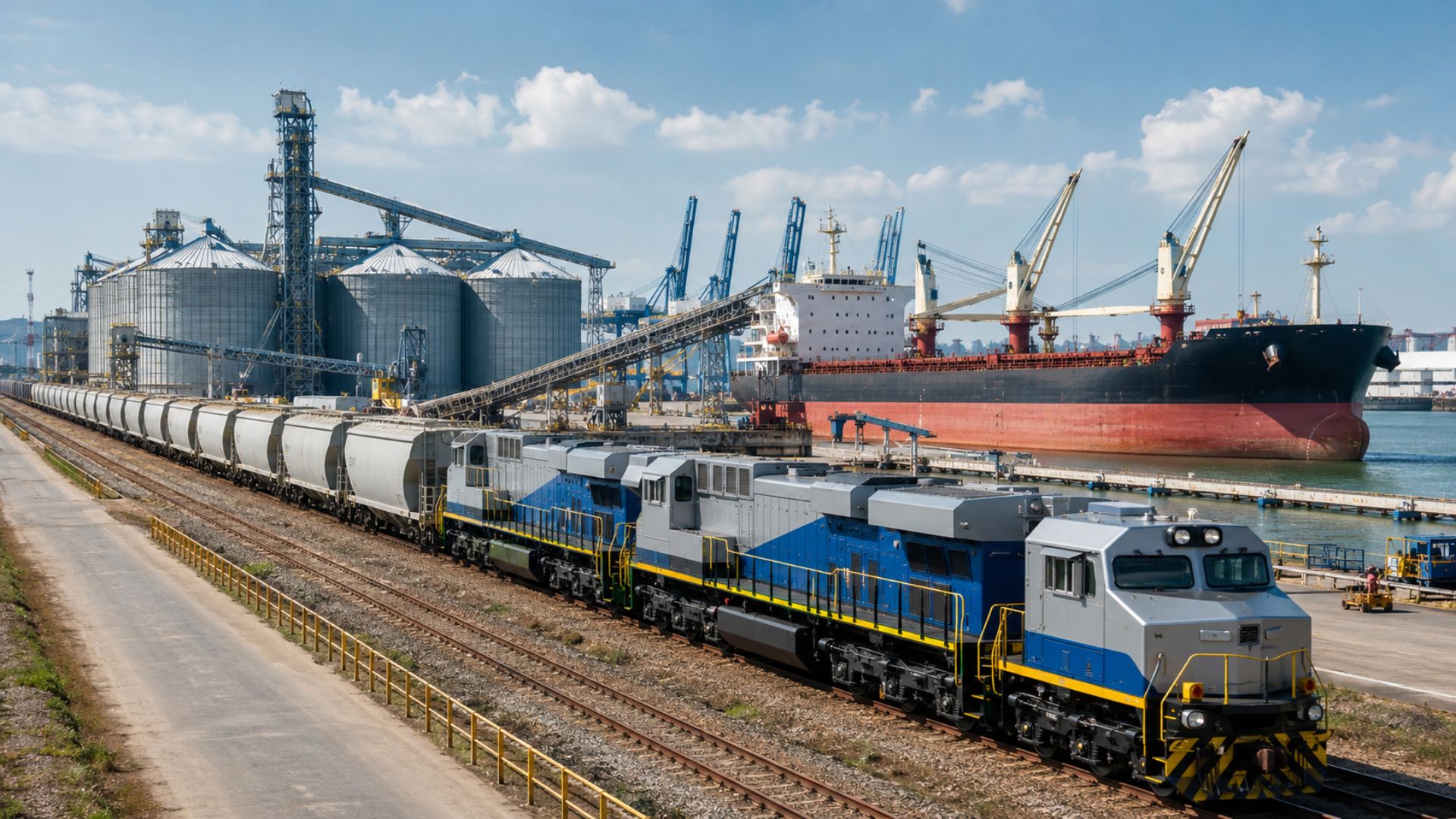

Cofco International, a Chinese state giant and the largest agricultural exporter in Brazil, purchased a package of 23 locomotives and 979 freight wagons throughout 2025 for R$ 1.2 billion. The material will be operated by Rumo and will transport 4 million tons of grains and sugar annually to the Port of Santos starting in 2026.
Cofco International, a state-owned company from China and the largest agricultural exporter in Brazil, completed throughout 2025 an investment package that places the company at a new level in controlling the logistics chain of the national agribusiness. The operation involved the purchase of 23 locomotives and 979 freight wagons for R$ 1.2 billion, an amount that makes the Asian state company one of the largest recent investors in the railway sector aimed at commodity exports. The rolling stock will be operated by Rumo, the largest railway concessionaire in the country, and has a defined mission: to start transporting 4 million tons of grains and sugar from the producing regions to the Port of Santos starting in 2026.
The motivation behind the investment is the so-called logistics verticalization, a strategy that seeks to reduce costs and control all stages of the export process. Instead of relying exclusively on third parties to transport soybeans, corn, and sugar from the Brazilian interior to the Santos docks, Cofco will operate its own locomotives and wagons. According to InvestNews, the move is directly connected to the opening of the STS11 terminal, the company’s third facility at the Port of Santos, which began partial operations in March 2025 and is expected to be fully operational in 2026, increasing the Chinese state company’s capacity at the Santos port from 4.5 million to 14 million tons annually.
The weight of Cofco in Brazilian agribusiness

Cofco International is the second largest grain trader in the world, second only to the American company Cargill. In Brazil, it ranks at the top among agricultural product exporters. The company exported 17 million tons of products in 2024, with a focus on soybeans, corn, and sugar sent to dozens of countries.
-
Ports without drivers and cabins already move containers like automated factories: robotic cranes, autonomous electric vehicles, and software transform giant terminals into 24-hour logistics machines.

-
About 300 American ports still breathe diesel from trucks, cranes, and locomotives, but they are now trying to electrify heavy machinery to clean the air for 31 million nearby residents.

-
A 220-meter giant powered in part by solar energy and lithium batteries has just unloaded nearly 5,000 Chinese cars at the Port of Itajaí. It is the first of ten Grimaldi super ships and the first in the world prepared to run on ammonia as fuel.

-
The Port of SC has just entered the direct route to the largest hubs in Northern Europe with a new line from Maersk, gains a connection with Manaus in 13 days, and is preparing dredging to receive giant ships of up to 16,000 containers.


Only in trade between Brazil and China, the weight of the state-owned company is equally significant. In 2024, Brazil sold 72.5 million tons of soybeans to the Chinese market, and Cofco was responsible for transporting 6.65 million tons that same year. This number represents about 9% of everything that left Brazilian farms to feed the world’s largest soybean consumer, a role played precisely by China.
This volume places Cofco in a strategic position. The company is not just a trader like many others but the direct commercial arm of the main client of Brazilian soybeans. The move to buy locomotives and wagons to transport the production to the Port of Santos reinforces this role of logistical leadership built over the last decade.
How the operation of the new trains will work from 2026

The railway package purchased by Cofco in 2025 includes 23 locomotives and 979 freight wagons, totaling R$ 1.2 billion in investment. The operation will be managed by Rumo, the concessionaire that operates the railway network responsible for much of the grain transportation from the Brazilian Midwest to the coast.
The model foresees that Cofco’s trains will run on Rumo’s lines under the so-called right of passage. The initial goal is to move 4 million tons annually of grains and sugar from the producing regions to the Port of Santos, with effective operations starting in 2026, the year that also marks the full entry of the STS11 terminal.
This volume represents a significant portion of Cofco’s total capacity at the port. The company will transport by rail a significant part of what it intends to ship through the Santos quay, reducing dependence on road transport, which is historically more expensive and exposed to seasonal bottlenecks during the Brazilian agribusiness harvests.
The timeline of investments in the Port of Santos


The purchase of locomotives and wagons is not an isolated move. It fits into a clear sequence of investments by Cofco in the Port of Santos, with defined timelines for the coming years.
The main steps of the plan are:
- March 2025: partial opening of the STS11 terminal, Cofco’s third facility in Santos
- Throughout 2025: purchase of 23 locomotives and 979 wagons for R$ 1.2 billion
- 2026: start of railway operations with Rumo transporting 4 million tons annually
- 2026: full operation of the STS11 terminal, with a capacity jump from 4.5 million to 14 million tons annually
When STS11 is fully operational in 2026, the complex will become Cofco’s largest structure outside China, surpassing even terminals that the state-owned company operates in other countries in Latin America, Africa, and Asia. This leap consolidates Brazil as the main hub of international operations for the Chinese giant outside its home territory.
The capacity jump at the Port of Santos
Currently, Cofco operates with a total capacity of 4.5 million tons annually in Santos, combining two own terminals and the use of third-party facilities. When STS11 reaches full operation in 2026, this total will jump to about 14 million tons, more than triple the current capacity.
It’s worth noting that this increase doesn’t mean the company will export exactly 9.5 million additional tons. Part of the volume will come from reallocating cargo that currently exits through third-party terminals and will move to STS11. The central point is the company’s cost reduction, with more control over the operation and less dependence on third-party suppliers starting in 2026.
This model of vertical integration is a growing trend in global agribusiness. Major traders have realized that merely dominating the purchase and sale of grains is no longer enough to maintain competitive margins. The differentiator lies in controlling logistics, which accounts for between 25% and 40% of the total cost of exporting Brazilian agricultural commodities, according to industry surveys.
China’s presence in Brazilian infrastructure at different times
Cofco’s investment in railways and port terminals is just one piece of a broader mosaic. Other Chinese state-owned enterprises have established positions in different sectors of Brazilian infrastructure over the past years, forming a coordinated presence network that reinforces itself mutually.
Among the main moves by China in Brazil are:
- Since 2018: China Merchants Port Holdings (CMPorts) controls the Paranaguá Container Terminal in Paraná
- In February 2025: CMPorts signed an agreement to purchase 70% of the oil terminal at Porto do Açu in Rio de Janeiro
- In 2024: CRRC won the auction for the Intercity Train between São Paulo and Campinas, in consortium with the Brazilian company Comporte
- In October 2025: CRRC began operating the train factory in Araraquara, previously owned by South Korean Hyundai Rotem
- State Grid controls CPFL, responsible for 15% of electricity distribution in Brazil
- China Three Gorges (CTG) is responsible for 3.5% of Brazil’s electricity generation
This set of operations forms a network of Chinese presence that encompasses logistics, energy, transportation, and commodity exports, configuring a model of long-term economic integration between the two countries. The entry of Cofco into the Brazilian railway sector follows the same logic of this broader movement.
The impact on the Brazilian railway sector
For Brazil’s railway sector, the arrival of Cofco as a rolling stock operator has a direct effect starting in 2026. Rumo, which will operate the trains of the Chinese state company, gains a significant captive client, with a guaranteed volume of cargo for the coming years. The operation reinforces the Brazilian company’s leadership in grain transportation to ports.
The model also signals a path for other large traders. If Cofco’s operation proves successful in reducing costs and increasing predictability in the coming years, it is likely that other agribusiness giants, such as Cargill, Bunge, and Louis Dreyfus, will consider similar moves to acquire their own locomotives and wagons for crop transportation.
The effect on road transportation also deserves attention. Every 4 million tons that migrate from road to rail starting in 2026 means removing tens of thousands of truck trips from Brazilian highways, reducing congestion, road wear, and greenhouse gas emissions associated with road transport.
What changes in Brazil-China trade starting in 2026
China is, without dispute, the most important destination for Brazil’s agricultural exports. About 80% of Brazilian soybeans are shipped to Chinese ports, and the trend is for this percentage to increase in the coming years, with the growth of Asian demand.
When Cofco’s set of investments in Brazil is fully operational in 2026, the company will have a much greater capacity to serve the Chinese market with predictability and controlled costs. The coupling between Rumo’s railways, the Santos terminals, and the ships crossing the Pacific will become a more fluid mechanism, reducing risks of logistical bottlenecks that historically affect Brazilian exports during peak harvests.
The model also reduces China’s vulnerability concerning intermediary suppliers. Instead of relying exclusively on American Cargill or other Western giants to move Brazilian soybeans, Beijing now has a logistics chain controlled by a government-owned company, with a direct presence in Brazil’s main producing regions.
The acquisition of 23 locomotives and 979 wagons by Cofco, completed throughout 2025, confirms a long-term strategy of China’s state-owned companies in Brazil, focusing on controlling critical stages of the export logistics chain. The start of operations in 2026 will mark a new phase in Brazil-China trade, with even greater integration between the two economies.
And you, what do you think about this expansion? Do you believe that the presence of China’s state-owned companies in Brazilian infrastructure benefits the country in the long term? Do you think the national agribusiness gains competitiveness with investments like this starting in 2026? Leave your comment, share your opinion, and tag someone who follows the sector.