Portuguese
  Spanish


In the video from the Recanto Curicaca channel, with over 137,000 views, Rui shows the internal channels of the masonry heater, the mistakes he made in the construction, and the thermometers proving 21.7°C inside the house with 3.7°C outside
The Russian stove came out of old manuals and entered a wooden house in southern Brazil, and the result is measured in a video published on June 20, 2026, on the Recanto Curicaca channel on YouTube. In it, Rui presents the masonry heater he built with his own hands: burning 15 kg of wood in a single batch, the structure keeps the 90 m² house heated throughout the entire night and much of the next day.
The detail that changes everything is the mass. According to the Recanto Curicaca channel, 430 bricks were used just in the heat accumulation part, a structure of more than a ton that absorbs the heat from the fire and slowly returns it to the house for hours, even after the wood turns to embers.
The house that was designed to retain heat
Rui opens the video with a warning that shatters the expectation of a magical solution: most of the heat stored in the stove needs to stay inside the house, and its construction was made to ensure this. The house is made of wood, with double and thick walls, elevated from the cold ground, thick wooden flooring, sealed doors and windows, and wooden sub-roofing.
-
U.S. Farmer Tackles $4 Million Water Issue by Installing Hundreds of Miles of Drainage Pipes to Protect Farm Profits

-
Two-Person Team Builds Entire House from Scratch in Just 3 Days Using Low-Cost Materials, Documenting Every Step on Video
-
New Anti-Humidity Paint Reduces Mold and Fungus by Controlling Condensation, Enhancing Indoor Protection and Paint Durability Without Major Renovations

-
Polystyrene Panel Technique Goes Viral for Tackling Household Mold and Persistent Dampness


The most surprising thing is what it doesn’t have: no industrial insulation, neither fiberglass nor rock wool, just wood and air, according to the Recanto Curicaca channel. Rui also touches on a national mystery: with very few exceptions, the way of building houses in Brazil is the same from north to south, and thus those who live in the heat suffer and those who live in the cold do too.
The hidden channels through which the heat travels
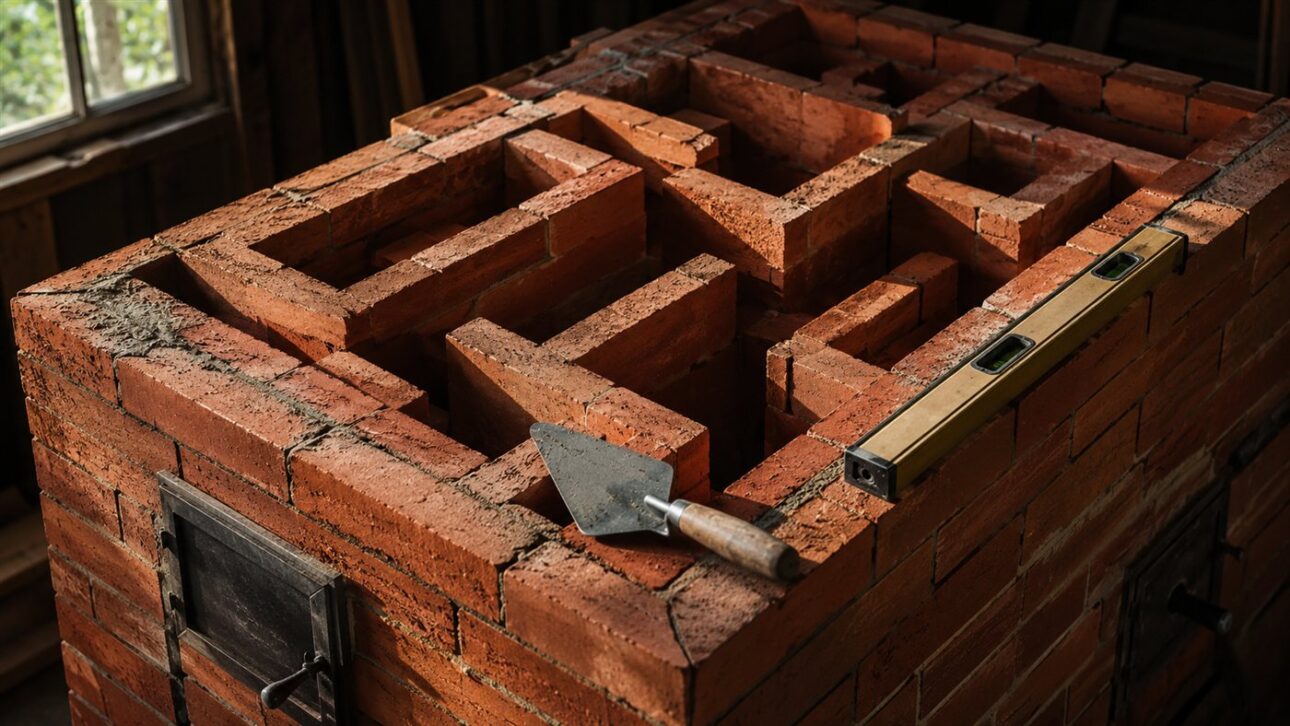
What no one sees in the ready Russian stove is precisely its secret: the internal channels. As the Recanto Curicaca channel shows in the work, the heat exits the furnace, travels through a sequence of channels formed by bricks and loose structures, and only then escapes through the chimney, delivering energy to the masonry at every turn of the path.
Rui’s version even has more channels than the large model in the manual. Once you understand how the channels are made, the quantity is up to the builder, he explains in the video. The base was made with stones and cement, outside the house’s floor, with a brick support filled with sand, and the stove occupies practically the center of the plan, to avoid wasting heat warming a wall facing outside.
A month of work in the hands of someone who had never laid a brick
The most inspiring part of the story is the builder’s inexperience. Rui admits he had very little masonry experience, so he assembled the entire stove dry, row by row, numbered all the pieces, dismantled everything, and only then reassembled with mortar.
The work took about 1 month, between checking the square and plumb and correcting errors. Someone with masonry experience, he assures in the video, would build the same stove in a few days. The main material was common solid bricks, with refractories only at the base of the furnace, the base of the oven, and in one of the channels, and even the crooked and out-of-standard bricks were used in the wall.
The mistakes he confesses: refractory mortar and manual brick
The video is worth gold for the admitted mistakes. The refractory mortar used in some points cracked or came loose already on the first fire, even mild; where Rui applied the mixture of cement, sand, and sugar, the result was better. And the golden rule he learned: the thinner the layer of mortar, the less chance of cracking, which was difficult with irregular bricks.
The other regret was following the manual’s measurements before choosing the bricks. If he were to build again, he would first select the material, assemble two test rows, and only then adjust the dimensions, cutting far fewer pieces. The cracks that remained, he assures, do not compromise either safety or efficiency.
The thermometers don’t lie: 21.7°C inside, 3.7°C outside
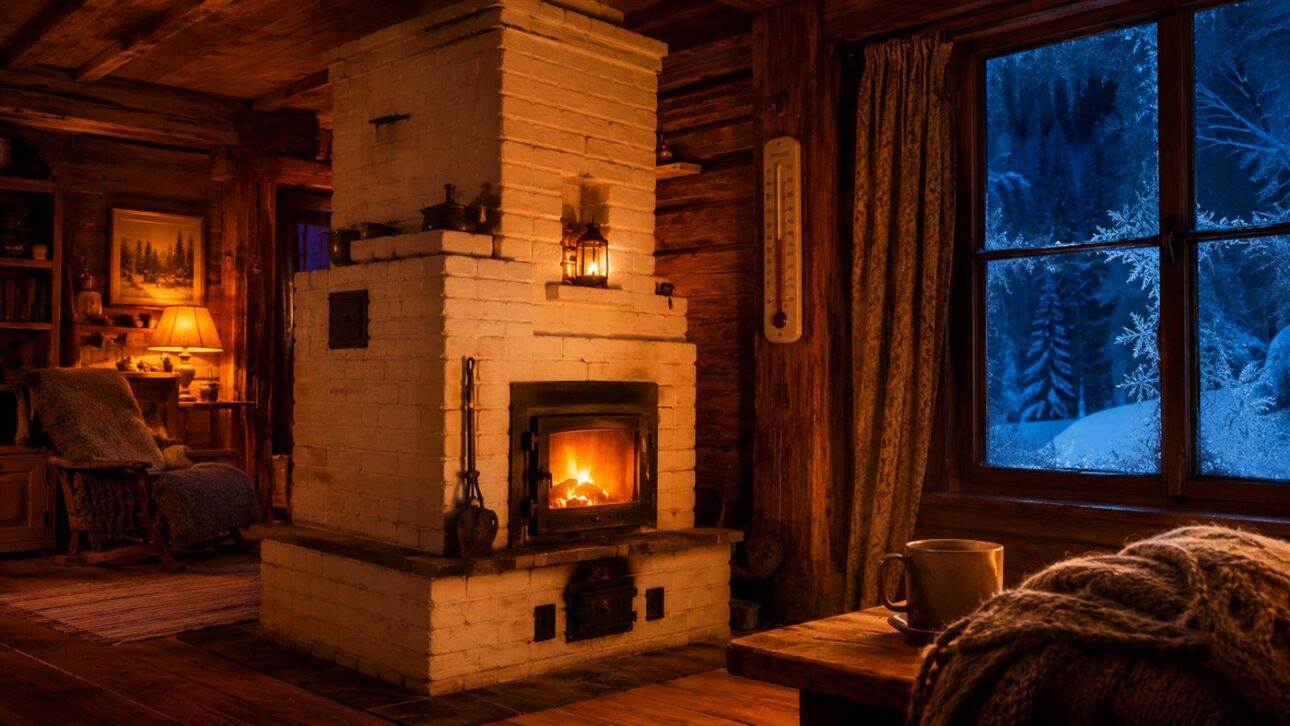
The performance test comes in numbers, with date and time. According to the Recanto Curicaca channel, on June 16, at 9:17 PM, the thermometer read 23.7°C rising indoors and 8.4°C dropping outside. The next morning, on the 17th, at 5 AM, there was still 21.7°C inside compared to 3.7°C outside.
On the wall of the greenhouse itself, the measurement reached 42.6°C and continued to rise, with points where you can’t touch it. The greenhouse takes about 2 hours to heat up, and after that, the couple extinguishes the fire before going to sleep, closes the air intake and the chimney damper, and the masonry continues to radiate heat all night long. The feeling, Rui describes, is like entering a place where the heat envelops the body, like being in the sun, without the classic problem of the wood stove heating the back and chilling the chest.
Cast Iron Door, Bread Oven, and Chimney Above the Ridge
The local adaptations are the most technical part of the video. Instead of the steel door suggested by the manual, which warps with prolonged heat, Rui found a cast iron door measuring 34 by 26 centimeters, a material that does not deform, and repeated the size for the oven door.
Yes, there is an oven: pushing the embers into the compartment, there is plenty of leftover heat to bake bread and make stews, an optional feature he decided to include because an oven is always useful. The chimney, ordered in a non-return model, rises about 1.10 meters above the ridge and does not return smoke even with strong wind, installed on a concrete slab instead of the steel plate from the manual. The firebox, almost 1 meter deep, swallows irregular wood and large pieces, without requiring fine cutting.
What the Russian Greenhouse Demands in Return
Not everything is a fairy tale, and the video does not hide it. Like all wood-burning equipment, the greenhouse requires periodic cleaning of the chimney and smoke ducts, with access points that usually require disassembling some part, and the interval depends on the wood: resinous wood gets dirty faster.
The strong heat also dries the air. The couple sleeps with the bedroom doors closed, keeping the sleeping environment about 5°C cooler and with humidity around 70%, an arrangement that combines thermal comfort in the living room and breathable air in the bedroom. The coil for heating water was possible, but Rui gave up on the weight of the water tank and boiler in the attic.
The Centuries-Old Technology That Cold Brazil Ignores
The conclusion of the video is a provocation. Nothing there is a new invention: the Russian greenhouse project is public, the manual is available, and Rui repeats that he wasn’t a bricklayer when he started and maybe still isn’t. Such a greenhouse can serve two floors and even be attached to a stove.
Even so, a simple, cheap, and proven solution in cold regions of the world remains practically unknown to much of those living in the Brazilian cold, where the Southern winter punishes houses built to the same standards as in the Northeast. The 430-brick greenhouse at Recanto Curicaca serves as a reminder: the problem of cold inside the house in Brazil is not a lack of technology, it’s a lack of information.
Watch the Russian greenhouse from the inside on video
The complete construction, from the hidden internal channels to the thermometers measuring performance on a chilly night, is on the Recanto Curicaca channel on YouTube.


After seeing 15 kg of firewood heat 90 m² all night, the question arises: why does Southern Brazil, which dresses for winter every year, still build houses as if living in an eternal summer? Tell us in the comments: would you build a Russian greenhouse in your home?