Portuguese
  Spanish


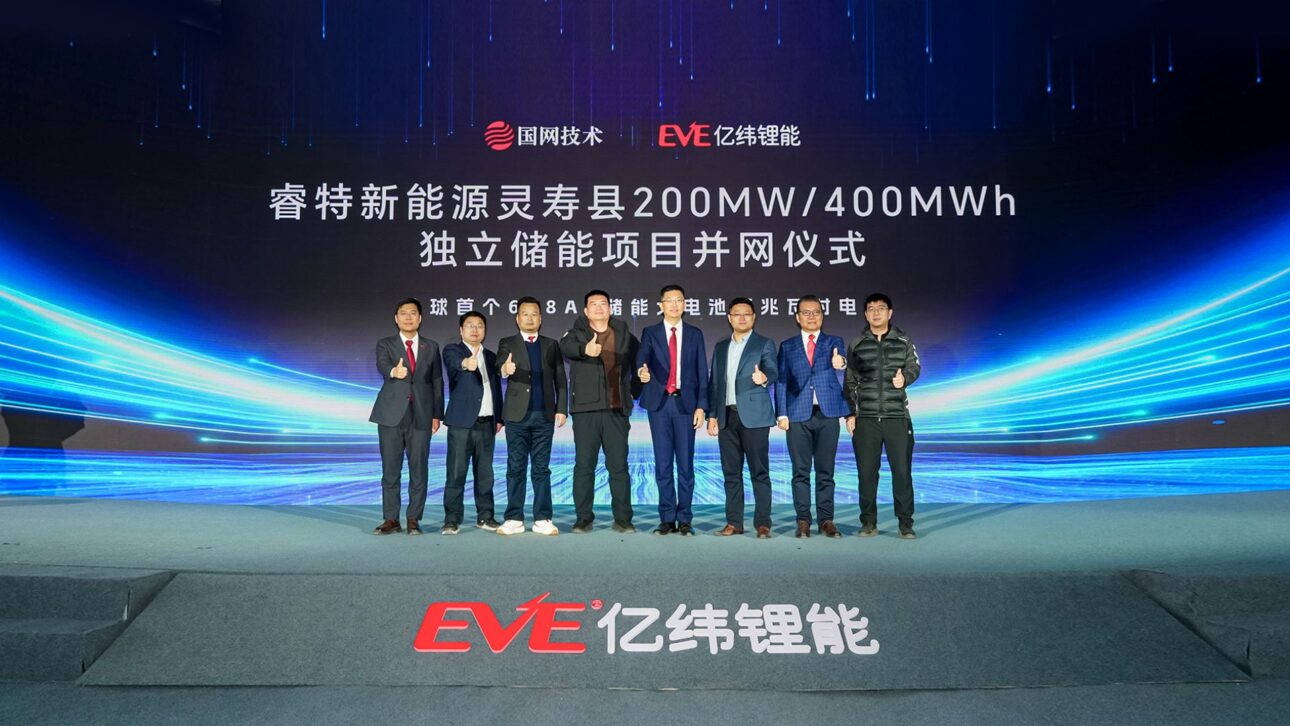
In January 2026, China put into operation a 400 MWh energy storage station equipped with ultra-large 628 Ah batteries, the largest ever used on a real network scale. EVE Energy, the responsible manufacturer, left the ceremony with an additional strategic contract of 10 GWh in hand.
On January 31, 2026, China connected to the power grid a facility that did not exist on a real scale anywhere else in the world. The independent 200 MW and 400 MWh energy storage station of the Ruite New Energy Lingshou project went into operation using ultra-large 628 Ah battery cells, an unprecedented capacity per cell in network deployment, according to an official statement from EVE Energy, the Chinese manufacturer responsible for the development and supply of the system.
At the same ceremony, China took another step. Beijing Guowang Power Technology and EVE Energy signed a strategic cooperation agreement for an additional supply of 10 GWh in large-scale battery systems. The number represents ten times the capacity of the newly inaugurated station and signals that what was tested in Lingshou is expected to be replicated on a much larger scale. The technology has come off the drawing board. The question now is the speed at which it will spread.
What makes this station different from everything that came before
What differentiates Lingshou is not just the total size, but the individual component used to get there.
-
Australia deploys poisoned sausages and uses traps, shooting, and fences in a battle against invasive cats that kill over 1.5 billion native animals annually, threatening more than 200 species.

-
NASA Rover Captures “Tired Face” on Mars, Highlighting Human Brain’s Tendency to See Faces in Rock Formations

-
Ancient Stone City in the Desert, Once Home to 30,000, Puzzles Scientists with Nabateans’ Water Mastery 2,000 Years Ago

-
Ancient Creature Thought Extinct Since Dinosaur Era Reappears, Baffling Scientists




The 628 Ah cells are called ultra-large because each one stores an amount of energy per unit much higher than what was commercially available until recently.
The larger the individual cell, the fewer connections, cables, and components need to be integrated to assemble the system, which reduces points of failure and cost per unit of stored energy.
The station features 80 sets of the storage system called CC Mr. Giant, each with 5 MWh, in addition to 40 sets of integrated conversion and power elevation cabins, as detailed by EVE Energy in the official statement.
The project integrates what the company describes as a minimalist integration philosophy: fewer components, more intrinsic safety, longer lifespan.
The logic is simple, but executing it on a network scale is something no manufacturer had achieved before with cells of this capacity.
EVE Energy and the Three Pioneering Achievements it Claims
EVE Energy is one of the most active lithium cell manufacturers in China and has built its positioning in the high-capacity segment with a sequence it describes as three pioneering achievements: first to announce the product, first to mass-produce, and first to deploy on a real network scale.
The three steps were taken in a relatively short sequence, which is uncommon for storage technologies that usually take years between announcement and field validation.
As of the date of the statement, EVE Energy’s accumulated production of high-capacity cells had exceeded 1 million units, according to the company itself.
This number serves as an argument for maturity: it is not a laboratory product nor a unique prototype installed for demonstration.
It is a cell that has already gone through the series manufacturing process and now has its first documented deployment on a network scale. The difference between the two stages is where many energy technologies stall.
What is LCOS and Why it Matters to the Sector
One of EVE Energy’s central arguments for justifying the ultra-large cell technology is the optimization of LCOS, an acronym for Levelized Cost of Storage.
The indicator measures the total cost of storing and dispatching a megawatt-hour of energy over the lifespan of a system, taking into account the initial cost, charge and discharge efficiency, degradation over time, and maintenance costs.
It is the metric that defines whether a storage system is economically viable to operate on a network.
Larger cells tend to reduce LCOS because they decrease the number of auxiliary components needed and increase the energy density per square meter of installation.
EVE Energy claims that the innovations of the system deployed in Lingshou, including the internal stacking process and the use of high-strength separators, enhance intrinsic safety and contribute to the longevity of the cells.
If the lifespan numbers are confirmed in real operation, the economic argument for large-scale adoption becomes much easier to sustain.
Guowang and EVE: from client and supplier to strategic partners
Beijing Guowang Power Technology is not just any company in the Chinese energy sector. It is described in the statement as a central force in the country’s energy infrastructure, which, in the Chinese context, indicates a company closely linked to the state’s energy planning structure. Signing a strategic 10 GWh contract by this type of organization acts as an endorsement with a different weight than a common commercial order.
Zhou Ziguan, chairman of the board of Guowang Technology, stated at the ceremony that the Lingshou project validates the advantages of large-scale batteries to improve the economy of power plants and grid support capacity, according to the EVE Energy statement.
The relationship between the two companies, according to the document, has shifted from executing occasional projects to being described as symbiotic and long-term.
In the energy sector, this type of early commitment to future volumes acts as market protection for both sides.
400 MWh: what this number means in practice
Four hundred megawatt-hours is a unit that may seem abstract but has concrete references. A medium-sized Brazilian city, with 200,000 to 300,000 inhabitants, consumes something between 300 and 600 MWh per hour during peak periods, depending on the industrial and climatic profile.
A 400 MWh station would not power this city indefinitely, but it could cover a critical coverage period during generation failure or peak demand, precisely the function that grid-scale storage systems are designed to fulfill.
The role of such stations is to complement intermittent renewable sources, such as solar and wind, which generate when the sun shines or the wind blows, not necessarily when demand is highest.
A robust storage system breaks this time dependency: energy generated at the wrong time can be stored and dispatched when the grid needs it.
This function transforms energy storage from an accessory into a central piece of the energy transition.
What China signals to the world with Lingshou
China already dominates lithium cell production in volume.
What Lingshou adds to this dominance is another layer: the validation of a more advanced technological generation in real network operation, ahead of any relevant competitor.
The EVE Energy statement explicitly mentions the ambition to consolidate capabilities in global manufacturing, global cooperation, and global service.
These are corporate words, but they describe a real trajectory of international expansion that is already happening in other segments of China’s energy sector.
For countries planning to expand grid energy storage, including Brazil, which has energy transition goals and growing solar and wind capacity, what was installed in Lingshou is a reference for where the technology has reached.
The question that will remain open in the coming years is whether the technical advancement will remain concentrated in China or if it will spread through partnerships, exports, and technology transfer.
The answer to this question has implications that go far beyond the electric sector.
Is China consolidating a technological advantage in energy storage that other countries will struggle to reach, or will this technology quickly spread around the world? Should Brazil seek partnerships in this area or invest in its own development? Leave your opinion in the comments.