Portuguese
  Spanish


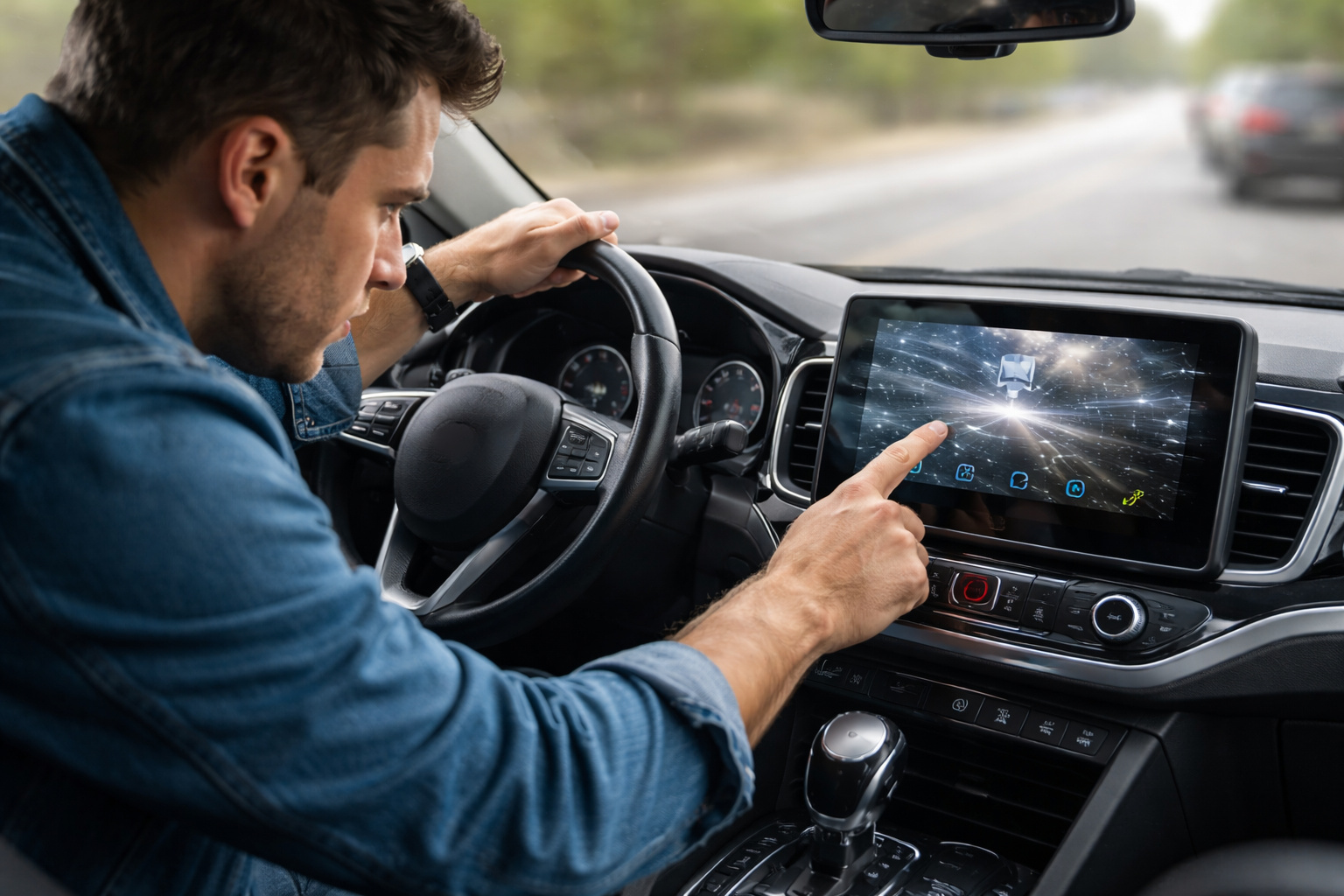

Recurring problems in multimedia centers reveal technical limitations, design decisions, and direct impacts on drivers’ routines
A significant change has occurred in the automotive sector in recent years, with the popularization of multimedia centers in cars sold in Brazil, attracting the attention of increasingly demanding consumers.
These systems have ceased to be luxury items and have begun to concentrate essential driving functions, bringing together commands and information in a single interface.
This technological advancement has expanded features and connectivity but has also highlighted important limitations in various models available on the market.
The current scenario shows that, despite the evolution, performance, design, and integration failures still directly affect the driver’s experience.
Technical criteria reveal what defines a good multimedia center
The quality of a multimedia center depends on a set of technical factors that determine its efficiency in everyday use.
The hardware serves as the system’s foundation and ensures quick response to commands and stability in connections with external devices.
The screen needs to offer good brightness, an adequate viewing angle, and touch sensitivity, allowing for smooth navigation even while in motion.
The software should organize functions intuitively, with clear icons and direct access, avoiding distractions during driving.
Slow response compromises the driver experience
Slow response is one of the most frequent problems in multimedia centers available in the Brazilian market.
Some systems have difficulty recognizing commands or establishing connections with smartphones, which compromises usability.
Models from Stellantis, especially vehicles from Citroën, illustrate this scenario with noticeable delays in operation.
This behavior forces the driver to repeat actions, reducing practicality and increasing frustration during use.
-
Turbocharged Engines with Direct Injection: Why High-Performance Engines Over 130 HP/Liter and Turbines at 200,000 RPM Challenge Durability

-
Chevrolet’s Parent Company to Invest Billions in Brazil to Modernize Factories, Update Cars, and Accelerate Hybrid Launch by 2028

-
Practical Driving Tests in Brazil Surge by 23.5%, Exceeding 2.2 Million by 2026, as New Rules Make the Process Cheaper and Simpler
-
Brazil’s Lula Government Allocates $463 Million Quota for Electric Car Parts, Waives Import Tax Until December, Sparking Competition Among BYD, Automakers, and Unions as Consumers Question Impact on Prices and Local Industry


Low resolution of cameras reduces function efficiency
The quality of cameras has become essential with the advancement of embedded technologies in vehicles.
Even so, some models still present images with lower definition than expected for the category.
Vehicles like the Toyota Corolla Cross and the Honda City offer rear cameras with low resolution, which limits visibility.
This contrast becomes evident against competitors that already use more modern and detailed systems.
Screen size directly influences usability
The screen size is a determining factor for the experience with the multimedia center.
Simpler models tend to have smaller screens, which is expected within the vehicle’s proposal.
In more expensive vehicles, however, the size limitation compromises navigation and access to functions.
The Jeep Renegade, for example, had a small center for years, later updated with a larger screen.
The Nissan Kicks also received criticism for having reduced dimensions.
In contrast, the BYD Seal features a 15.6-inch screen, considered excessively large, without proportional gains in functionality.

Absence of physical buttons increases risks during driving
The minimalist design has gained space in automotive interiors, reducing the presence of physical buttons.
This change, although aesthetic, makes quick access to essential functions during driving more difficult.
Adjustments like air conditioning temperature and mirror settings now depend on digital menus.
This process requires more attention from the driver and increases the risk of distractions.
Regulatory bodies in Europe and China have begun to demand the return of these physical controls.
The Euro NCAP program has started to consider this criterion for vehicle safety evaluation.
Excess of menus makes the system less practical
The technological evolution has expanded the number of functions available in multimedia centers.
This increase has brought complexity and made navigation slower in some models.
The Leapmotor C10 exemplifies this problem by requiring multiple steps for simple adjustments.
The need to navigate through different layers of menus reduces practicality and compromises the experience.
Invasive cameras interfere with navigation
Driver assistance systems have brought new safety features to modern vehicles.
In some cases, however, these technologies interfere with the display of main information.
Side cameras may automatically appear on the screen and overlay the navigation map.
This behavior is observed in models like the Haval H6.
Some systems allow this function to be disabled, which reduces interference during driving.
Lack of integration with Android Auto and Apple CarPlay limits usage
The integration with smartphones has become one of the main requirements in multimedia centers.
In recent years, several models have arrived in Brazil without complete support for Android Auto and Apple CarPlay.
According to data from Statista released in 2023, about 80% of Brazilians use the Android system.
The absence of this compatibility directly impacts the user experience.
Models like GAC GS4 and Geely EX5 present this limitation.
On the other hand, Volvo offers direct integration with applications in vehicles like XC60 and EX90.
Impact of Failures in the Automotive Market
The evolution of multimedia centers accompanies the technological transformation of the automotive industry.
Consumers have begun to demand faster, more intuitive systems that are integrated into their digital daily lives.
Failures in these systems directly influence the perception of vehicle quality.
Design and technology decisions impact not only comfort but also safety while driving.
Multimedia centers continue to evolve, but they still present significant limitations; is technology being applied in a truly efficient way to improve the driver’s experience?