






 Portuguese
  Spanish


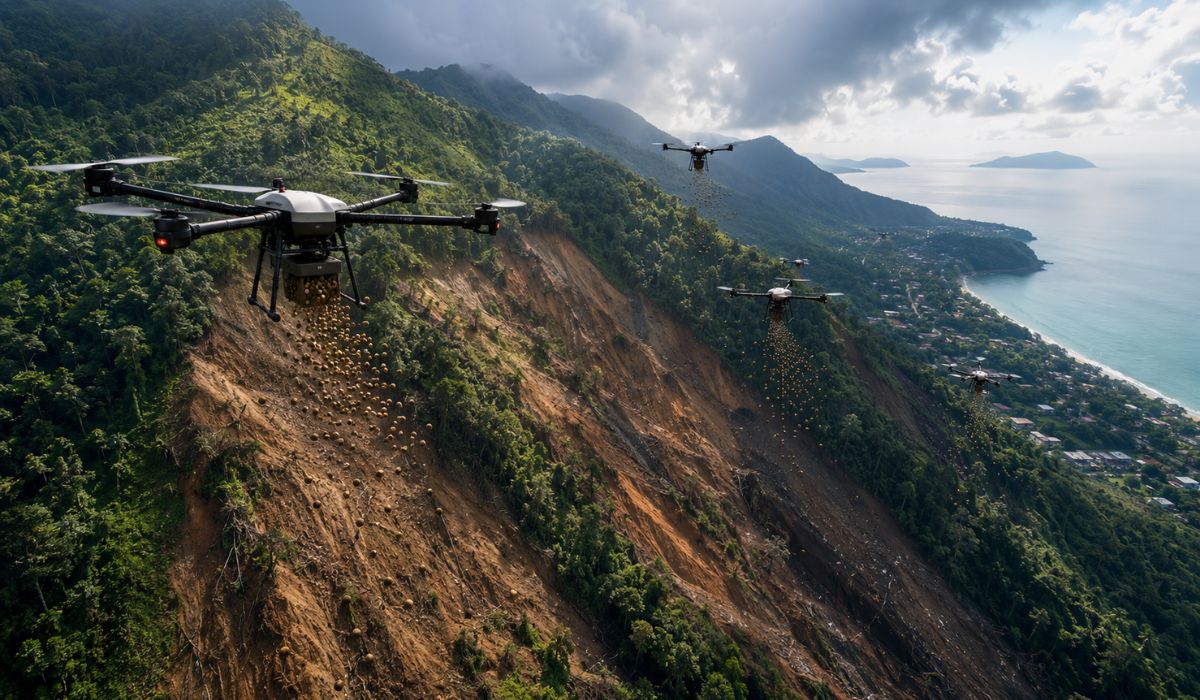

Recent monitoring indicates the advancement of vegetation cover on the slopes of São Sebastião, where drones released native Atlantic Forest seeds in areas affected by landslides on the northern coast of São Paulo.
The most recent monitoring of the North Coast Restoration Project indicates that 79.6% of the restored area in São Sebastião already shows native vegetation cover, according to a report released by the Coastal Conservation Institute.
The assessment was conducted during the 7th monitoring campaign and covered 203.39 hectares of slopes affected by landslides, where drones released native Atlantic Forest seeds to accelerate regeneration in hard-to-reach areas.
The result updates the work started after the extreme rains that hit the northern coast of São Paulo in February 2023.
-
NASA’s Plan to Dump ISS Debris in Ocean Sparks Environmental Concerns Among Scientists

-
14-Year-Old Invents Eco-Friendly Water Pump Using Recycled Materials to Aid Communities Without Water Access
-
Pigeons Trained to Detect Cancerous Changes in Medical Images Astonish Scientific Community

-
Plastic Waste from Beaches and Poor Communities in Kenya Transformed into School Desks, Replacing Wood in Classrooms and Turning Marine Litter into Durable Study Tables


During that period, the landslides left scars on the slopes of the South Coast of São Sebastião, especially in areas like Vila Sahy, and prompted the use of technologies such as biodegradable biocapsules, biomats, hydroseeding, and aerial seeding by drones.
The action spread about 134 million native Atlantic Forest seeds over an area of approximately 203 hectares, equivalent to more than 280 soccer fields, within the North Coast Restoration project.
The initiative combines ecological restoration techniques with erosion control measures on slope areas.
According to the Government of São Paulo, the goal is to restore vegetation in steep sections, reduce soil exposure, and monitor the response of native species in locations where access by ground teams is limited.
Drones deliver seeds to slopes affected by landslides
The operation was directed at the so-called “scars” left by the landslides.
These marks appear on the slopes after the displacement of soil, rocks, and vegetation, especially in areas like Vila Sahy, one of the regions most affected by the storm.
According to information released by the Government of São Paulo and the Coastal Conservation Institute, more than 2,000 drone flights were conducted during the process.
The aircraft released almost 1.5 tons of biocapsules in about 850 areas affected by landslides, including steep, unstable, or access-considered risky points.
The technique works like targeted aerial seeding.
Instead of manually planting seedlings at each point, drones distribute capsules with seeds and compounds that aid in fixation and germination.
With this, the intervention reaches extensive areas and sections where fieldwork would require more time and greater exposure of teams.
The biocapsules used in the project were developed by Ambipar, according to the Coastal Conservation Institute.
The material reuses waste from the pharmaceutical industry and biodegradable components, as well as ecosoil, a conditioner made with organic waste linked to the cellulose and biomass chain.
The composition was created to protect the seeds and provide initial conditions for germination in exposed areas.


Native species help in the regeneration of the Atlantic Forest
The recomposition of a degraded area usually starts with pioneer species.
These are plants capable of developing under greater sun exposure, in poorer soils, and in places with little vegetation cover, according to principles adopted in forest restoration projects.
In São Sebastião, species such as guapuruvu, embaúba, and crindiúva were prioritized, along with other native trees of the Atlantic Forest.
These plants are used in regeneration processes as they help in forming shade, accumulating organic matter, and creating conditions for the arrival of other species over time.
The recovery of the forest occurs in stages.
First, the vegetation cover reduces the direct exposure of the soil to rain.
Then, roots, leaves, and organic matter begin to modify local conditions, favoring the presence of new organisms and other plants, as the process of ecological succession advances.
Up to the most recent phase officially announced, about 203 hectares had been reforested in nine seeding campaigns.
With the new monitoring, the Coastal Conservation Institute reported that 79.6% of the restored area has native vegetation cover.
The index exceeds the expectation previously announced by the São Paulo government, which predicted 60% of the area affected by landslides covered by native vegetation by 2026.
Vegetation cover reduces soil exposure in risk areas
The storm in February 2023 put the South Coast of São Sebastião at the center of discussions about extreme events on the São Paulo coast.
In 24 hours, the municipality recorded 683 millimeters of rain, a volume associated with more than 800 landslide points in different regions.
When a hillside loses vegetation cover, the soil becomes more exposed to the impact of water.
The rain can carry away particles, create grooves, remove nutrients, and increase instability in already weakened areas.
For this reason, technicians treat vegetation recovery as one of the response fronts, alongside construction works, monitoring, Civil Defense actions, environmental research, and territorial planning.
In addition to seeding by drones, the Forest Foundation applied biomats and bioretainers on 3 hectares of slopes.
These materials are used to help retain the soil while the vegetation establishes itself.
The investment reported by the Forest Foundation for stabilization and erosion containment actions reached R$ 908 thousand.
The seeding stage was completed in November 2024 and entered the monitoring phase.
In this phase, technical teams check which species germinated, where there was the most advancement of vegetation cover, and which points still require monitoring or new interventions.
The monitoring should also indicate, based on field data, whether the vegetation recomposition helps reduce erosive processes on the slopes of the South Coast.
The evaluation is necessary because soil behavior depends on factors such as slope, type of terrain, intensity of rainfall, drainage, and level of vegetation regeneration.

Restaura Litoral Norte Project brings together public agencies and supporters
The Restaura Litoral Norte is carried out by the Coastal Conservation Institute, with sponsorship from Concessionária Tamoios, Gerando Falcões, and a network of private supporters.
The project also has the support of agencies such as the Federal Public Prosecutor’s Office, São Paulo Public Prosecutor’s Office, Cetesb, Secretariat of Environment, Infrastructure and Logistics, Forest Foundation, São Sebastião City Hall, Atlântica Environmental Consulting, and Ambipar Group.
The executive director of the Coastal Conservation Institute, Fernanda Carbonelli, stated that environmental recovery goes beyond reforestation.
According to her, the project is an opportunity to “rebuild stories, protect lives, and strengthen communities.”
The statement also highlighted the integration between technology, science, and climate education.
The Environmental Research Institute worked on actions following the landslides, providing technical support to Civil Defense, residual risk analysis, and surveying affected areas.
Among the measures cited by the São Paulo government is the classification of affected housing, used to guide interdictions, monitoring, and preventive removals when necessary.
In the educational area, the work included contingency plans, training, and guidance actions in schools.
The strategy, according to the institutions involved, seeks to enhance the response capacity of the local population in communities exposed to heavy rains, landslides, and other climate-related events.
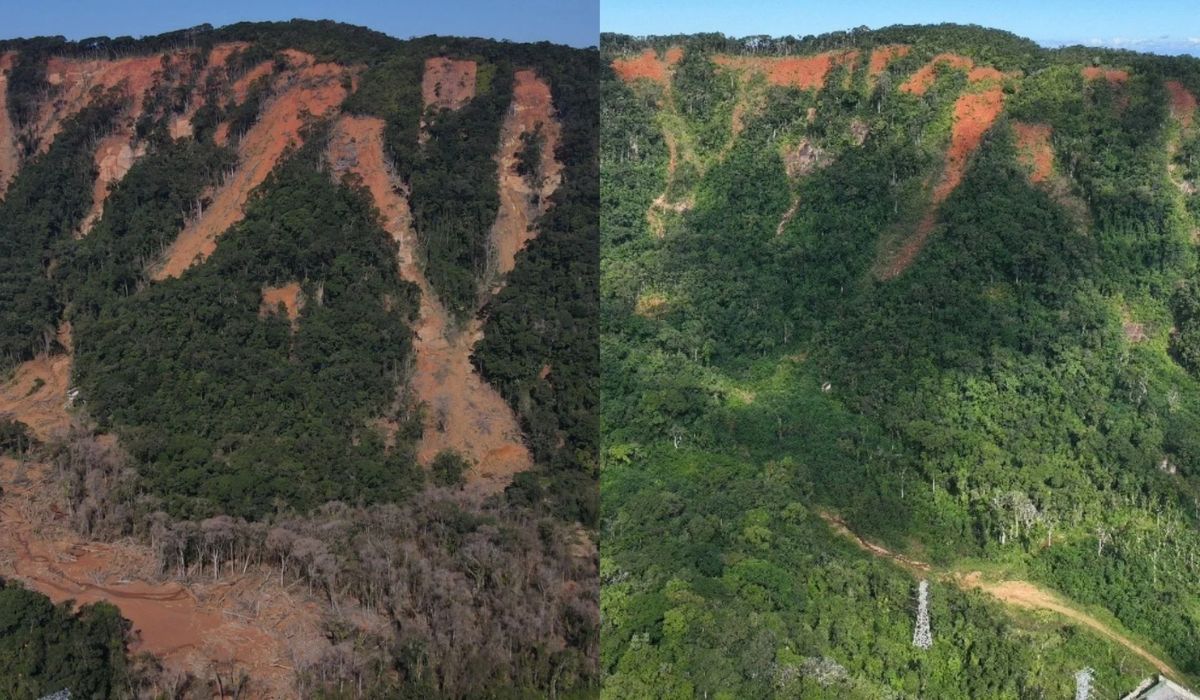
Monitoring follows the result of drone seeding
The project combines a recent technology with natural regeneration processes.
The seeds follow the dynamics of forest restoration but are launched by aerial equipment, protected by biodegradable material, and monitored by technical teams during the post-seeding phase.
This combination allows testing, on a scale, restoration techniques in areas where the terrain makes human access difficult.
It also helps gather information on the performance of native seeds on tropical, humid slopes subject to heavy rainfall.
In the Serra do Mar, the recomposition of the Atlantic Forest does not depend solely on the dispersal of seeds.
The result requires continuous monitoring, erosion control, community participation, and technical adjustments according to the response observed in the field.

The data collected during the monitoring should guide new stages of the project and indicate which methods performed best in the affected areas.
For restoration specialists, this type of monitoring is necessary because the recovery of a slope involves both the return of vegetation and the stability of the soil over time.
With drones capable of delivering millions of seeds to areas where human access is limited, technology becomes part of initiatives for the recovery of degraded areas and the preparation of municipalities for extreme climate events.


