Portuguese
  Spanish


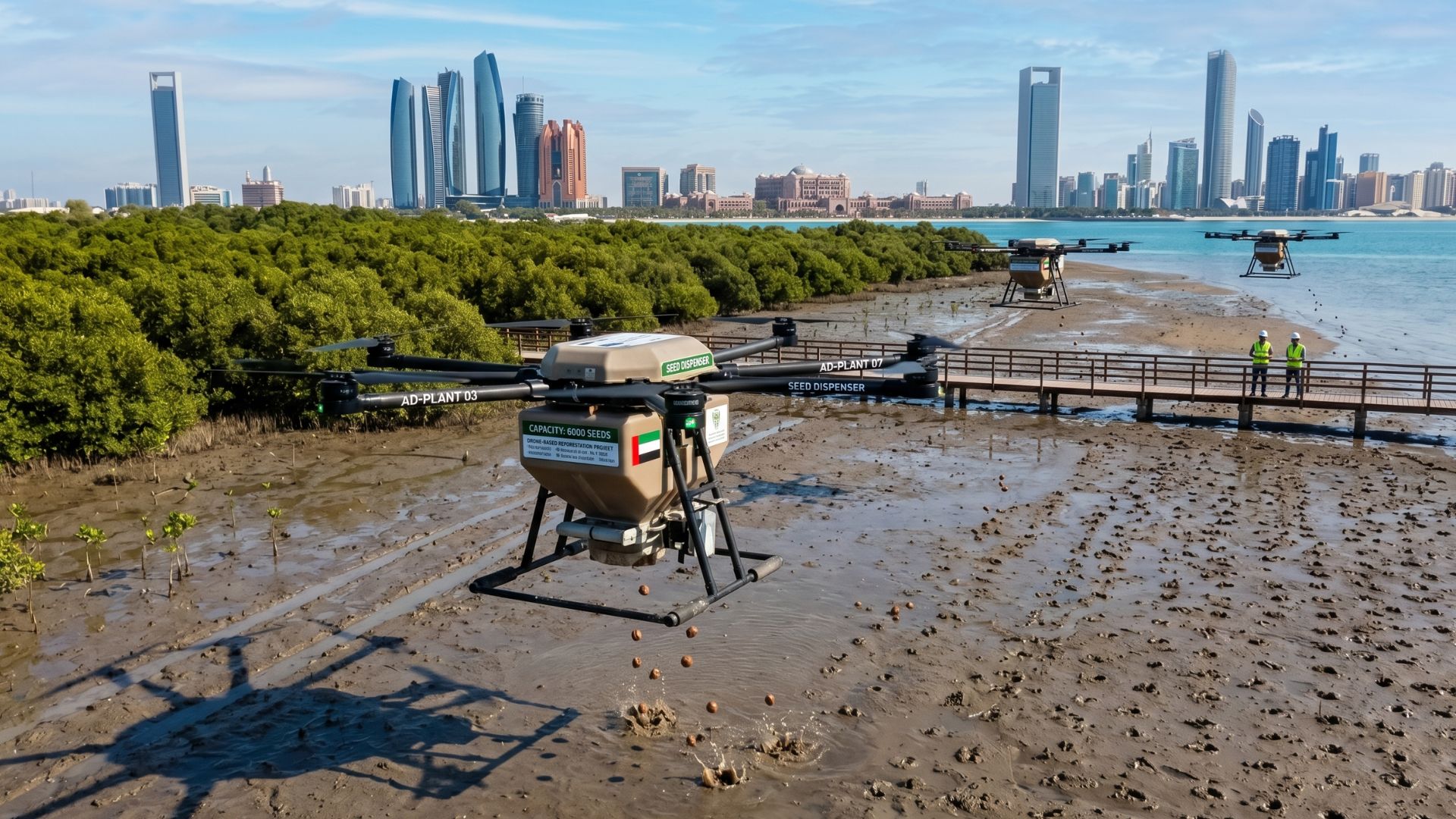


Emirates use drones to launch mangrove seeds in Abu Dhabi and accelerate the goal of 100 million trees by 2030.
In Abu Dhabi, in the United Arab Emirates, adapted drones are launching mangrove seeds over tidal coastal areas to accelerate an environmental goal of gigantic scale: planting 100 million mangroves by 2030. The initiative is part of the Abu Dhabi Mangrove Initiative, linked to the Environment Agency Abu Dhabi, and is connected to the commitment announced by the UAE Ministry of Climate Change and Environment during COP26, held in Glasgow in 2021.
The scene seems unlikely in a country marked by the desert: flying machines cross the coastline carrying thousands of Avicennia marina seeds, a common mangrove species in the region, and shoot this material directly into the tidal mud. According to the Abu Dhabi Mangrove Initiative, each drone can carry up to 6,000 seeds, while more than 6 million seeds were distributed by drones only in 2023.
Drones become flying planters in Abu Dhabi and launch mangrove seeds where the sea meets the desert
The operation works like precision aerial seeding. Before the launch, coastal areas are analyzed to identify mudflats with suitable conditions for fixation, germination, and growth.
-
In Rural Brazil, José Sirval Operates a Water-Powered Mill Grinding 125 Kilograms of Corn Daily Using His Great-Grandfather’s Century-Old Monjolo

-
From Market Stall to Agribusiness: Patagonian Fruit Grower Owns 550 Hectares and Processes 18 Million Kilos of Pears and Apples Annually, Exporting Directly to Brazil
-
At 93, Brazilian Farmer Restores 56 Hectares of Forest and Revives Spring in the Amazon, Installs First Climate Tower in the Region
-
Brazilian Cheesemaker Wins European Award for Ant-Infused Cheese with Nutty Flavor Inspired by Indigenous Tradition


Then, the drones fly over these sections and launch the seeds directly into the wet sediment, where the tide’s influence creates the necessary environment for the mangrove to develop.
The system was created to accelerate a task that, using the traditional method, requires teams working in flooded, unstable, and difficult-to-access regions. With drones, the distribution covers larger areas in less time, reduces the need for human movement over sensitive ecosystems, and increases the scale of coastal restoration.


The first large-scale phase gained prominence in January 2023, when the Environment Agency Abu Dhabi announced the planting of 1 million mangrove seeds using drones in areas near Al Mirfa, in the Al Dhafra region. The action marked the entry of aerial technology into the emirate’s mangrove expansion plan.
The goal of 100 million mangroves by 2030 was born at COP26 and expanded an environmental plan that was previously 30 million
The strongest number of the project was officially announced in November 2021, during COP26. At the climate conference, the United Arab Emirates expanded their previous goal of 30 million to 100 million mangroves planted by 2030, in an attempt to reinforce nature-based solutions against climate change.
The goal is not limited to a symbolic planting campaign. The Emirati government presents mangroves as part of a climate mitigation strategy, coastal protection, and expansion of blue carbon ecosystems.
The logic is to transform coastal trees into a natural infrastructure capable of capturing carbon and protecting vulnerable areas.
According to official information from the UAE Ministry of Climate Change and Environment, the expansion of mangroves could increase the coverage of this ecosystem to 483 square kilometers and increase the annual capture to approximately 115 thousand tons of carbon dioxide. This data gives a climatic dimension to the operation and explains why the country has started to treat mangroves as a strategic asset.
The green rain of the Emirates happens on the coast, where mangroves can survive salinity and tides
Although the image of drones over a desert country is strong, the planting does not occur in the middle of the dunes. Mangroves depend on coastal areas, salty or brackish water, moist sediments and tidal influence.
Therefore, the drones operate in coastal stretches of Abu Dhabi, where the meeting between the sea and the land creates suitable conditions for germination.
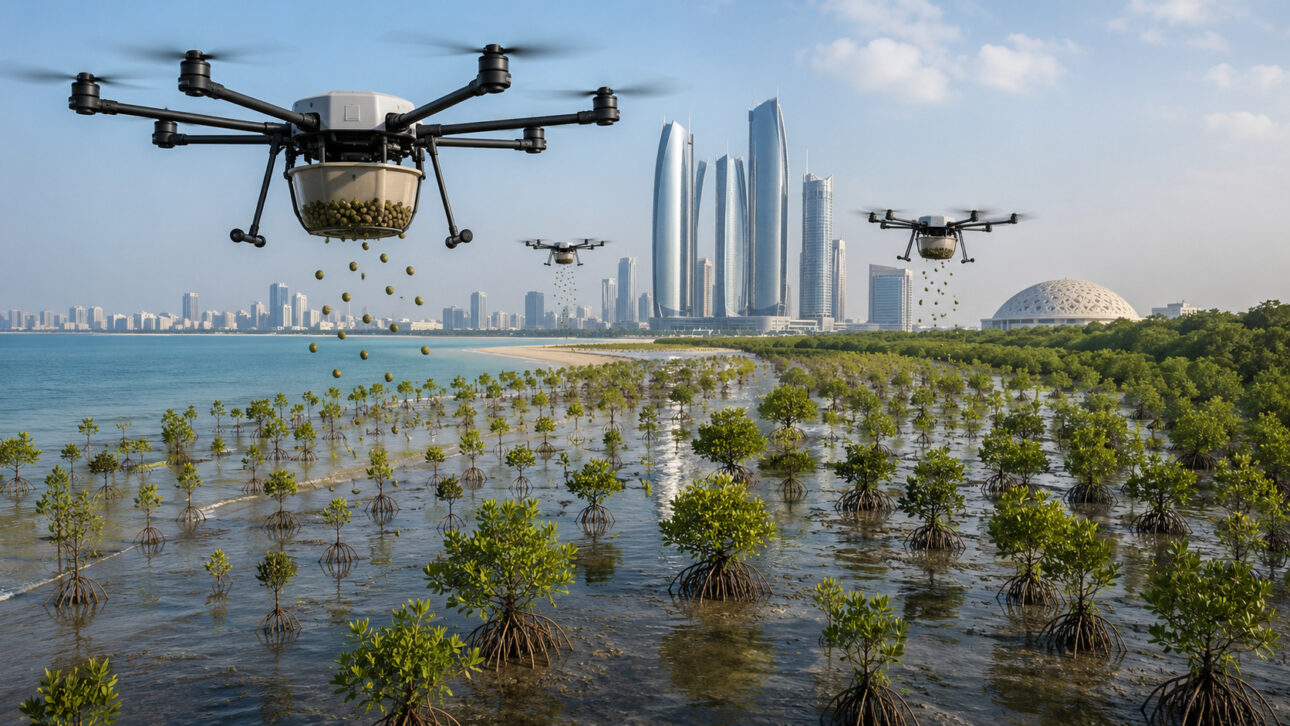
This contrast makes the operation even more visual. Instead of a conventional forest emerging in the interior desert, the project aims to expand a coastal green wall in a region marked by extreme heat, accelerated urbanization, and coastal infrastructure sensitive to sea advancement and erosion.
The species used, Avicennia marina, also known as grey mangrove, is adapted to saline environments and appears as one of the most important species of Emirati mangroves. Its roots help stabilize sediments, reduce wave force, and create shelter for marine organisms in transition areas between land and water.
The drone that carries up to 6,000 seeds transforms a slow task into an industrial-scale operation
The technical data that supports the scale of the initiative lies in the capacity of the drones. Each device can carry up to 6,000 seeds, allowing for the distribution of a large volume of plant material in areas where manual work would be slower, more expensive, and difficult. The technology reduces operation time and expands the coverage of the selected areas.
In 2023, more than 6 million seeds were distributed with specially adapted drones. The system does not just randomly drop seeds. It follows mapped areas, avoids unsuitable sections, and seeks to reproduce natural dispersion patterns, increasing the chances of establishment of future trees.
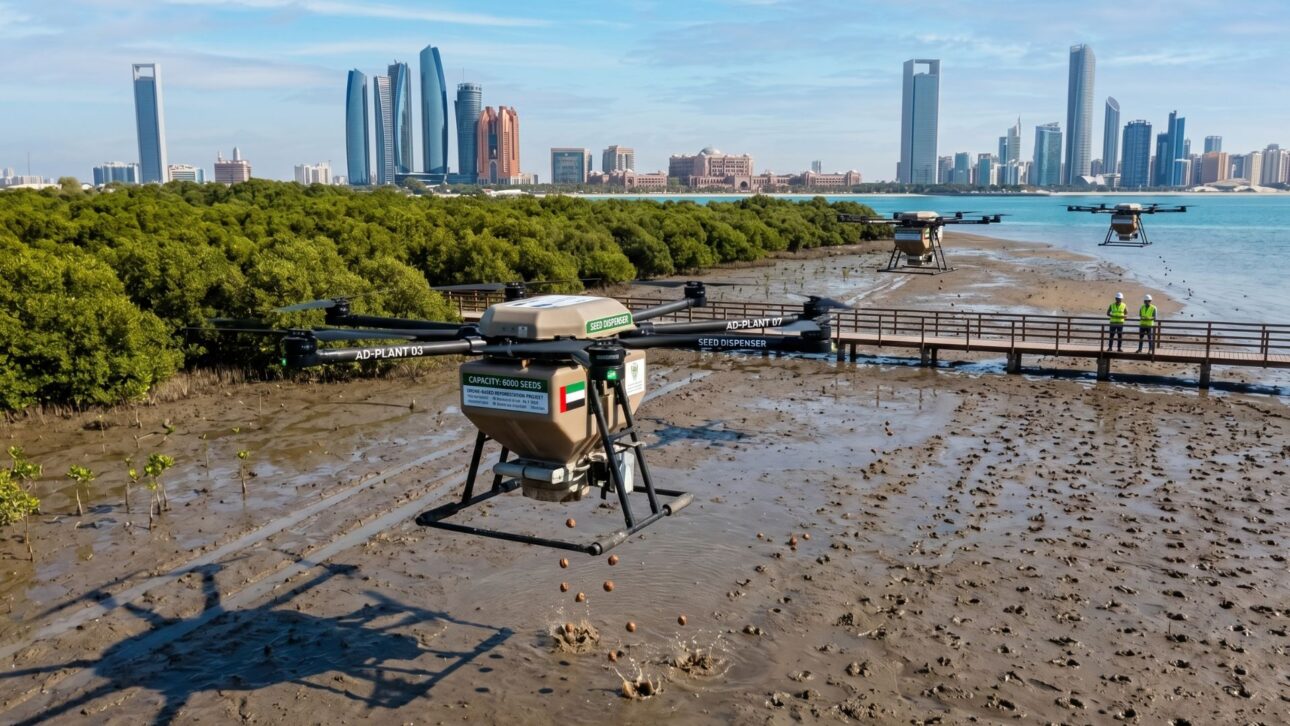
This type of planting also reduces physical interference in sensitive areas. In ecosystems of mud, roots, and tides, trampling, trails, and team movement can alter the sediment. By launching seeds from the air, the operation attempts to restore the environment without excessively stressing the very ecosystem it aims to recover.
Mangroves function as a natural barrier against carbon, erosion, extreme heat, and sea encroachment
Mangroves are considered strategic ecosystems because they combine several environmental functions at once. They store carbon in biomass and soil, help contain erosion, reduce wave force, and create habitats for fish, crustaceans, birds, and other coastal species.
In the Emirates, this role gains importance because much of the urban and economic infrastructure is concentrated on the coast. Abu Dhabi and Dubai have grown with ports, artificial islands, tourist areas, industrial zones, and coastal neighborhoods, making natural shoreline protection a relevant topic for the coming decades.
The concept of blue carbon appears in this scenario. It refers to the carbon captured and stored by coastal and marine ecosystems, such as mangroves, seagrass meadows, and salt marshes. By expanding mangroves, the Emirates aim to strengthen a natural solution that captures carbon while also helping to protect the coast against physical impacts.
After COP28 in Dubai, mangroves gained even more strength as a climate symbol of the Emirates
The mangrove agenda gained additional visibility after COP28, held in Dubai between November and December 2023. In April 2024, the Environment Agency Abu Dhabi announced the planting of 850,000 mangroves along the emirate’s coastal areas as part of the Ghars Al Emarat initiative.

The initiative planned the planting of 10 mangroves for each visitor of COP28, reinforcing the link between global climate events and local restoration actions. The agency also reported the use of innovative methods, including drone seeding, to expand the recovery of coastal areas.
This movement consolidated mangroves as one of the strongest environmental symbols of the Emirates. The tree that grows in tidal mud has become part of a national narrative about climate, coastal protection, technology, and international commitments.
The operation depends on the survival of the seeds after they fall from the sky
Aerial deployment accelerates distribution, but does not automatically turn each seed into a tree. Once the material reaches the sediment, the most challenging stage begins: germinating, taking root, resisting salinity, enduring tidal variations, and surviving the region’s intense heat.
Therefore, mapping the areas is crucial. Drones do not operate at just any point along the coast. They are directed to sections where the combination of mud, tide, and coastal position offers a greater chance of growth, reducing losses and increasing restoration efficiency.
The final result will be measured over the years, as the seeds transform into seedlings and then into trees capable of forming functional mangroves. Technology accelerates the beginning of the forest, but consolidation depends on the ecosystem’s behavior.
Abu Dhabi attempts to make the sky the most unlikely path to a new green wall
The ambition of the Emirates is to transform millions of seeds launched in coastal areas into a living forest with climate function and physical protection.
If the plan progresses as expected, the mangroves could increase carbon capture, reduce erosion, and strengthen the natural defense of the coastline in a country heavily exposed to heat and coastal pressure.
The contrast is what makes the project so striking. In a region known for dunes, skyscrapers, and urban megaprojects, drones are being used to spread seeds over the tidal mud and attempt to build a long-term green wall.
At the edge between the desert and the sea, Abu Dhabi is betting on a rare scene: a coastal forest that starts in the sky, falls in the form of seeds, and could become one of the largest environmental showcases of the Emirates by 2030.