






 Portuguese
  Spanish
  3 min of reading
  0 comments



A Unique Aircraft With A Radar Dome On Top, The E-3 Sentry Of The US Air Force Stands Out For Its Unique Appearance And Essential Function. Valued At US$ 300 Million, This Flying Control Tower Is Crucial For US Military Operations.
The E-3 Sentry, a unique aircraft of the US Air Force, impresses with its peculiar structure, featuring a large radar dome over the fuselage and the absence of visible armaments. Delivered to the military for the first time in March 1977, this aircraft has become a key asset for the air warning and control system, providing reconnaissance and facilitating communication in the air.
Despite its appearance, the E-3 Sentry offers superior defensive and offensive capabilities. Measuring 152 feet in length, with a wingspan of 145 feet and a weight of 185,000 pounds, it is equipped with state-of-the-art systems for reconnaissance in hostile environments.
E-3 Sentry Is A Vital Component Of The US Air Force
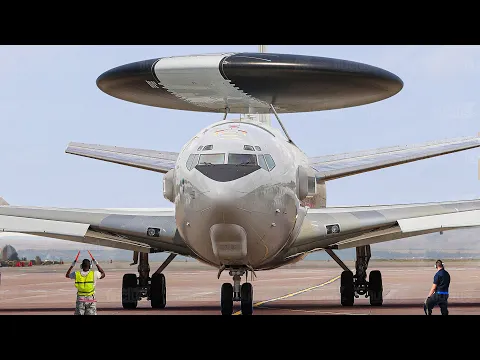

The E-3 Sentry is a vital component of the US Air Force, operating as an air warning and control system. Its radar dome, measuring 30 feet in diameter and 6 feet thick, has an effective range of up to 250 miles, making it indispensable in both battles and routine troop movements.
-
Why can the crane operator only obey the correct signalman on the construction site: among dozens of workers, a hand raised by the wrong person can confuse the maneuver and turn a load of tons into an immediate risk.

-
What changes with the new public transportation rules that can reduce pressure on fares and pave the way for zero fare in Brazil?
-
Offshore air transport soars in Brazil, surpasses 2.5 million passengers, and reveals how oil has transformed Rio’s airports into key pieces of national logistics.

-
Latin America becomes the “global champion” of aviation taxes, tickets may become more expensive in Brazil, and IATA’s warning exposes risk for flights, tourism, and passengers.




Before each flight, ground teams thoroughly inspect the landing gear, basic avionics, and fluid levels. After clearance for takeoff, pilots start the engines and the aircraft slowly taxies to the runway. With continuous flight capability for over 8 hours, the E-3 can extend its mission time through aerial refueling.
E-3 Radar Provides Detailed Information On Hostile Aircraft
During flight, the E-3 radar provides detailed information on hostile aircraft and weather conditions, essential data analyzed by a team of 12 to 20 members. They use consoles that display processed data in graphical formats, enabling surveillance, identification, weapon control, battle management, and communication functions.
Due to the complexity of the E-3, new pilots undergo rigorous training, including consecutive landings and takeoffs to refine their skills. Regular maintenance is crucial to ensure the aircraft is always ready for its next mission, with detailed inspections of landing gear, fuel lines, radar dome, and avionics.
It Is A Testament To The US Air Force’s Commitment To Preserving National Security
Since its introduction in the 1970s, the E-3 Sentry has continued to evolve technologically, remaining relevant in modern warfare. It is a testament to the US Air Force’s commitment to preserving national security and dominating electronic warfare, acting as a true guardian of the skies.
The E-3 Sentry not only provides essential support during conflicts, but also ensures constant surveillance and operational readiness, solidifying its indispensable role within the US Air Force.





Be the first to react!