Portuguese
  Spanish




An email of one hundred words requested from ChatGPT can use about 520 milliliters of water, equivalent to a small bottle. The data comes from an estimate by the University of California Riverside and varies greatly depending on the region, time, and type of cooling. It is an approximate calculation, not a fixed number.
Behind a simple email requested from ChatGPT lies a gigantic physical structure, on the other side of the world. Researchers estimate that generating a text of one hundred words can consume about 520 milliliters of water, roughly a small bottle. The number is impressive but requires context.
The estimate, cited by Catraca Livre, is attributed to the University of California Riverside, under the coordination of researcher Shaolei Ren. The central point is that this value is not fixed, it changes significantly depending on where and when the task is processed, and even includes the water used indirectly to generate electricity. The data centers consume water mainly to cool servers that heat up continuously.
Why artificial intelligence uses water
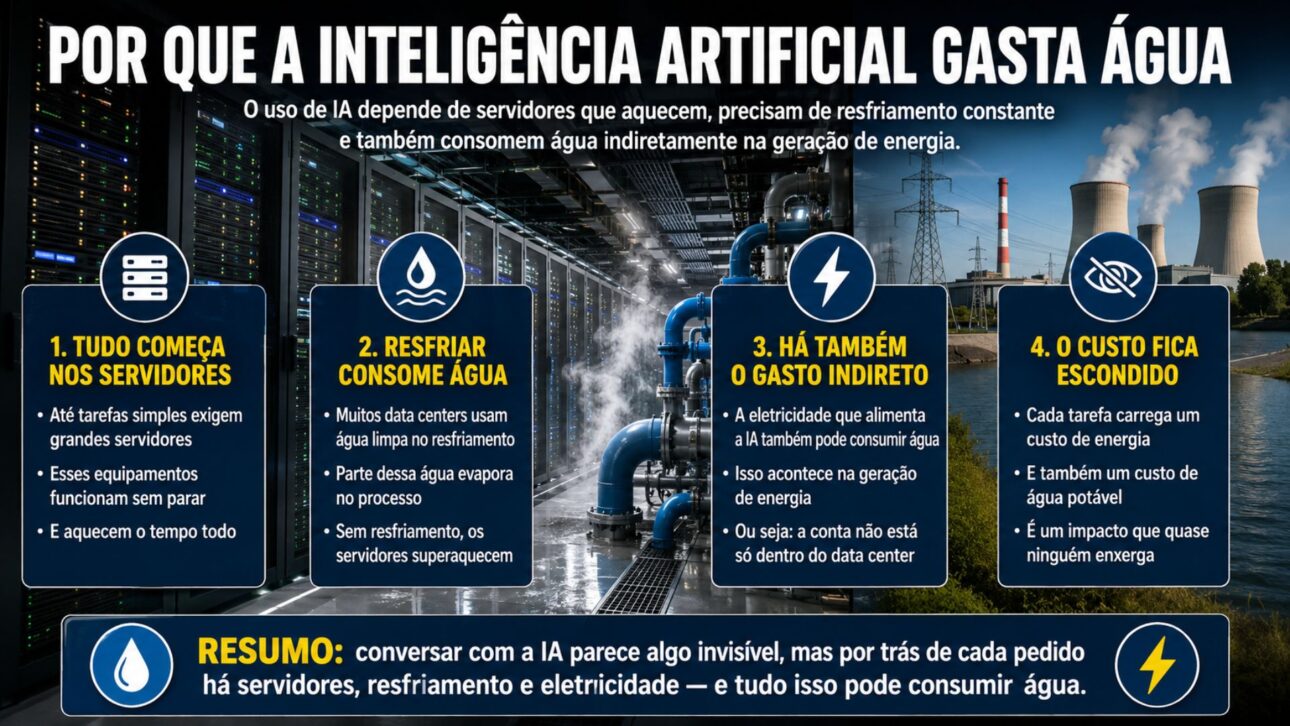
Processing even simple commands requires enormous servers in remote centers, which heat up all the time and need constant cooling.
-
Oceanographer Turns Abandoned Fishing Nets from Brazilian Waters into Bags, Creating Jobs and Earning Over $7,000 Monthly

-
Australia deploys poisoned sausages and uses traps, shooting, and fences in a battle against invasive cats that kill over 1.5 billion native animals annually, threatening more than 200 species.

-
NASA Rover Captures “Tired Face” on Mars, Highlighting Human Brain’s Tendency to See Faces in Rock Formations

-
Ancient Stone City in the Desert, Once Home to 30,000, Puzzles Scientists with Nabateans’ Water Mastery 2,000 Years Ago





In many data centers, this cooling is done with clean water, which evaporates in the process.
And it’s not just the cooling water that counts.
A significant part of the electricity that powers artificial intelligence also consumes water indirectly, in energy generation.
Add one thing to another, and each task, no matter how small it seems, carries an energy and potable water cost that almost no one sees.
Where the number of 520 milliliters comes from
The data that went viral has an origin and has caveats.
The estimate of about 520 milliliters per email of one hundred words is linked to models the size of GPT-4, which is behind ChatGPT, and is based on analyses from the University of California Riverside, with researcher Shaolei Ren.
The group itself makes it clear that this value is not a universal measure.
In practice, the consumption varies greatly. It depends on the region, time, and climate, because dry and hot places need more cooling through evaporation.
Furthermore, the number combines the water used for cooling with the water used indirectly in electricity.
In other words, 520 milliliters is an order of magnitude, not an exact measure per message.
What really concerns, and what is missing to know
The concern arises when you multiply.
Even a small consumption per task becomes a relevant volume when millions of people use ChatGPT and similar tools every day, and this is more concerning in regions already facing long droughts.
It is a legitimate warning, as long as it is without panic.
However, there is an important gap in this story, the lack of transparency.
There are no public and standardized metrics on the water footprint of these systems, and companies do not always disclose detailed numbers.
Without this, it is difficult to truly gauge the problem or demand solutions, and much of the debate ends up revolving around estimates.
What companies and users can do


On the companies’ side, there are already paths being tested.
Closed-loop systems, which reuse water, dry air cooling, installing centers in cold regions, and reusing treated wastewater are among the most cited solutions to reduce the water footprint of data centers.
The shift to clean energy is also part of the equation.
And the average user is not left empty-handed.
Simple habits help, such as avoiding rewriting the same long email multiple times and preferring direct requests to ChatGPT, which reduces unnecessary requests.
It’s not about demonizing technology, but rather using it with a bit more awareness.
The 520 milliliters account serves less as a sentence and more as a reminder.
Each interaction with ChatGPT has a real environmental cost, even if it’s difficult to measure precisely and varies greatly from one place to another.
The researchers’ message is for more transparency and efficiency, not to abandon the tool.
And you, have you ever stopped to think about the water consumption behind artificial intelligence? Do you think technology companies should disclose these numbers? Share your opinion in the comments, respecting different views, and share this article with those who use ChatGPT every day and never imagined this invisible side.