Portuguese
  Spanish


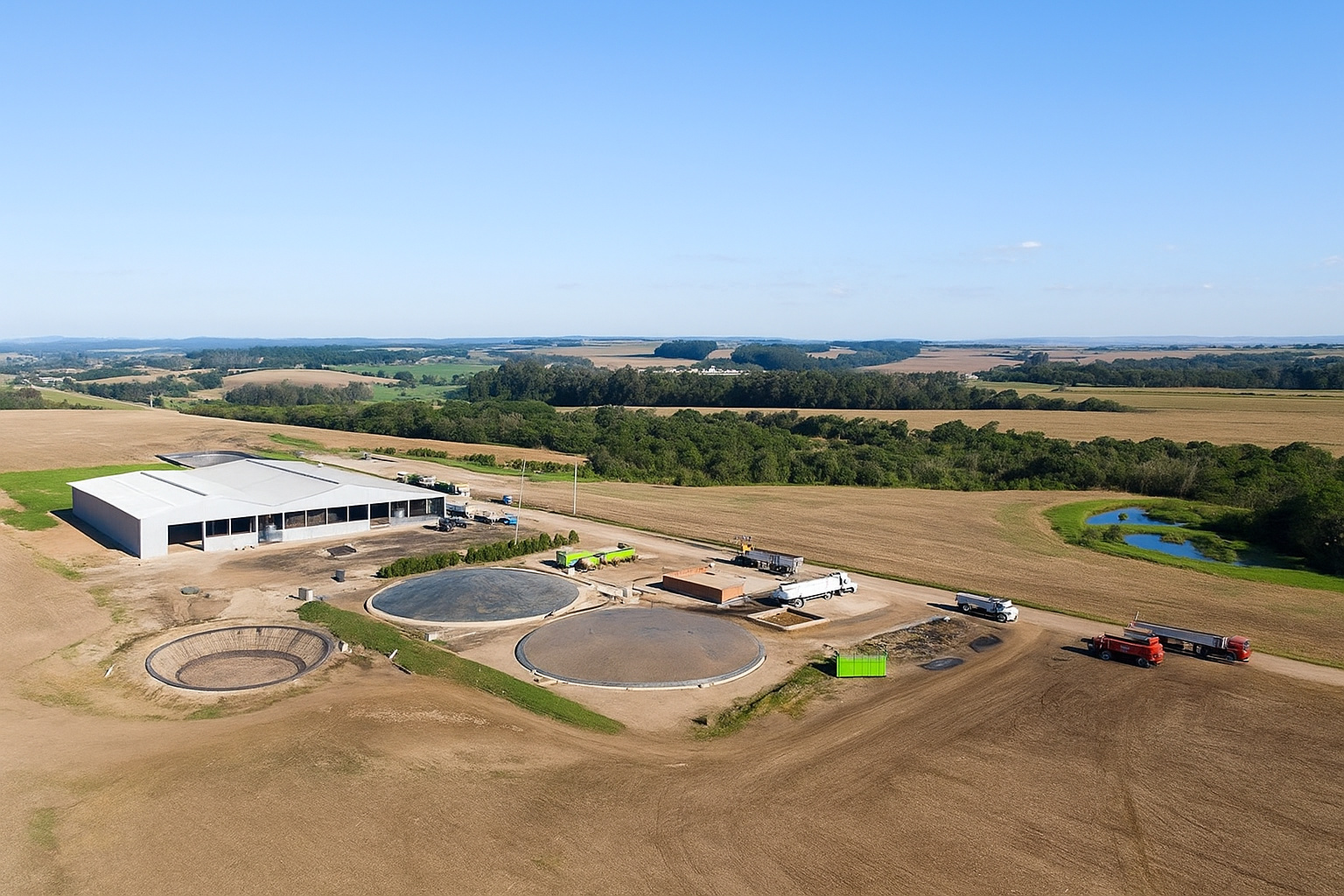

Energisa Expands Presence in Clean Energy with New Biogas Plant in Carambeí, Investment of R$ 100 Million That Drives Sustainability and Regional Development.
In recent years, the search for cleaner and more sustainable energy sources has grown significantly in Brazil. Furthermore, one of the pathways that has been consolidating is the use of biogas, a renewable fuel produced from the decomposition of organic waste.
This trend reflects a profound change in the energy sector. Marked by the transition to a low-carbon economy and the strengthening of bioenergy as a vector for regional development.
Therefore, in this context, Energisa announces the construction of the biogas plant in Carambeí. An important milestone for both Paraná and the future of renewable energy in the country.
-
H2A to Invest $570 Million in 22 Biomethane Plants in Brazil, Converting Agricultural Waste into 700 Tons of Renewable Fuel Daily

-
Brazil to Introduce B16 Diesel with Increased Soybean Oil Content for Trucks by 2026
-
Brazil Advances with JetBio’s Megaproject to Build the World’s Largest Ethanol-Based Sustainable Aviation Fuel Plant, Aiming to Become a Global Exporter

-
Brazil on Track for Record 40.7 Billion Liters of Ethanol in 2026/27 Season, Driven by Corn Ethanol


In this context, Energisa, one of Brazil’s largest energy groups, will invest R$ 100 million to build the new biogas production unit in Carambeí. A municipality located in the Campos Gerais region of Paraná.
Moreover, the project arises from the acquisition of 52% of Lurean, a local company specialized in waste treatment and organic fertilizer production.
Thus, the company will expand its operations in the biofuels market and strengthen its presence in the renewable energy sector.
In addition, besides marking a new phase in Energisa’s trajectory, the investment symbolizes the confidence in the potential of the Brazilian biogas and biogas market, which is growing at a rapid pace.
In recent years, the country has stood out internationally for its ability to convert agroindustrial waste into clean energy. Taking advantage of the abundance of raw material generated by its strong agricultural base.
This context positions Brazil strategically to lead the global bioeconomy, combining technological innovation, sustainability, and competitiveness.
Strategy for Expansion and Consolidation in the Clean Energy Market
Furthermore, the new plant, which Energisa Biogas (Ebio) — the group’s arm dedicated to clean energy solutions — will manage, will start its commercial operations in the first quarter of 2028.
As a result, the unit will have the capacity to produce 28,000 cubic meters of biogas per day. Representing a significant advance in Energisa’s diversification strategy.
Thus, the company aims to reduce its carbon footprint and offer integrated solutions for industrial and logistics clients who wish to shift to more sustainable fuels.
In addition, according to the CEO of Energisa’s Gas Business, Débora Oliver, the company applies the lessons learned from its first experience in the sector. The plant in Santa Catarina, developed by Agric — a company acquired by the group in 2023 — will have a capacity of 25,000 m³/day and will begin operations in 2026.
Therefore, this evolution demonstrates a consistent movement of increasing infrastructure dedicated to biogas and biogas. Two fundamental pillars in the decarbonization of the Brazilian energy matrix.
Moreover, the biogas, by its nature, replaces fossil natural gas and offers a clean and renewable alternative.
Thus, companies obtain biogas from biogas, which arises from the decomposition of organic waste, such as agroindustrial leftovers, animal waste, and urban organic matter.
Subsequently, the biogas undergoes a purification process and is transformed into biogas, a fuel with similar physical-chemical characteristics to conventional natural gas, but with a much lower environmental impact.
Biogas Plant in Carambeí and Agroindustrial Potential in Renewable Energy Generation
Thus, the choice of Carambeí as the site for the new unit is not coincidental.
The city, known for its strong agroindustrial vocation, offers a large availability of organic waste, essential for the production of biogas and biogas.
Additionally, in 2024, Lurean treated over 95,000 tons of agroindustrial waste, transforming part of that volume into 38,000 tons of biofertilizers.
This utilization demonstrates how waste can be converted into economic and environmental value, combining productivity, sustainability, and innovation.
Moreover, Carambeí has a strategic location.
As a result, located in the Campos Gerais region, the city has easy access to highways and a solid industrial base, especially in the dairy, pig farming, and food processing sectors.
Thus, this concentration of agroindustrial activities generates a significant volume of waste, which the plant will convert into clean energy and sustainable agricultural inputs, closing the circular economy cycle.
Therefore, the project will generate direct and indirect jobs during the construction and operation phases, strengthening the local and regional economy.
The construction will begin in 2026, with completion in early 2028.
Additionally, another strategic factor is the proximity of the plant to the natural gas network — less than four kilometers away — which will facilitate the distribution of production and reduce logistical costs.
Thus, the biogas produced in Carambeí will supply local industries, transporters, and distributors, partially replacing fossil natural gas and reducing carbon emissions.
The Role of Paraná and the Strengthening of Bioenergy in Brazil
Furthermore, Paraná also stands out as one of the states that has made the most progress in policies to encourage the production and consumption of biogas.
Thus, the state government promotes projects that take advantage of agricultural and agroindustrial waste, utilizing the potential of the agribusiness sector — especially in the Campos Gerais region — to make the state a national reference in bioenergy.
This environment attracts companies that seek to unite profitability and sustainability, as well as align their operations with the carbon reduction targets set in international agreements.
In addition, the consolidation of Paraná as a bioenergy hub reflects a trend observed throughout the country.
As a result, Brazil has exceptional natural conditions for the utilization of organic waste, due to its extensive agricultural, livestock, and agroindustrial production.
If the full potential of biogas and biogas were explored, the country could replace a significant portion of imported natural gas consumption, as well as create thousands of green jobs.
Thus, this generates a concrete opportunity to generate energy, reduce emissions, and promote sustainable development.
Therefore, in the historical context of energy in Brazil, the investment in biogas represents another step in the diversification of the national energy matrix.
Since the 1970s, with the National Alcohol Program (Proálcool), the country has invested in renewable sources, such as ethanol and biodiesel, which reduced the dependence on imported oil.
Furthermore, starting in the 2000s, wave and solar energy began to gain ground, and now biogas emerges as a new protagonist in this transition.
Thus, it offers not only clean energy but also promotes the integration between the countryside and industry, strengthening local productive chains.
The Biogas Plant in Carambeí and the Future of the Energy Transition
Furthermore, with the growing demand for sustainable energy solutions, biogas will occupy an increasingly central role in the Brazilian energy matrix.
<pThus, companies and transporters who adopt this fuel will reduce costs and emissions, while the biofertilizer industry will benefit from the reuse of waste.
Thus, biogas transforms waste into a productive asset, reinforcing the so-called bioeconomy, which gains global relevance.
Therefore, the biogas plant in Carambeí represents more than an investment of R$ 100 million.
It symbolizes the advancement of a new productive logic, where energy, sustainability, and development walk together.
Additionally, the presence of Energisa strengthens the confidence of large groups in the potential of bioenergy and in Brazil’s ability to lead the energy transition.
With its robust agricultural base, consolidated infrastructure, and favorable public policies, the country has ideal conditions to transform waste into wealth and reduce the emissions that concern the planet.
Moreover, by uniting business experience, technology, and environmental commitment, Energisa’s project in Carambeí projects the future of clean energy in Brazil.
Thus, the plant will be more than an industrial facility: it will be a symbol of transformation — of the economy, the energy matrix, and the relationship of humans with natural resources.
Thus, initiatives like this point the way to a greener, more inclusive, and prosperous future.