Portuguese
  Spanish





Research Published On October 7 Indicates That The Statues Were Moved Upright, With Ropes And Side Swaying. Test With Replica Confirmed The Method In The Field.
The way the Moai of Easter Island (Rapa Nui) were transported has intrigued archaeology for decades. A new peer-reviewed study claims that the statues “walked” upright, moved by ropes in coordinated movements. The article was published in the Journal of Archaeological Science.
The team, led by Carl P. Lipo (Binghamton University) and Terry L. Hunt (University of Arizona), combined 3D modeling, a field database, and practical tests. The conclusion reinforces Rapa Nui oral reports and refutes hypotheses of horizontal dragging on sleds.
The work comes just days after new reports on climate threats to the statues, increasing Brazilian public interest in evidence-based solutions regarding Rapa Nui engineering.
-
Brazil Faces Norway in World Cup at Stadium Linked to Jimmy Hoffa’s Mysterious Disappearance

-
Retired Woman Leaves French Public Housing Due to Fear, Lives in Van for Weeks, Prompting Response from Local Authorities and a Priest
-
9-Year-Old Fabio Isaac Wins Gold at Copernicus Math Olympiad in Singapore, Representing Peru Against Global Young Talents
-
Brazilian Physics Student Builds Realistic Cardboard Replica of Honda Africa Twin Using Mathematical Calculations





What The New Study Says About The Moai Of Easter Island
The article was released on October 7, 2025 and presents what the authors call the “walking moai hypothesis”. They argue that the Moai were designed to be transported upright, with controlled sways and alternating pulls of ropes.
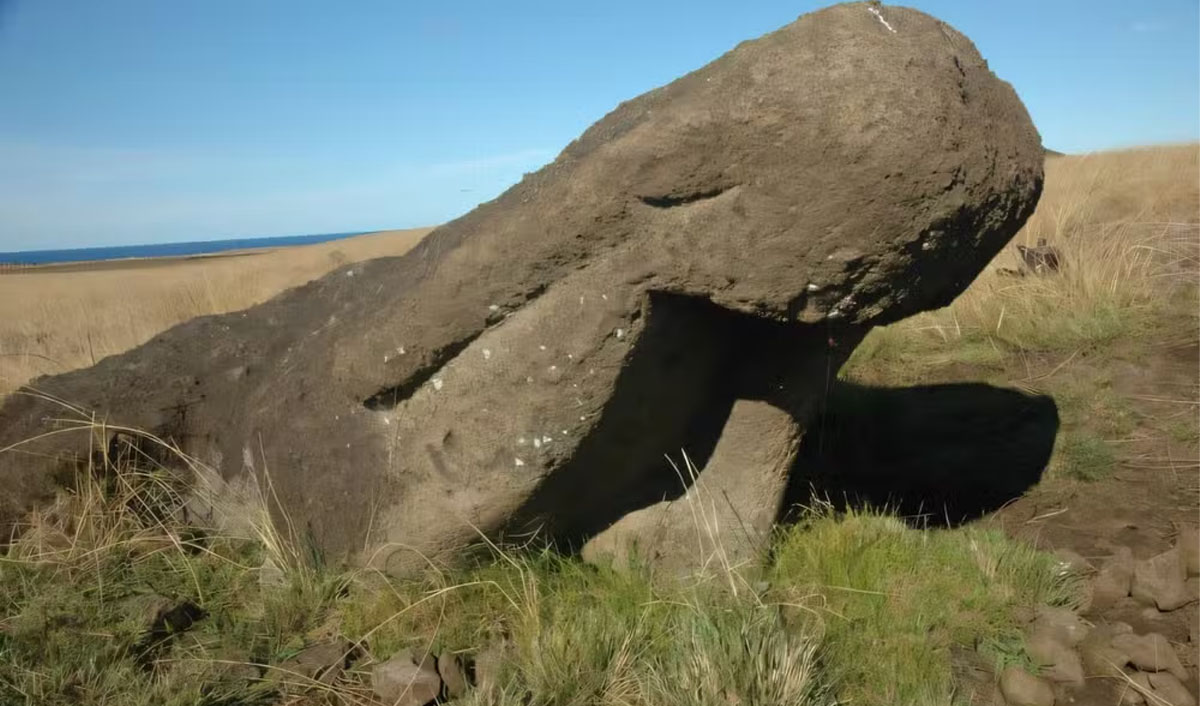
The empirical basis includes a systematic analysis of 962 Moai scattered across the island, focusing on 62 road statues associated with transport routes. This sample supports the functional interpretation of shapes and wear observed.
According to a statement from Binghamton University, the study integrates photogrammetric surveys, field measurements, and experimentation to test physical predictions of vertical movement.
For historical context, the AP itself notes that the Moai were erected between the 10th and 16th centuries. The new article does not discuss chronology but reinterprets how the statues reached the ceremonial platforms (ahu).
How The Statues “Walked” With Ropes
The principle is simple and efficient, involving ropes tied at lateral and sometimes rear points to create a side sway. The weight shifts the center of mass and the statue “takes a step,” repeating the cycle in zigzag until the destination. See the diagram released to illustrate:
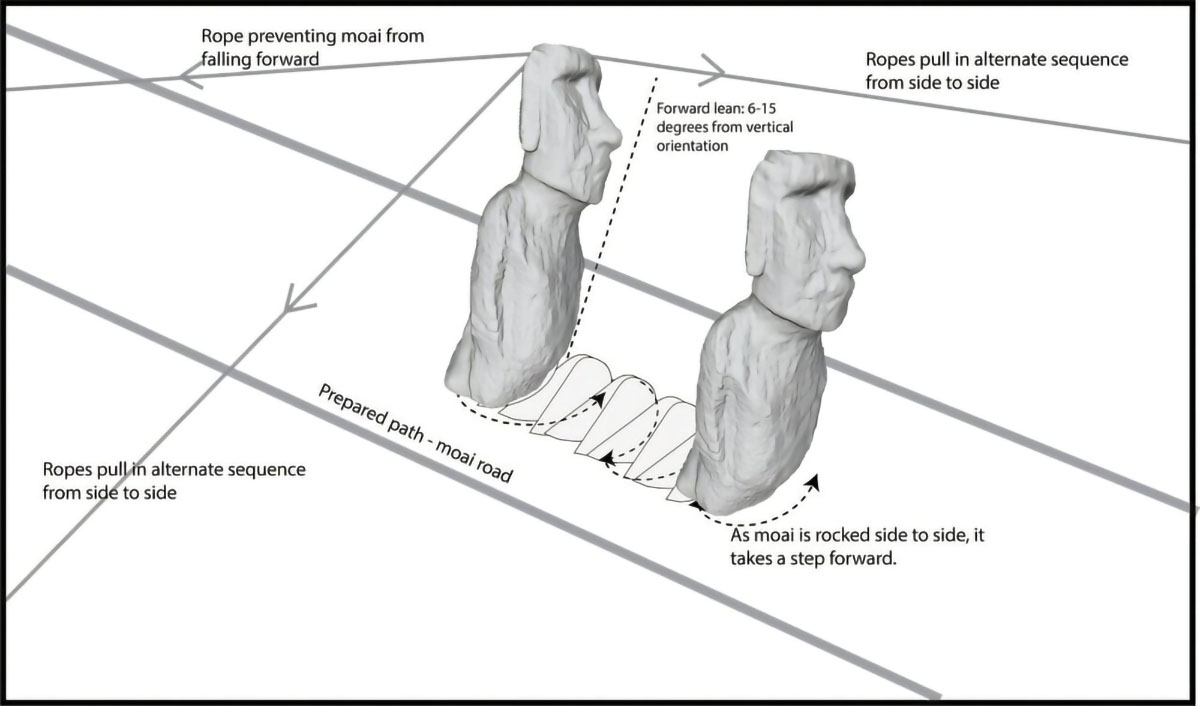
To test the hypothesis, the team built a 4.35-ton replica with a slight forward tilt. In the field, 18 people moved the piece 100 meters in 40 minutes, demonstrating the method’s feasibility on a real scale. “The physics make sense,” Lipo summarizes in reports to the media.
Accounts and videos of the trial show that, after starting the movement, the effort decreases and the pace increases, with part of the team pulling with one arm. The performance exceeds previous attempts at vertical transport without the controlled sway.
The result aligns with local traditions and invalidates older explanations of lying drag on wooden rollers, now seen as energetically worse for pieces of this shape.
Roads, Design Of The Moai Of Easter Island And The 3D Modeling
The authors highlight wide bases in “D” and front tilt of many Moai, attributes that favor dynamic stability during “walking.” These features repeatedly appear in the analyzed collection.
Three-dimensional modeling allowed for simulating forces and trajectories. The generated pattern matches marks on the ground and the location of statues abandoned along the routes, interpreted as falls during vertical transport.
The so-called “ceremonial roads” gain new meaning: they would be functional pathways opened and adjusted as the statue advanced. In various sections, there are parallel and overlapping routes, signaling progressive planning of construction and logistics.
Physics, morphology, and field records converge. For the authors, the attributes grow with scale and the “walking” strategy becomes the most consistent option as the statues get larger.
Do you agree that the new experiment settles the controversy? Leave your comment: Does the method of “walking with ropes” explain everything, or are there still missing larger-scale field proofs?