






 Portuguese
  Spanish


With a Cost of US$ 3 Billion, the Tunnel System at the Oyu Tolgoi Mine is the Most Expensive in Mining History and Extracts Copper at 1,300 Meters Deep.
In the heart of one of the driest deserts in the world, in the vastness of Mongolia, lies one of the greatest feats of modern engineering: the most expensive tunnel system in mining history. With an investment exceeding US$ 3 billion, the Oyu Tolgoi project, led by the giant Rio Tinto, is not just a billion-dollar venture — it is an example of what happens when geology presents extreme challenges and engineering responds with unprecedented innovation.
To extract copper and gold at over 1,300 meters deep, it was necessary to develop a colossal underground network, operated by autonomous systems and designed to function for decades. But what makes this tunnel so special? And why is the whole world keeping an eye on this project?
The Most Expensive Tunnel in Mining History: Where is Oyu Tolgoi and Why is it So Important?
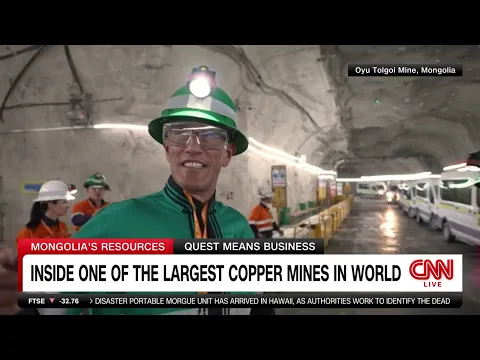

Oyu Tolgoi is located in the Gobi Desert, in southern Mongolia, just 80 km from the border with China. Its name means “Bright Turquoise” in the Mongolian language, and it is not by chance: the mine harbors one of the largest worldwide reserves of copper and gold, essential for the global economy.
-
Eni Acquires 25% Stake in Chilean Lithium Project, Plans to Invest Up to $225 Million in Eco-Friendly Extraction Method

-
Mexico’s Giant Crystal Cave: A Deadly 58°C Underground Palace with 11-Meter Crystals Formed Over Nearly a Million Years

-
China Dominates Over 90% of Rare Earth Refining, Prompting Global Concerns: Canada and Japan Launch Billion-Dollar Plan to Reduce Dependency and Safeguard Batteries, Semiconductors, and Defense
-
Ancient Mines in Spain Reveal Tools and Metals That May Explain Bronze Age Trade with Scandinavia


It is estimated that, when fully operational, the project could produce up to 500,000 tons of copper per year — enough to meet part of the growing global demand for this metal, driven by sectors such as renewable energy, electric vehicles, and digital infrastructure.
Gold, in turn, is also present in significant concentrations, being extracted as a byproduct of the process.
The Most Expensive Tunnel in Mining History
The main differentiator of Oyu Tolgoi is the fact that its main mineral deposits are not accessible through open-pit mining. To reach the ore body, it was necessary to excavate a complex tunnel system with over 200 km of total length, including:
- Vertical shafts for ventilation and transport
- Tunnels providing access to the mineral body
- Underground support infrastructure
- Extraction galleries using block caving technology
Block caving is one of the most sophisticated techniques in underground mining. It allows for large-scale extraction of deep mineral bodies, such as those at Oyu Tolgoi, but requires meticulous planning, heavy ventilation systems, and automation — justifying the billion-dollar investment.
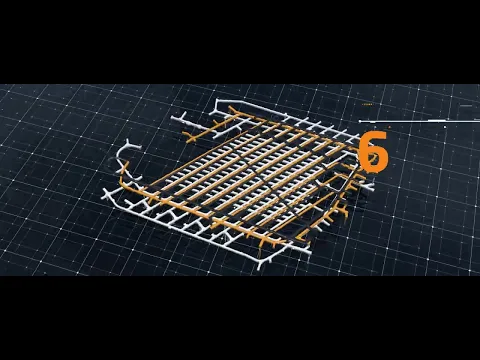
Only the construction of this infrastructure required US$ 3 billion, making the tunnel system the most expensive ever built for mining purposes in the world.
Record Depth: Over 1,300 Meters
To access the most valuable reserves, excavations reached depths exceeding 1,300 meters, equivalent to more than 4 Eiffel Towers stacked. At this depth, heat, pressure, and geotechnical risks are enormous. It was necessary to design systems for cooling, gas control, and structural reinforcements to ensure the safety of workers and machines.
Additionally, the entire system was designed to operate with minimal direct human presence, utilizing autonomous equipment, remotely operated and powered by artificial intelligence. Autonomous trucks, robotic drillers, and real-time sensors make up the underground ecosystem of Oyu Tolgoi.
The Importance of Copper in the New Global Economy
The justification for so much effort and investment lies in the very copper. This metal is at the center of the global energy transition: it is used in wind turbines, solar panels, transmission cables, batteries, electric vehicle motors, computers, satellites, and 5G networks.
The International Energy Agency (IEA) estimates that global demand for copper could double by 2040, making mines like Oyu Tolgoi strategic for countries and companies competing in the green and technological sectors.
For this reason, Rio Tinto views the project as one of its most important bets for the coming decades.
A Geopolitically Sensitive Project
Besides the technical challenge, Oyu Tolgoi also involves complex negotiations with the government of Mongolia, which holds 34% of the mine through the state-owned company Erdenes Oyu Tolgoi LLC. The rest is operated by Rio Tinto.
Over the years, there have been disputes about taxes, royalties, deadlines, and profits, delaying project stages by almost a decade. In 2022, a historic agreement was reached to unlock the underground expansion of the mine, allowing the tunnels to be completed and the project to advance to full production.
This geopolitical dimension makes Oyu Tolgoi a delicate piece on the energy and diplomatic board of Asia.
Local and Global Economic Impact
For Mongolia, Oyu Tolgoi represents over 30% of the national GDP when fully operational. The mine already employs around 12,000 people directly and indirectly, in addition to generating billions in investments in local infrastructure, such as roads, power lines, and technical education.
For the world, it means access to a reliable source of copper and gold, especially at a time of scarcity and rising prices. Diversifying suppliers, moving away from dependence on countries like Chile and Peru, also has a direct impact on the balance of the global metals market.
The case of Oyu Tolgoi shows that the future of mining is increasingly going underground. With the exhaustion of surface deposits, companies are being forced to invest in technologies that allow the safe, efficient, and environmentally friendly exploration of great depths.
This is the new paradigm of the sector: underground, automated, connected, and billion-dollar mining. And the tunnel system of Oyu Tolgoi represents, so far, the peak of this transformation.
The most expensive tunnel in mining history is more than an engineering feat: it is a symbol of how science, geopolitics, and natural resources intertwine to meet the demands of a transforming world.
Investing billions to dig beneath Mongolia may seem excessive — but, in the face of the global race for copper and gold, every meter dug at Oyu Tolgoi is a bet on the energy and technological future of humanity.







