Portuguese
  Spanish


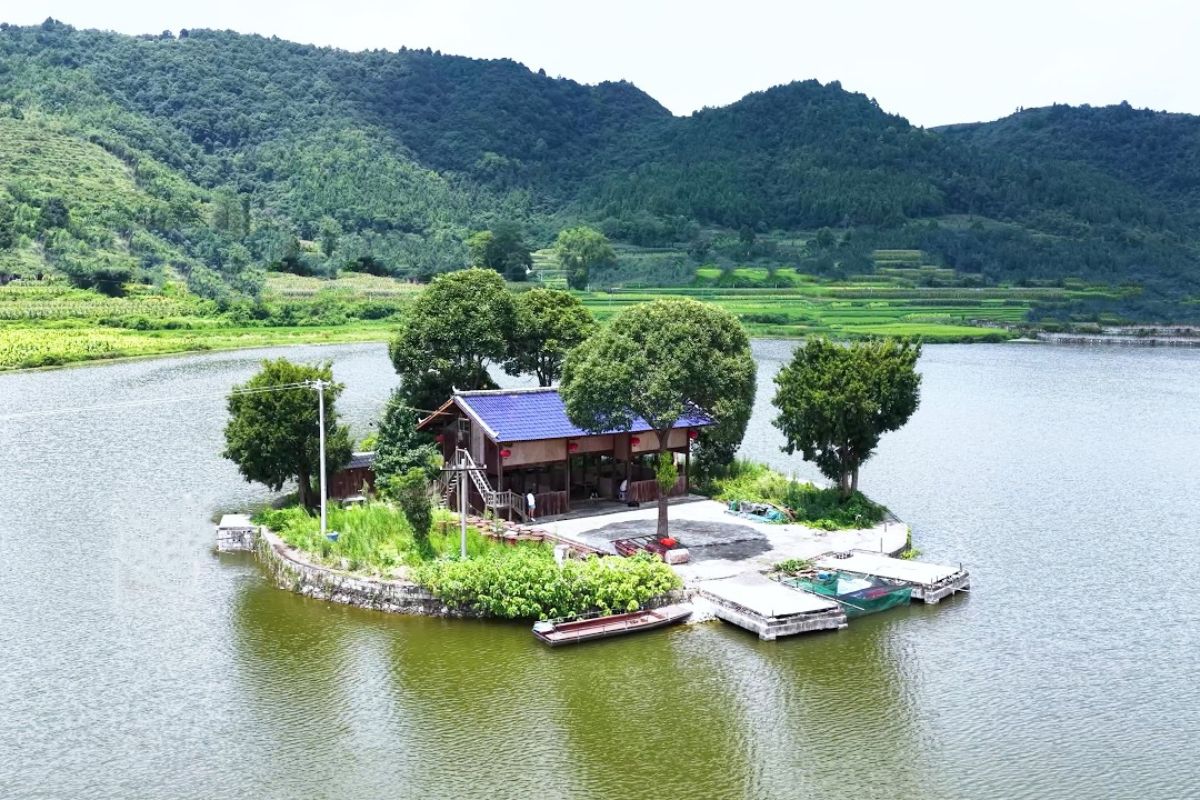


Wooden House On Secret Island In Guizhou Reveals Ancient Temples, Lake Feng Shui Excavated Centuries Ago, And An Isolated Retreat Preserved By The Yang Family
Building a perfect refuge amid water and mountains seems like a legend, but in China, it has a real address: a secret island in Guizhou, embedded in the middle of an artificial lake created over 300 years ago to satisfy the feng shui of an ancient local chief. At first glance, what you see is a two-story wooden house, surrounded by tall trees, calm water, and absolute silence, accessible only by boat.
Behind this postcard scenery lies a long story, made of political decisions, belief in the territory’s energies, and a lot of manual labor.
The secret island in Guizhou houses a house built with wood from an ancient century-old property, forgotten temples dedicated to the Yang family, a reservoir excavated to harmonize an ancestral tomb, and a lifestyle that blends fishing, spiritual retreat, and a foot in modernity.
-
11-Year-Old Entrepreneur Turns Fear of Bees into Honey Lemonade, Wins $60,000 on Shark Tank, Secures Whole Foods Deal, and Expands Brand Across U.S. Stores

-
9-Year-Old in Brazil Sells Homemade Sweets to Support Grandfather with Parkinson’s, Family Dreams of Buying Candy-Making Machine

-
Man Disguises as His Own Mother to Collect €3,000 Monthly Pension, but Makeup and Beard Stubble Raise Suspicions at Registry Office

-
Brazilian Airport to Receive $2.8 Million Investment, Completion Expected Within a Year





The First View Of The Secret Island In Guizhou
From a distance, the scene seems straight out of a romance: in the middle of the lake, an isolated wooden house rises on a small island, surrounded by lush trees and water that reflects mountains and sky like a mirror. There is no bridge, walkway, or road; the only way to get there is by boat.
As explorers approach, the feeling is of entering another world. With each paddle, the secret island in Guizhou stops being just a distant spot and becomes a tangible place, with history, characters, and secrets.
The idea of a “martial arts island”, a typical setting of Chinese romances, seems to come alive there: a perfect retreat for someone to live in seclusion, away from the noise of the cities.
Upon disembarking, the contrast is immediate. The grass grows tall, many corners still seem poorly attended to, and the atmosphere is that of a place that has been occupied, used, and then left to its own pace.
But a closer look reveals that nothing there is accidental: the house, the trees, the lake, and even the ancient tomb were all designed within a feng shui logic that spans centuries.
A Century-Old House Transplanted To The Middle Of The Lake

The owner of the island, with the surname Yang, explains that the wooden structure did not originate there, but carries a history of almost a hundred years. The original house was dismantled from another location, and its materials were repurposed to build the current structure, now by the water.
On the outside, it looks simple, but the design is smart. The first floor is spacious and well-ventilated, with openings on various sides to allow the wind to pass through.
Even on a scorching summer day, the interior remains cool without relying on air conditioning, only through air circulation and the shade of the ancient trees.
On the second floor, several beds indicate the use of the house as a space for rest and rural lodging. Rather than just being a support point for fishermen, the place has been prepared as a kind of rustic inn on the water.
The house has electricity, running water, and a wooden bathroom whose aesthetic matches the whole, avoiding the visual clash that a brick construction would bring in the middle of the island.
Thus, the secret island in Guizhou blends the ancient and the recent: a house made with wood from a century-old property, adapted to a historic lake, but equipped enough to host family, friends, and visitors seeking a different retreat.
The Feng Shui Lake Created Over 300 Years Ago
If the house has about a century of history in its materials, the lake surrounding it is even older. According to local accounts, the reservoir was created over 300 years ago by a local chief of the Yang family, named Yang Hui.
At that time, the chief system prevailed in the region. In search of a “treasure land feng shui” for his tomb and for the clan, Yang Hui identified that valley stretch as ideal, but there was a serious problem: there was no water.
The solution was to excavate an artificial lake and build a dam, creating a mirror of water that, according to traditional belief, would harmonize the energies of the place.
The original lake did not have the cement infrastructure and modern channels that exist today. It was a dam made of earth and mud, hand-consolidated, with simple drainage.
Over time, the government upgraded the system, reinforced the dam, changed the water outlet position, and installed a more robust drainage channel.
But the central logic remained: the secret island in Guizhou was born as part of a large feng shui project linked to an ancestral tomb of the Yang family.
Surrounding the lake, the century-old trees are also part of this original plan. Many were planted during the construction of the reservoir, both to consolidate the banks and to complete the desired “landscape frame.” Today, they form a green wall that reinforces the feeling of an isolated refuge.
Ancient Temples, Ancestral Tomb, And Memory Halls
The history of the secret island in Guizhou is not limited to the current house and the feng shui lake. In the past, the site hosted temples and structures directly linked to the worship of the Yang family’s ancestors.
Residents recount that there was a temple called Shuiyun Temple, built on the island itself, dedicated to the family and the guardian of the tomb.
The place served as a vigil and ritual point, surrounded by the water of the reservoir. Wooden platforms on stilts functioned as walkways, connecting the shore to the temple area, in a kind of suspended path over the lake.
Behind the island, on solid ground, there was still an ancestral hall called Leiyin Temple, with monuments and inscriptions related to the Yang clan. On a gigantic turtle-shaped stone, ancient records reinforced the connection between the territory, the tomb, and the family lineage.
Many of these structures are no longer active or visible as in the past, but the traces remain.
For those visiting today, it feels like walking through a scenario where layers of history, religion, and local culture overlap: the most recent wooden house, the 300-year-old lake, the forgotten temple, and the ancestral tomb that motivated it all.
Life On The Island Today: Fishing, Rest, And Private Retreat

If the island previously had a clearly religious and ritual focus, today it is simultaneously a family business and an emotional refuge. The lake is leased by the Yang family, who are dedicated to fish farming and productive use of the water.
In practice, this means that the secret island in Guizhou functions as an operational base and also as a resting place. There are areas prepared for fishing, spaces for barbecues, simple rooms for rural lodging, and an atmosphere of “farm over water.”
Those who manage to spend a few days there experience a routine where the dominant noise is that of leaves rustling in the wind and water lapping the banks.
The island owner comments that many visitors arrive with the same impression: it feels like a real version of the “Peach Blossom Island” from martial arts novels, where the outside world feels distant and the landscape is almost stage-like.
Planting more flowers, restoring some points of the house, and enhancing the landscaping is a recurring plan in conversations, with the idea of turning the place into an even more beautiful retreat to welcome people seeking silence and nature.
Despite its simplicity, it has electricity, running water, and basic infrastructure that allows for days spent there without major hassle. It is the kind of place where someone could, without exaggeration, “disappear from the world” for a while, living among trees, water, fresh fish, and the memory of centuries of history.
Why Does The Secret Island In Guizhou Fascinate So Much?
Part of the charm comes from the unlikely combination of elements. On one hand, you have a secret island in Guizhou, accessible only by boat, with a wooden house nearly a hundred years old, surrounded by trees that have grown alongside the feng shui lake.
On the other, there is the narrative of a local chief who, over 300 years ago, ordered the excavation of an entire reservoir to ensure the best possible location for his tomb and for the prosperity of his family.
In the middle of it all, life goes on: fish farming, small barbecues, occasional guests, boat rides, children running through the tall grass, and a rural pace that does not align with the image of a purely urban and industrial China.
It is a reminder that great stories sometimes hide in small spots on the map, far from famous tourist destinations.
Ultimately, this island is one of those places where landscape, family memory, spiritual belief, and economic use blend in a way that is hard to replicate in any other scenario.
At the same time, it is a tangible, visitable space with an address: Baiguo Village, Bozhou District, Zunyi, in Guizhou Province.
And you, if you had the chance to spend a few days on this secret island in Guizhou, surrounded by water, history, and silence, would you take the leap?