Portuguese
  Spanish


According to the Renewable Capacity Statistics 2026 report by IRENA, India added more than 37 GW of solar energy in 2025 and surpassed the United States, becoming the second largest solar growth market in the world, behind only China. The Indian government highlighted the achievement in June 2026.
India reached an unprecedented milestone in the solar energy race. According to the Renewable Capacity Statistics 2026 report by the International Renewable Energy Agency (IRENA), with data referring to December 2025, the country surpassed the United States in terms of installed solar capacity throughout that year and became the second largest growth market in the sector worldwide, behind only China. The achievement was highlighted by India’s Minister of New and Renewable Energy, Pralhad Joshi, on June 3, 2026.
It is important to understand the time frame. The numbers refer to the year 2025 and measure how much each country added in capacity during that period, not the total accumulated. By this criterion, India installed more than 37 GW of solar energy in 2025, compared to 34 GW by the United States, ranking behind only China. However, in terms of total installed capacity, the Americans remain well ahead.
How India surpassed the United States in solar energy
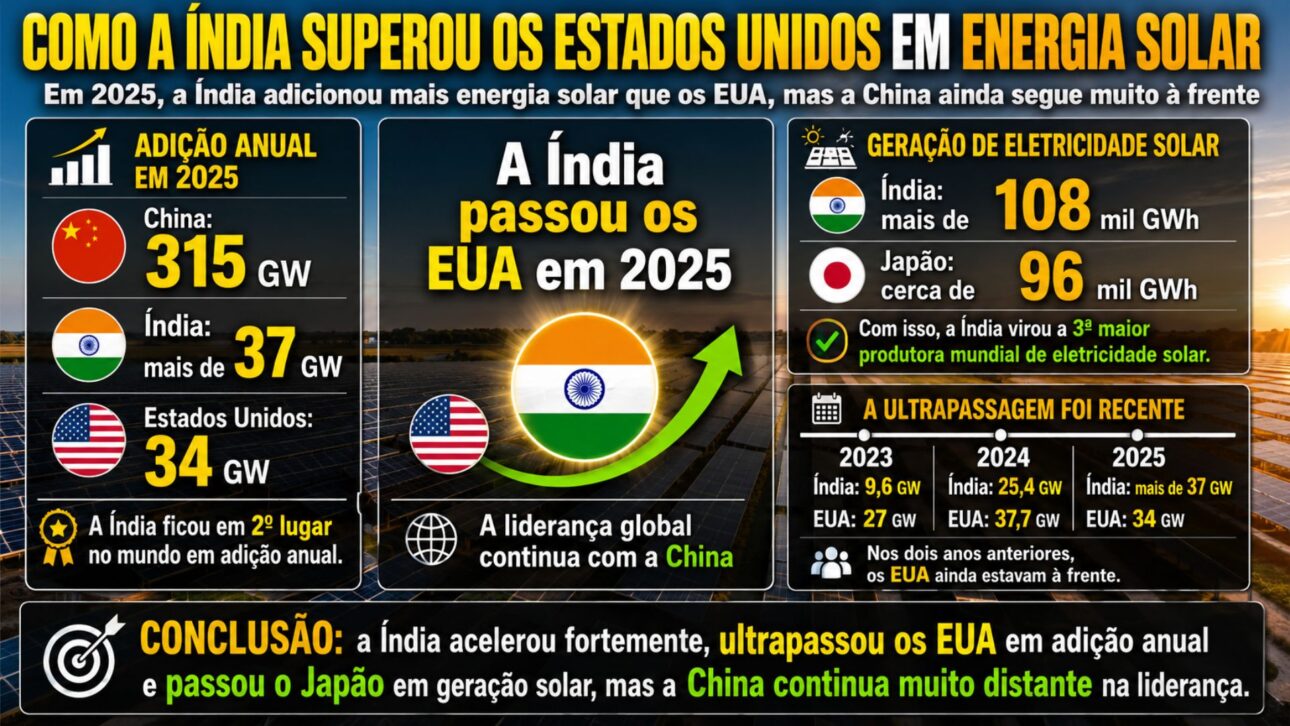
According to IRENA, India added more than 37 GW of solar energy in 2025, while the United States added 34 GW in the same year.
-
Rescue Teams Use Flashlights to Find 47 Dogs in Abandoned, Powerless U.S. Home, Offering Them a Fresh Start Through Responsible Adoption

-
Siblings Discover 1939 Superman Comic in Late Mother’s Attic, Sets Record at $9.12 Million Auction

-
12-Year-Old Discovers 80-Million-Year-Old Marine Tylosaurus Fossil During Kansas Field Trip
-
At 24, Beatriz Becomes First Woman from Mato Grosso to Work on Live Power Lines with Energisa, Starting as a Meter Reader in 2022



The result placed the Asian country in the second position worldwide in annual addition, behind only China, which leads by a wide margin by installing 315 GW in the period. The difference shows that although India has advanced, there is still a giant far ahead.
The leap also earned another prominent position in 2025. India surpassed Japan and became the third largest global producer of solar electricity, generating more than 108,000 GWh, compared to about 96,000 GWh by the Japanese.
It is worth remembering that the overtaking of the United States is recent: in 2023, India had added only 9.6 GW of solar energy, and in 2024, 25.4 GW, while the Americans added 27 GW and 37.7 GW in those two years. Only in 2025 did the country move ahead.
The two growth segments: calendar year and fiscal year
Part of the confusion about the numbers has a simple explanation. IRENA measures capacity by calendar year, from January to December, and it was in this segment that India added more than 37 GW of solar energy in 2025.
The Indian government, however, usually releases its data by fiscal year, which runs from April to March, causing some milestones to extend into 2026.
It was by this fiscal calendar that another record emerged. In the fiscal year 2025-26, ending in March 2026, India added 44.61 GW of solar capacity, against a target of 34 GW and almost double the previous record of 23.83 GW in the past fiscal year, according to Minister Pralhad Joshi.
At the pace of accumulated capacity, the country started from about 2.8 GW in 2014, took 96 months to reach the first 50 GW, another 36 months for the next 50 GW, and only 14 months to jump from 100 GW to 150 GW of solar energy, a milestone surpassed already in 2026.
China leads and the United States remains ahead in total
Despite the celebration, two things need to be separated. In annual addition, India was in second place in 2025; but in accumulated solar capacity, the United States remains well ahead, with about 211 GW installed, compared to approximately 135 GW for India at the end of 2025, according to IRENA. In other words, the Asian country grew faster in the year, but still has a smaller stock of solar energy than its rival.
At the global top, China remains isolated in the lead, both in the addition of 2025 and in the total accumulated. Considering all renewable sources, India rose to the third position worldwide in installed capacity, with about 250 GW at the end of 2025, surpassing Brazil and trailing only China and the United States, a ranking also announced by the government in 2026.
In that year, the world set a record by adding 692 GW of renewable capacity, of which 510 GW was solar, with China, United States, and the European Union accounting for almost 80% of the total.
The challenges behind the solar energy record


The advancement of solar energy in India is real, but it is advisable to look with caution. The country still faces significant bottlenecks, such as limitations in the electrical grid infrastructure, insufficient storage capacity, and dependence on importing components, although the purchase of modules abroad has decreased with the growth of national production.
These points accompany the growth celebrated by the government.
There is still a detail that puts the achievement in perspective.
Even having reached the mark of 50% of installed capacity coming from non-fossil sources in June 2025, these sources accounted for about 29% of the electricity actually generated in India in the fiscal year 2025-26, precisely because solar energy is intermittent and depends on the sun.
Transforming the installed capacity into reliable generation, therefore, is the next big obstacle of the Indian energy transition, which aims for 500 GW of renewable sources by 2030.
India surpassing the United States in solar energy in a single year, even though still behind China and the US itself in the total accumulated, shows how the race for clean energy is changing hands.
Tell us in the comments if you think Brazil should accelerate in the same way in solar energy and what might be holding back this advancement here. Your opinion can heat up the debate.