Portuguese
  Spanish


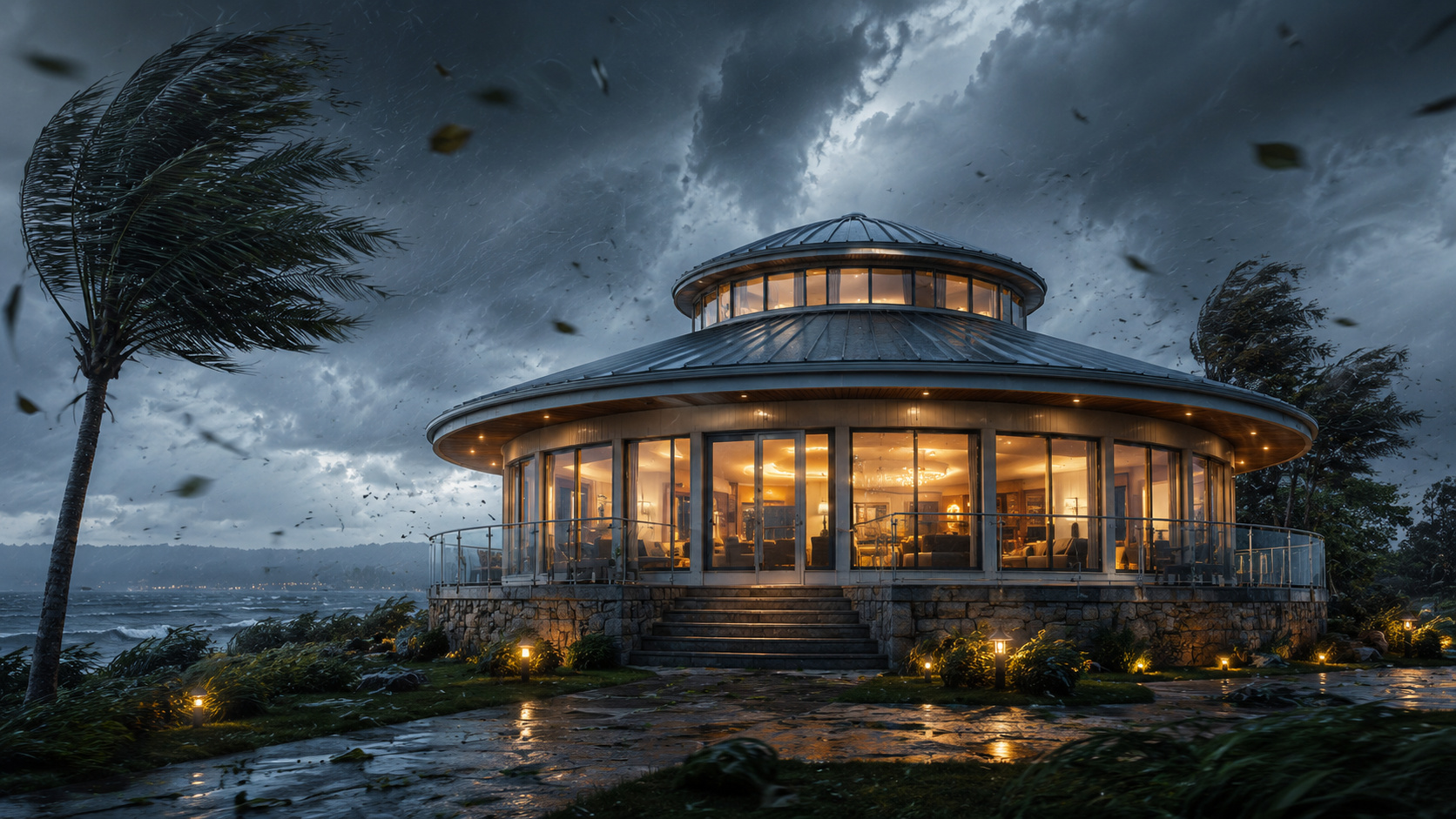

Round hurricane-resistant houses by Deltec Homes use a circular shape to reduce wind pressure, starting at 130 mph and can be reinforced to 160, 170, or 190 mph in regions exposed to strong storms in the United States
Common houses usually face the hurricane head-on, but a company in the United States sells round hurricane-resistant houses that attempt to make the wind flow around the structure. Deltec Homes launched the Tranquility model with a standard resistance of 130 mph.
The information was released by PR Newswire, a press release distribution service. The announcement was published on July 24, 2025 and presented a round house of about 123 m², with an option of 3 bedrooms.
The most striking point is the shape. Instead of relying solely on straight walls against strong gusts, the proposal uses a circular construction to reduce wind pressure and improve resistance in hurricane-prone areas.
-
Engineering Feat in Brazil: 6.4 km Tunnel and Powerful Pumps Overcome 200-Meter Elevation to Save São Paulo’s Cantareira Water System

-
Engineering Students Build Off-Grid Tiny Home with Sustainable Features and Offer Free DIY Guide
-
Historic Brazilian Championship Stadium Demolished for New Supermarket and Shopping Center Development

-
Workers excavate one of the world’s longest railway tunnels beneath the Alps between France and Italy, stretching nearly 60 km, 600 meters deep, with an investment of 11 billion euros.



How the circular shape helps to deflect wind force
A square house has straight walls and well-defined corners. When strong wind hits, it encounters more direct surfaces to press against. In a severe storm, this can increase the stress on walls, roof, and openings.


The round house works differently. The wind encounters a continuous shape and tends to pass around the construction. Therefore, Deltec Homes relies on the circular design as part of the hurricane protection.
This idea is simple to visualize. The wind doesn’t disappear but stops hitting with the same frontal impact logic. The house tries to make the gust flow along the sides, which helps explain the appeal of hurricane-resistant houses.
The Tranquility model was launched with about 123 m² and an option of 3 bedrooms
The Tranquility model was introduced as a smaller house within the round line of Deltec Homes. The reported area is about 123 m², with an option of 3 bedrooms and separate entrances to the hall.
The proposal combines resilience with common residential use. In other words, it is not an isolated shelter just for emergencies. The house was announced as a complete residence, with open internal spaces, natural light, and panoramic windows.
PR Newswire, a press release distribution service, also featured a statement from Meg Gore, CEO of Deltec Homes. “At the heart of Tranquility is thoughtful design,” she stated in the release.
What 130 mph, 160 mph, 170 mph, and 190 mph mean in practice
The acronym mph stands for miles per hour. It is a speed measurement used in the United States to indicate the strength of moving wind.
The Tranquility house has a standard resistance of 130 mph. Additionally, the company offers reinforcements for winds of 160, 170, or 190 mph.
These reinforcements are additional packages to increase the building’s capacity to withstand stronger winds. The source also reports a limited 50% discount on hurricane and strong wind reinforcement packages at launch.
Why hurricane reinforcement is not a finishing detail
Hurricane reinforcement is not paint, decoration, or visual luxury. It is a part connected to the house’s structure, the fittings, and the way the property tries to withstand strong winds.
In the case of Deltec Homes, the resistance appears along with the round shape. The house doesn’t rely solely on its different appearance. It also uses construction systems designed to handle intense gusts.
The stronger the wind expected for a region, the greater the care needed with structure, roof, windows, and fastening points.
The company cites 99.9% survival in hurricanes over the last 30 years
Deltec Homes reports that its round houses built over the last 30 years have recorded a survival rate of 99.9% in hurricanes. This data helps to understand why the company uses resilience as a central argument.
This number should not be confused with an absolute guarantee for any storm. Hurricanes change in strength, route, and local impact. Additionally, damage can also come from water, wind-borne objects, and terrain conditions.
Even with this caution, the data reinforces the project’s curiosity. The round house has ceased to be just an aesthetic choice and has become an example of construction designed to withstand extreme events.
Energy efficiency also appears as an argument for the round house
In addition to resistance, Deltec Homes claims that their round houses can be up to 20% more energy-efficient than traditional square houses. The explanation lies in the smaller external area and better air sealing.
In simple terms, this means that the house can lose less air to the outside and require less effort to maintain internal comfort. The company also presents the 360° Signature Collection, consisting of 7 models, with areas ranging from 500 to 2,000 square feet and 40 floor plans.
This part shows that the circular shape does not appear as an isolated curiosity. It has transformed into a line of homes of different sizes, aimed at those seeking resistance, comfort, and efficiency.
What Brazilian regions with strong winds can learn from this idea
Brazil does not have the same hurricane routine as the United States. Even so, strong winds, storms, and gusts are part of the reality in many Brazilian regions.
The main lesson is not to copy the model without local study. The point is to realize that the construction’s shape also influences how the wind acts on walls, roofs, and windows.
In areas with strong winds, the safety of a house does not depend solely on resistant material. Design, anchoring, roofing, openings, and wind circulation need to be part of the conversation from the beginning of the construction.
Deltec Homes’ round houses show that the design of a dwelling can play an important role in protection against extreme winds. The Tranquility model combines 130 mph standard resistance, the option of 3 bedrooms, and reinforcements for 160, 170, or 190 mph.
The question that remains is simple and important: if the shape of the house can help against strong winds, does it still make sense to build in risk areas without considering the path the wind takes around the dwelling? Share your opinion and share with those who enjoy curious engineering.