Portuguese
  Spanish


Prototype created by students in India uses multi-stage filtration and solar energy to try to contain urban pollutants before they reach lakes and other bodies of water.
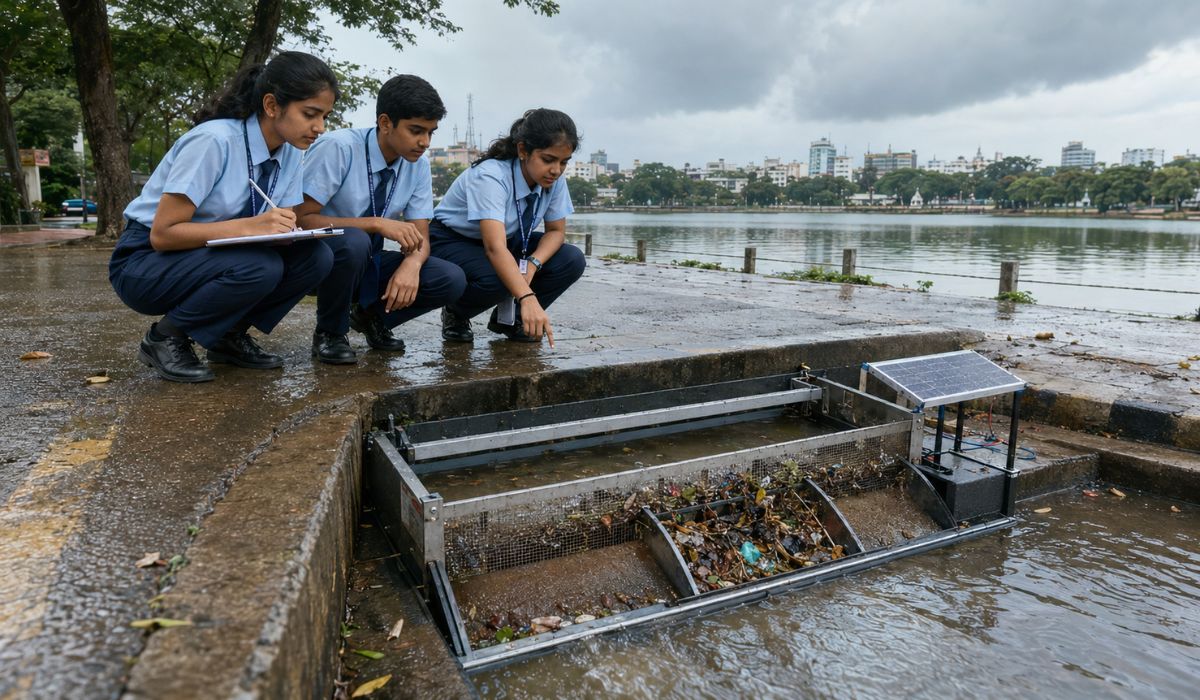
Students from Excel Public School, in Mysuru, southern India, have developed a modular filtration prototype for urban drainage networks with the aim of reducing the arrival of pollutants to lakes and other bodies of water.
Named Project Shudhi, the system was designed to be installed at points in the stormwater network and to retain solid waste, sediments, oils, heavy metals, and microplastics carried by rainwater.
The project was created by Dishaa Arjun, from 9th grade, and by Saanvi Bojamma K. M. and Amritha Biligiri Prashanth, from 10th grade, under the guidance of mentor Akhil Sasankan.
-
Extreme Heat of 41.3°C Warps Roads in Germany, Causes Autobahn Asphalt to Crack, Injures People, and Forces Snowplows to Cool Down Highways

-
AI Security System in Brazil Aims to Cut False Alarms by Differentiating Pets from Intruders, Enhancing 24/7 Monitoring for Homes and Businesses

-
Archaeologists Discover 1,500-Year-Old Byzantine Mosaic with Greek Biblical Inscription in Israel, Uncover Ruins of 10 Buildings Near Kiryat Gat
-
Ohio Carpenter Finds 308-Gram Meteorite the Size of a Baseball After Dreaming of Its Location





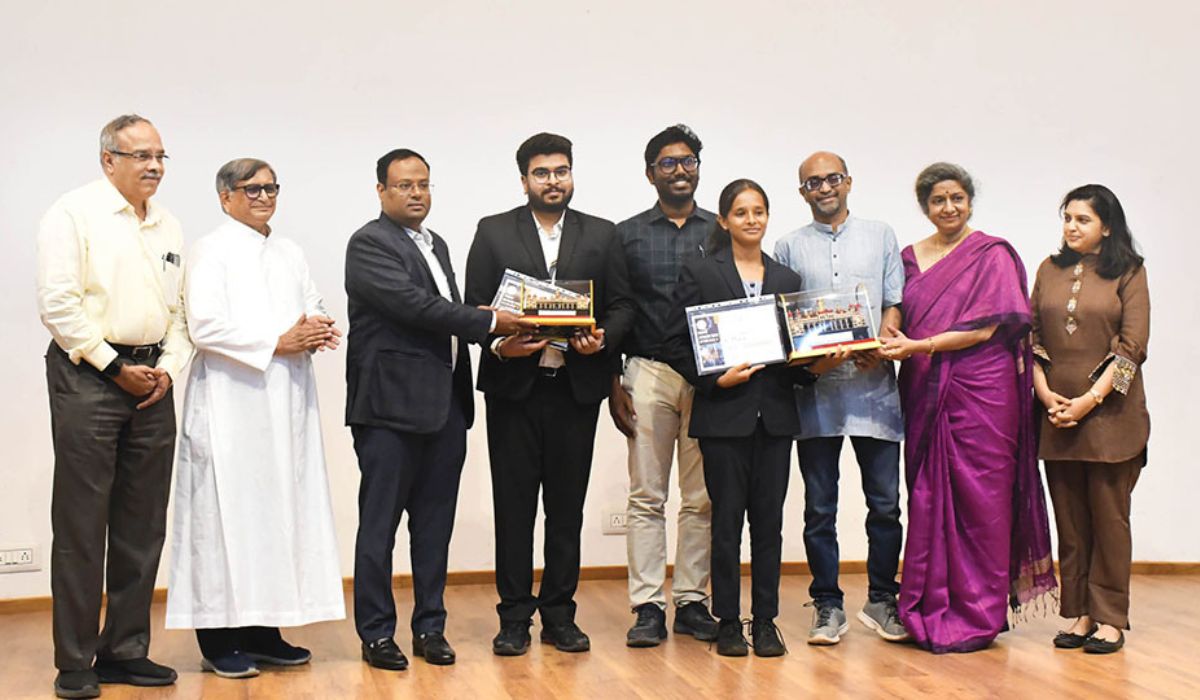
The initiative received first place in the final of Vision Mysuru-2050, an event organized by the SDM Institute for Management Development, in a competition that gathered 317 entries, according to a publication by the Indian newspaper Star of Mysore.
The proposal addresses a common problem in urban centers: rainwater, as it flows through streets, sidewalks, paved areas, and irregular disposal points, can carry different types of waste to stormwater galleries.
This material, when not retained along the way, reaches lakes, streams, and reservoirs, affecting water quality and increasing pressure on urban cleaning and management systems.
In the case of Mysuru, the students reported that the idea arose after observing the situation of the city’s lakes, including Koorgalli, and the use of drainage channels as waste disposal points.
From this observation, the team spent almost a year researching ways to intercept pollutants at the source, before they were carried by runoff to bodies of water.
How the filter created by the students works
Project Shudhi was conceived as a multi-stage filtration unit.
Instead of using just a grid or physical barrier, the prototype combines different processes to handle materials of various sizes and compositions.
The description released by those responsible indicates the use of aeration, vortex separation, sediment capture, and adsorption media.
Each stage has a specific function within the system.
Vortex separation helps direct particles according to the weight and movement of the water.
Sediment capture retains soil, sand, and smaller debris.
Adsorption methods are employed to capture contaminants that would not be removed by simple filtration alone.
According to the team, the prototype was built with accessible and low-cost materials, including repurposed components.
The stated intention is to facilitate installation in existing networks and reduce the need for complex maintenance.
The system was also described as solar-powered, a feature that may allow operation in drainage points without directly relying on the electrical grid.
The modular structure is another aspect presented by the students.
This format allows the unit to be adapted to different points in the city, as not all drains or channels receive the same volume of water, the same amount of waste, or the same type of pollution.
In areas with higher waste accumulation, for example, the physical retention stage tends to be more demanding; in others, sediments and oily residues may be the main problem.
Urban pollution carried by rainwater
The pollution carried by runoff does not always appear on the water’s surface.
Bottles, bags, and packaging are easily identified, but smaller particles, oil residues, plastic fragments, and materials associated with urban wear can remain mixed with the drainage flow.
When they reach lakes or streams, removal becomes more difficult.
In the report released about Project Shudhi, the team claims to have identified both visible waste and smaller-scale contaminants during the research phase.
This observation guided the creation of a system that not only blocks large waste but also seeks to reduce the entry of fine materials and substances associated with water degradation.
Retention close to the source is a strategy adopted in different stormwater management models.
It does not replace basic sanitation, enforcement against illegal dumping, or urban cleaning, but it can function as an additional layer of control.
When part of the waste is collected before reaching larger channels, removal tends to be operationally simpler.
In rapidly growing cities, drainage networks are often pressured by larger volumes of water and improper waste disposal.
Under these conditions, manholes and galleries stop transporting only rainwater and start carrying waste and contaminants as well.
The Indian prototype was developed precisely to act at this intermediate point between the street and the water body.
School project targets application in drainage networks
Although developed by basic education students, Project Shudhi was presented as a solution aimed at urban management.
The proposal combines field observation, research on pollutants, and the application of physics and chemistry principles in a functional prototype.
The work was also framed in the context of Mysuru’s long-term planning, the central theme of Vision Mysuru-2050.
According to the project’s disclosure, the unit was designed to support local authorities and communities in sustainable water management.
The students’ expectation is that, with continuous use, the system will help reduce pollutant loads, protect aquatic organisms, and decrease conditions associated with algae proliferation.
These points, however, were presented as project objectives, not as results already proven in large-scale operation.
So far, no independent public data has been found on the removal percentages of microplastics, heavy metals, oils, or sediments by the prototype.
There is also no confirmation of widespread application in a municipal drainage network.
For this reason, the initiative should be treated as a award-winning experimental model, not as technology already validated by long-term urban tests.
The proposal, nevertheless, shows how common city structures can be used to reduce the arrival of waste to water bodies.
Manholes are usually remembered only during floods or blockages, but when equipped with retention and filtration devices, they can act as interception points for pollutants in the path of stormwater.
Manholes as a barrier against microplastics and waste
Rainwater travels a short path between the streets and the water bodies.
In many cases, this path does not undergo treatment before reaching lakes or streams.
Therefore, solutions installed in the drainage network itself are studied as a way to reduce diffuse pollution, a term used for contamination that does not come from a single identifiable source, but from various urban surfaces.
In the case of Project Shudhi, choosing the storm drain as the point of action allows for retaining part of the material before it spreads.
A package caught in a filtration unit can be removed during maintenance.
The same waste, when it reaches a lake, can fragment, sink, or circulate over larger areas, making cleaning difficult.
The logic also applies to sediments and small particles.
When these materials enter water bodies, they can settle at the bottom or remain suspended.
In both cases, control becomes more complex than retention in a drainage structure accessible by maintenance teams.
The award received by the students places Project Shudhi among the innovative proposals aimed at the conservation of urban lakes in Mysuru.