Portuguese
  Spanish


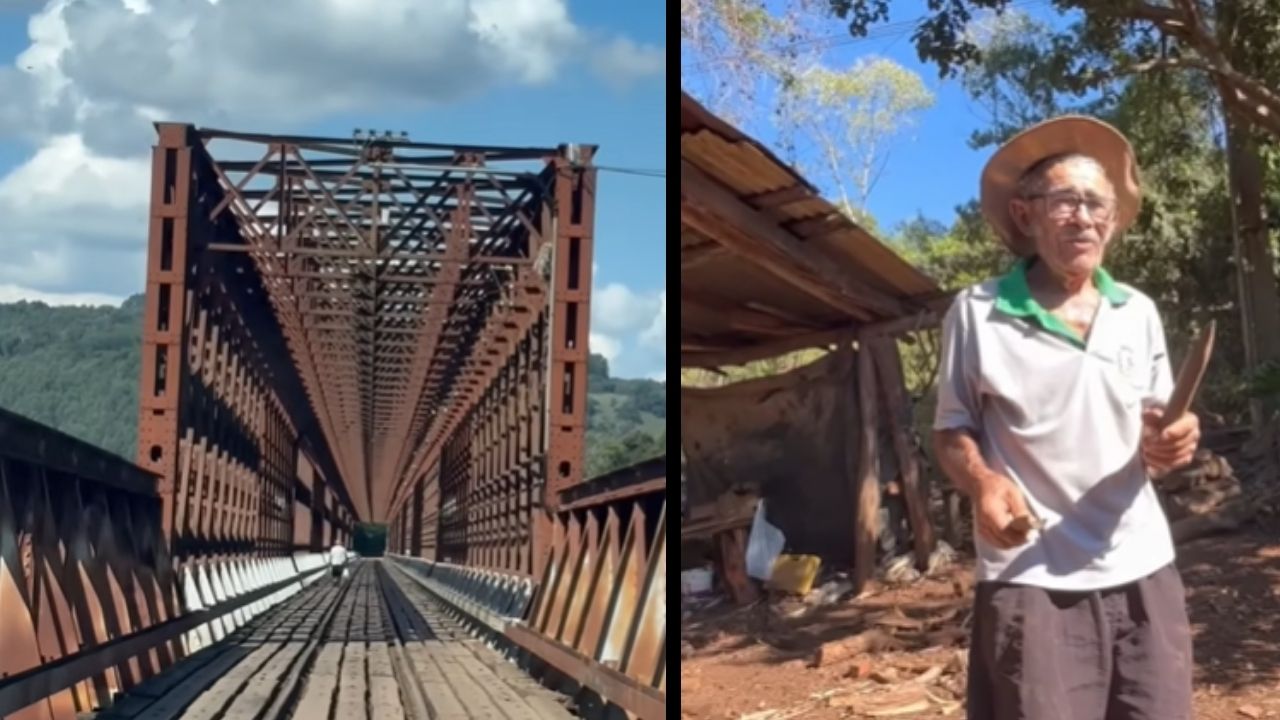

In a video from the JJ88 channel, Jon Morais crosses the railway bridge of Marcelino Ramos, in Rio Grande do Sul, over the Uruguay River, and meets a rural couple who keep sugar in the pot, beans in the manguá, old tools, subsistence farming, and living rural memory in the southern interior.
The railway bridge over the Uruguay River, in Marcelino Ramos, in Rio Grande do Sul, paved the way for a journey that mixes road, rural memory, and ancient techniques still preserved in the interior. In the video from the JJ88 channel, Jon Morais crosses the century-old structure and heads towards Santa Catarina.
In a video published on March 28, 2026, on the jj88 channel on YouTube, locates the crossing in Marcelino Ramos, shows the Uruguay River as a natural border, and follows the encounter with a rural couple who still preserve practices such as making sugar in the pot, threshing beans in the manguá, and keeping traditional tools.
Crossing begins in Marcelino Ramos
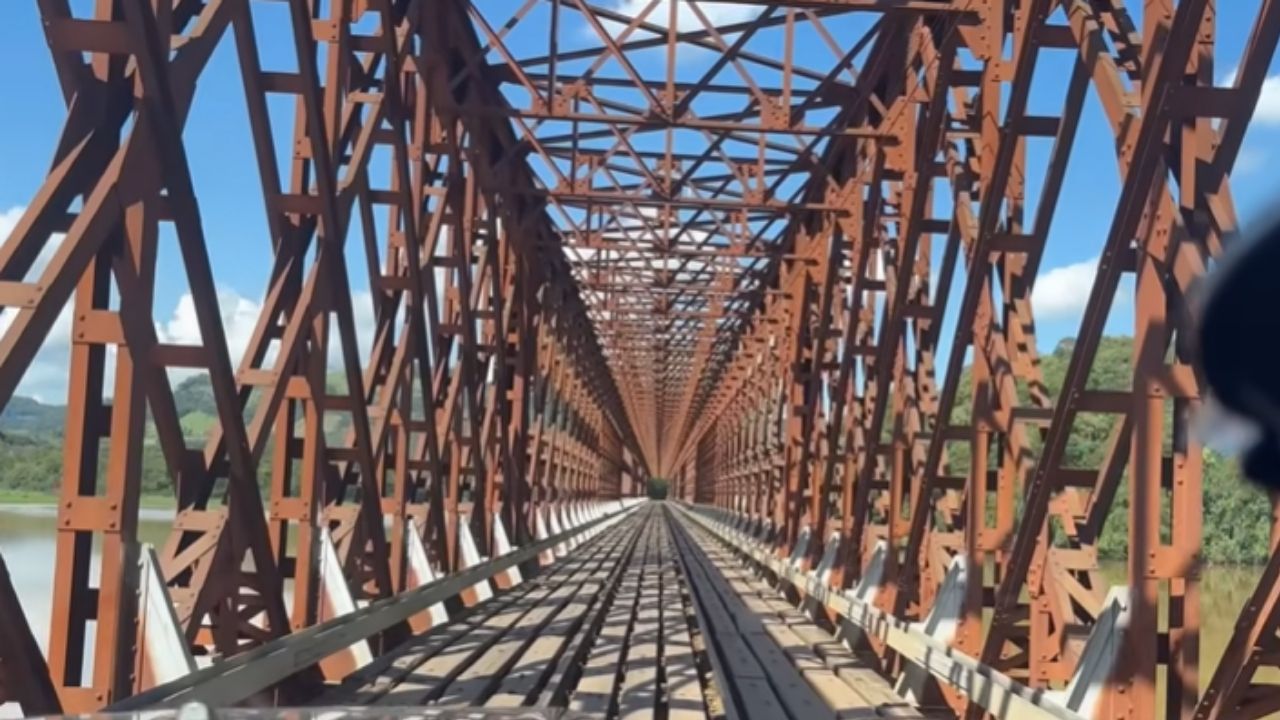
The video begins in Marcelino Ramos, a city in Rio Grande do Sul on the banks of the Uruguay River. Jon Morais shows the landscape and explains that, on the other side of the river, is already Santa Catarina, in a region marked by small roads, hills, and rural properties.
-
Rural Producer Returns to Brazilian Farmland, Builds Family Agricultural Business with Children’s Support and Industry Backing

-
Goiás Couple Boosts Artisan Cheese Production from 25 to 70 Kilos Daily with Technical Support, Transforming Family Life in Rural Brazil
-
13-Year-Old Discovers Ancient Roman Ring Near Mount Carmel, Now Set for Display in Jerusalem
-
São Paulo Recycling Campaign Collects 16.1 Tons of Used Cooking Oil, Distributes Over 19,000 Biodegradable Soap Bars to Families




The railway bridge appears as the first impactful element of the journey. According to the narrator, the structure is over 100 years old and was originally built for train passage, not for car traffic.
Cars pass one at a time
The passage of vehicles over the bridge follows a simple logic: whoever is going to cross needs to look to the other side and check if there is no car coming in the opposite direction. If there is movement, you need to wait.
This detail gives visual strength to the scene. The railway bridge does not function as a common road, but as a narrow, old, and shared crossing, where the driver’s attention is an essential part of the journey.
Structure still holds historical function
In the video, Jon Morais comments that the train has already passed through the structure and mentions the tourist trip linked to the Piratuba region, although he does not confirm the exact situation at that moment. The safe point is that the bridge was designed for railway transport.
Today, in the presented record, it also serves the local circulation of vehicles. This combination between old function and current use helps explain why the railway bridge draws attention: it remains in daily life even carrying marks of another time.
Uruguay River marks the landscape of the journey
The Uruguay River is more than a scene. It organizes the geography of the video, separates Rio Grande do Sul and Santa Catarina, and accompanies part of the path shown by the JJ88 channel.
After the crossing, the journey continues on a dirt road of about 14 kilometers, according to the narrator. The landscape alternates views of the river, hills, sloping areas, and stretches where the road seems to run over a high mountain line.
Encounter changes the course of the recording
Along the way, Jon Morais meets a resident identified in the transcript as Mr. Adelino, accompanied by Mrs. Luía. The conversation begins simply, related to the passage over the bridge and life around the Uruguay River.
From there, the video changes focus. The railway bridge ceases to be just a crossing and becomes a gateway to a story of farming, old tools, manual techniques, and production methods that almost no longer appear in cities.
Couple maintains routine connected to the land
The couple talks about life in the colony, working on the farm, and staying in the countryside. They mention growing beans, corn, sugarcane, cassava, and sweet potatoes, as well as raising pigs and using cows for property tasks.
The record does not present the property as a formal tourist attraction. What appears is a preserved rural routine, with objects, practices, and tools used in daily life or kept as a memory of a life connected to the land.
Sugar is still made in the pan
One of the strongest points of the video is the place where the sugar is made. The resident shows the pan, the fire space, the tools used to stir the syrup, and the process that, according to him, can yield about 30 kilos when the wood is good.
The scene draws attention because it shows an artisanal production uncommon to many people. Sugar in the pan appears as an old practice still alive, made with accumulated knowledge and simple instruments.
Beans beaten in the manguá arouse curiosity


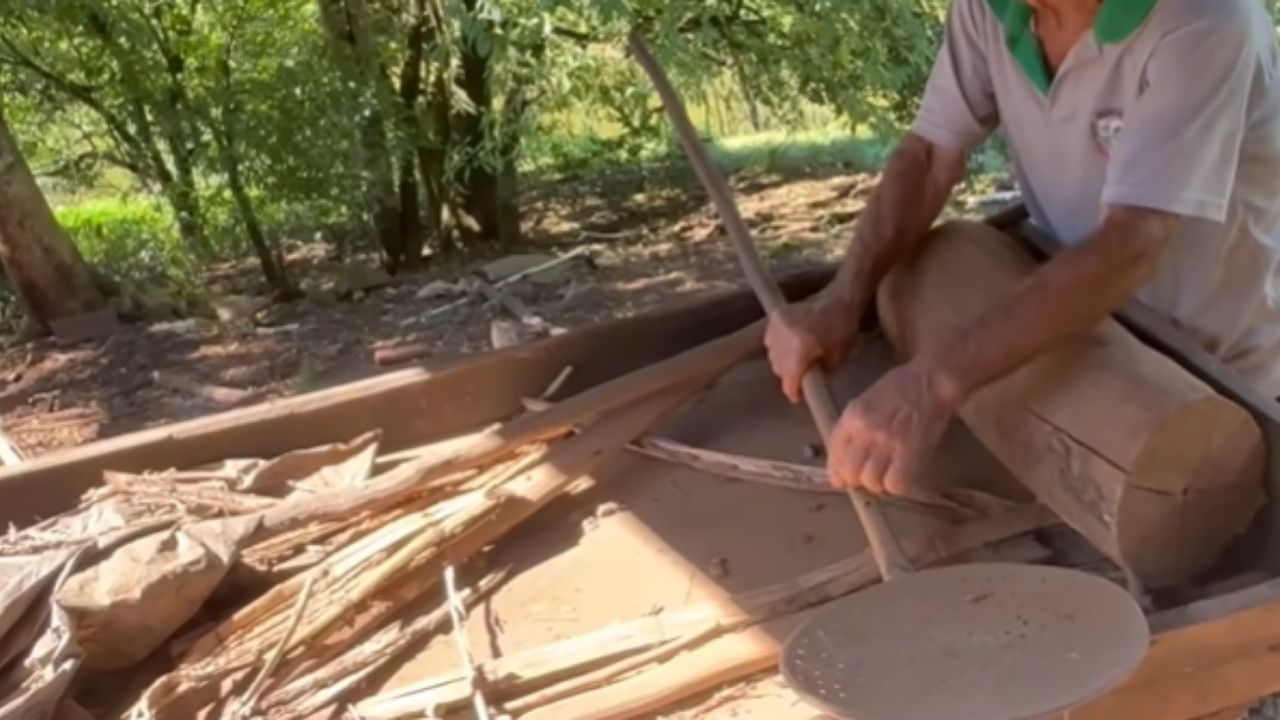
Another striking image is the beans beaten in the manguá. The resident himself comments that, the day before, a car had stopped because someone wanted to understand how that technique worked.
The manguá appears in the video as part of a set of practices that withstand time. For those who grew up far from the farm, the object may seem like a museum piece; for the couple, it is part of a work logic that still has utility.
Tools form a living museum
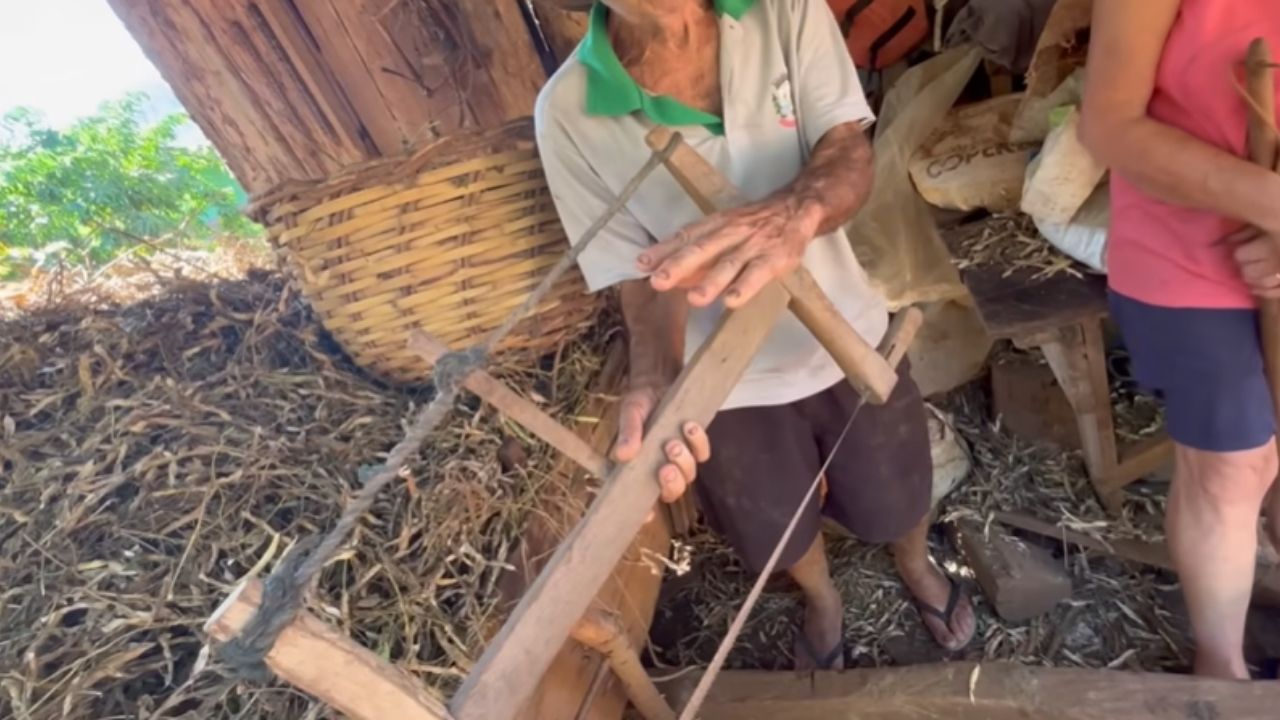
Walking through the property, Jon Morais shows a plow, ox planter, press, blacksmith tools, anvil, auger, old saw, grindstone, gouge, adze, trough, basket, cart, and pieces made or adapted by the resident himself.
The strength of the scene lies precisely in this mix between use and preservation. It is not a museum set up for visitation, but a living rural collection, formed by objects that tell how work was done before broader mechanization.
Blacksmithing shows manual skill
The resident also shows the small blacksmith shop, where he heats iron, makes or adapts tools, and explains processes such as tempering pieces to make them gain resistance. He demonstrates practical knowledge of fire, metal, wood, and field use.
This passage enhances the documentary value of the video. The railway bridge leads to an ancient landscape, but the visit reveals something even rarer: manual knowledge that depends on observation, trial, experience, and family memory.
Basket, leather, and wood enter history
Among the objects shown, the basket stands out. Made with vine and bamboo, it appears as a work tool and also as an example of artisanal skill. The resident explains the assembly steps and shows the care with the weaving.
There are also leather pieces, wooden handles, utensils, and tools adapted to the property’s reality. The video shows that, in the countryside, many objects were not simply bought: they were made, repaired, or reinvented as needed.
Food reveals another way of life
The conversation also touches on the old food in the countryside. The couple mentions beans, cassava flour, eggs, pigs raised on the property, cassava, corn, and products grown right there.
This passage does not need to be read as idealized nostalgia. It shows a way of life where food production was very close to the house, the fields, and the animals. The countryside appears as a space of work, sustenance, and practical knowledge.
Technology and tradition appear on the same path
Interestingly, the video also talks about technology. Jon Morais comments on the use of GPS, the road, the camera, and even artificial intelligence, while traveling through a region where ancient techniques remain visible.
This contrast helps to give rhythm to the narrative. On one side, the journey guided by technology; on the other, the railway bridge, the manguá, the cauldron, the blacksmith shop, and the handmade tools. The video places these two worlds on the same road.
Record values rural memories
The presenter’s speech reinforces the importance of recording these practices for new generations. He comments that many young people may no longer know objects like those and encourages the audience to observe the value of old things.
This point is the journalistic heart of the topic. The journey does not just show a beautiful crossing or a curious property. It records techniques, words, tools, and stories that help understand how part of rural life was built in the interior of the South.
Bridge becomes gateway to another era
The centenary railway bridge over the Uruguay River functions as a symbol of the article. It connects states, crosses a historical landscape, and leads the driver to a series of encounters that seem to suspend time.
In the end, what remains is the combination of road, river, farm, and memory. The bridge leads to the other side, but it also opens the way for practices that still survive on small properties and reveal a rural Brazil rarely seen in big cities.
A path between road, river, and memory
Jon Morais’s journey through the JJ88 channel shows how an old railway bridge can be more than just a passage structure. It can lead to stories kept in pots, tools, crops, baskets, and roadside conversations.
Do you think practices like making sugar in a pot, threshing beans in a manguá, and maintaining old tools should be more documented for future generations? Leave your opinion in the comments and tell us if something similar still exists in your family or region.