Portuguese
  Spanish


Strawberry Moon lights up the Brazilian sky on June 29. Check the best time, how to observe, and why the phenomenon doesn’t turn the Moon pink.
Monday, June 29, will have two events capable of mobilizing Brazilians. After the National Team faces Japan in the World Cup knockout stage at 2 PM, eyes can turn to the sky to watch the so-called Strawberry Moon.
The June full moon will reach its peak illumination around 8:58 PM, Brasília time. It won’t be necessary to use a telescope or any special equipment: the phenomenon can be observed with the naked eye throughout the country, as long as the sky is clear and not heavily clouded.
Those intending to watch the spectacle don’t need to wait until the exact time of the full phase. The Moon will begin to appear on the horizon late in the afternoon, shortly after the Brazilian National Team’s match.
-
Driver Crosses 100-Year-Old Railway Bridge Over Uruguay River, Encounters Rural Couple Preserving Traditional Farming Methods

-
Rural Producer Returns to Brazilian Farmland, Builds Family Agricultural Business with Children’s Support and Industry Backing
-
Goiás Couple Boosts Artisan Cheese Production from 25 to 70 Kilos Daily with Technical Support, Transforming Family Life in Rural Brazil
-
13-Year-Old Discovers Ancient Roman Ring Near Mount Carmel, Now Set for Display in Jerusalem



In São Paulo, the Moonrise is expected at approximately 5:11 PM. In Rio de Janeiro, the satellite should appear around 4:58 PM. These times change according to the observer’s location and may vary even between nearby cities.
Best time to watch the Strawberry Moon
The period close to the Moonrise tends to offer one of the best opportunities for observation and photography. When low on the horizon, it may appear larger and take on golden, orange, or reddish hues.
The effect doesn’t represent a real change on the lunar surface. Near the horizon, the light reflected by the Moon needs to pass through a larger layer of Earth’s atmosphere. In this journey, part of the bluish tones is scattered, while colors like yellow, orange, and red become more evident.

Buildings, trees, mountains, and monuments can also be used as foreground elements, creating more striking images. To enhance the experience, the recommendation is to find an open area with a good view of the horizon, away from streetlights, illuminated facades, and other sources of artificial light.
Cell phones can capture the phenomenon, especially if they are supported on a stable surface. Binoculars and small telescopes are not mandatory, but they help to see craters, plains, and other features of the lunar surface.
Will the Moon turn pink or red?
Despite the name, the Strawberry Moon is not a phenomenon that naturally transforms the satellite into a pink or red sphere. Under normal conditions, it should appear white, silver, or slightly golden, common to other full moons.
The reddish hue may temporarily appear during its rise or disappearance on the horizon due to the atmosphere. Dust, humidity, smoke, and pollution can also influence the perceived color.
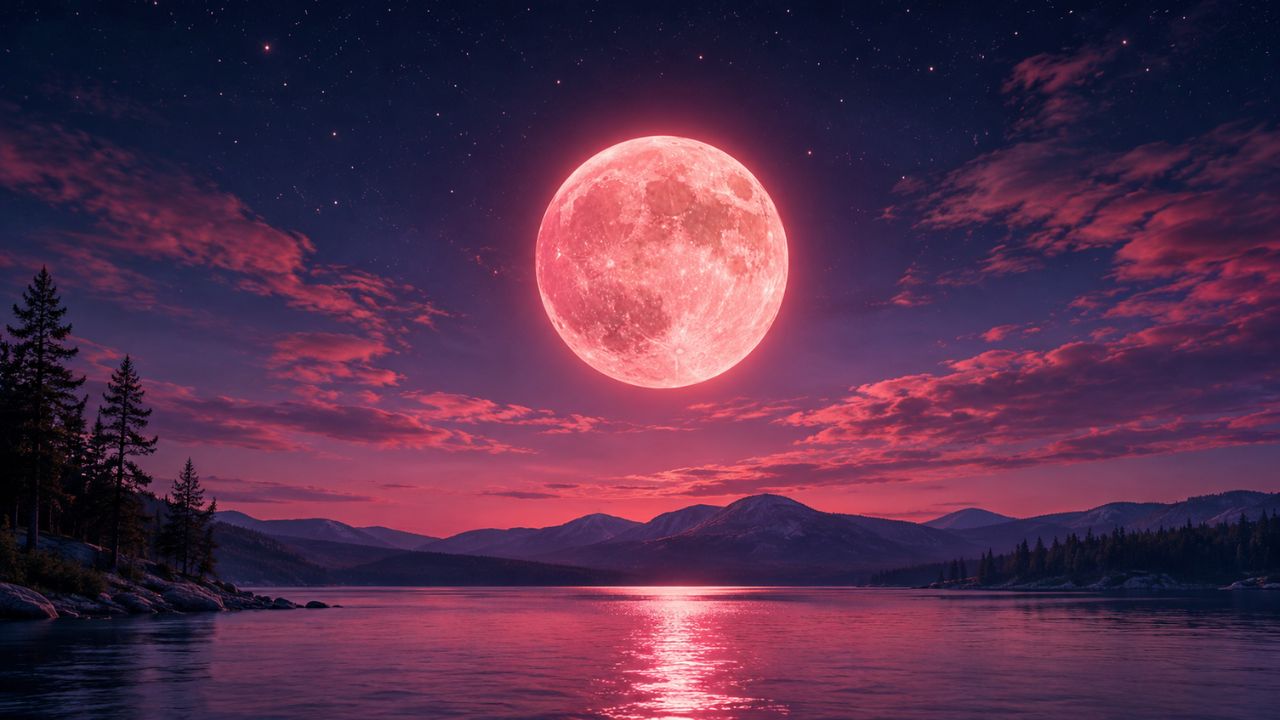
A truly reddish Moon is usually associated with a lunar eclipse, when the Earth blocks the direct incidence of sunlight on the satellite. This is not the case for the event on June 29.
Where does the name Strawberry Moon come from?
The name is linked to the agricultural calendar and the traditions of indigenous peoples of North America. The full moon in June coincided with the ripening and harvesting period of wild strawberries in certain regions of what are now the United States and Canada.
Therefore, the name refers to the time of year, not the appearance of the celestial body.
Different communities developed their own names for the full moon of this period. Among the recorded names are Blackberry Moon, Raspberry Moon, Ripe Berries Moon, Garden Moon, and Green Corn Moon. These expressions related lunar cycles to changes in nature, food availability, and agricultural activities.
In European tradition, the full moon of June was also known as Rose Moon, Honey Moon, or Mead Moon. In China, one of the traditional names is Lotus Moon. In the Southern Hemisphere, where June marks the arrival of winter, it can also be called Cold Moon.
The period also holds religious significance in different countries. In Sri Lanka, the full moon in June coincides with Poson Poya, a celebration linked to the introduction of Buddhism on the island. Hindu communities celebrate Vat Purnima, a tradition in which married women perform prayers and rituals associated with the well-being of their families.
Why will the Moon be in a favorable position in Brazil?
The apparent position of the Moon in the sky changes according to latitude and the season of the year. Near the June solstice, the full Moon follows a relatively low path for observers in the Northern Hemisphere.
According to the astronomy portal StarWalk, the opposite occurs in the Southern Hemisphere. Since most of Brazil’s territory is south of the Equator, the satellite may reach a high position in the sky throughout the night, favoring its visibility for several hours.


The Moon will be astronomically full only at a specific moment, when it will be approximately on the opposite side of the Sun relative to the Earth. For those observing without instruments, however, it will appear full during the nights of June 28, 29, and 30.
This means that any clouds on Monday do not completely eliminate observation opportunities. The satellite should still present an almost complete disk the following night.
More than a calendar curiosity, the Strawberry Moon brings together astronomy, history, and cultural traditions. It also offers the public an accessible opportunity to observe the sky: just find a place with a clear horizon, little artificial lighting, and favorable weather conditions.
With information from Metrópoles