Portuguese
  Spanish


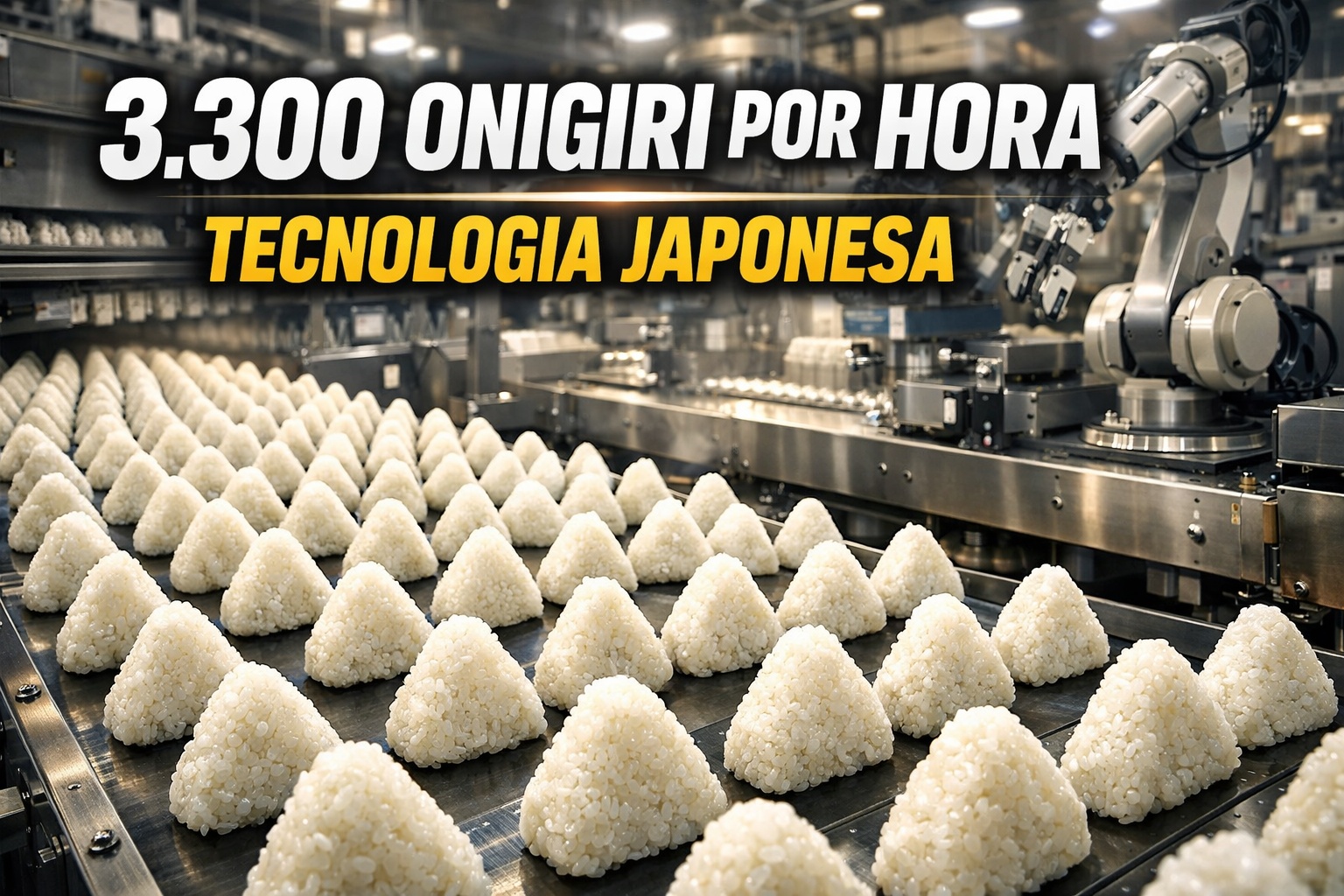


Japanese Machines Produce Up to 3,300 Onigiri Per Hour with Digital Control, Automatic Molding, and Logistics That Supplies Billions of Units Annually.
In Japan, onigiri has evolved from being just a traditional home cooking preparation into a highly precise industrial product. In automated factories located in regions such as Tokyo, Osaka, and Saitama, production lines equipped with machines developed by companies like Suzumo Machinery Co., Ltd. and Fuji Seiki Co., Ltd. shape thousands of units per hour with strict control of weight, temperature, and humidity.
According to data released by Japanese industrial equipment manufacturers, some automatic molding machines are capable of producing up to 3,000 to 3,300 units per hour, maintaining identical dimensional standards in each piece. The sector is mainly supplied by large convenience store chains such as 7-Eleven Japan, FamilyMart, and Lawson, which together operate over 50,000 stores throughout Japan, according to data from the Japan Franchise Association.
It is estimated that billions of units of onigiri are sold annually in the country, making the product one of the most consumed ready-to-eat foods in Asia.
-
Helsinki Residents Receive Water That Travels 120 Kilometers Through a Hidden Rock Tunnel from a Lake Before Treatment

-
SENAI Launches $36 Million Innovation Round to Boost Brazilian Manufacturing Productivity and Reduce Business Risks with R&D Projects by 2026
-
Indonesia Plans to Build 5,000 Suspension Bridges by 2026 to Connect Rural Communities to Schools, Health Centers, and Markets
-
U.S. Invests $75 Million in Projects to Extract Rare Earths, Gallium, Germanium, and Aluminum from Coal Waste




The Industrialization of an Ancient Food
The historical origins of onigiri date back to the Heian period (794–1185), when molded rice was used as portable food by travelers and warriors.
For centuries, its preparation remained artisanal: short-grain Japanese rice was cooked, lightly salted, and manually shaped, usually into triangular or oval forms.
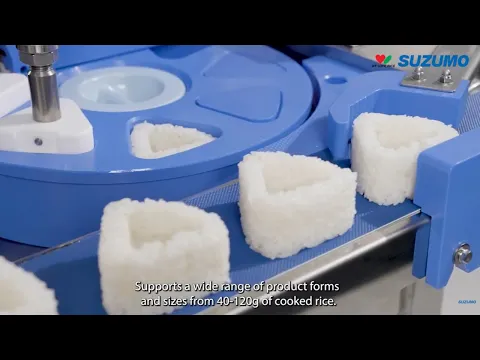

The industrialization began to gain scale in the 1970s when Japanese urban growth and the expansion of convenience store chains drove the demand for practical and standardized foods. Food engineering companies began to develop equipment capable of replicating the manual shape with mechanical precision.
Suzumo Machinery, founded in 1961 in Tokyo, became one of the pioneers in developing machines for sushi and onigiri. Today, its equipment is exported to dozens of countries and uses automated systems that control portions with gram precision.
How the Automated Production Line Works
The industrial manufacture of onigiri starts with japonica rice, which has a higher starch content and adhesive capability. After washing and controlled cooking in industrial kettles, the rice goes through cooling systems that adjust the ideal molding temperature, usually between 35 °C and 45 °C.
The rice is then fed into automatic molding machines. Inside the equipment, hydraulic pistons or pneumatic systems press the rice into digitally calibrated triangular molds. The standard weight usually varies between 90 g and 110 g per unit, depending on the type.
Some lines use dual-chamber systems: first, a central cavity is formed where the filling is automatically inserted by dispensing nozzles. The fillings vary between tuna with mayonnaise, grilled salmon, umeboshi (pickled Japanese plum), and seasoned kombu.
After the filling, the machine closes the mold and releases the structured piece. The process can occur in cycles of a few seconds, allowing thousands of units per shift.
Quality Control and Food Safety
Since it is ready-to-eat food, health control is rigorous. Factories operate under standards set by the Ministry of Health, Labor, and Welfare of Japan. Production environments have temperature controls, positive pressure to prevent external contamination, and automated inspections.
X-ray detection systems or metal detectors check for possible foreign fragments before packaging. Optical sensors also analyze the shape and structural integrity.
After molding, onigiri goes through a crucial step: the wrapping with nori seaweed. Many packages use a patented system that separates rice from nori, keeping the nori dry until the moment of opening by the consumer, preventing it from becoming moist before sale.
Highly Efficient Logistics
A large part of the production is made on demand to supply convenience store chains with daily deliveries or even multiple deliveries a day. Refrigerated distribution centers keep the products at controlled temperatures, usually below 10 °C.
According to corporate reports from 7-Eleven Japan, the logistics model is based on frequent deliveries of small batches to ensure maximum freshness. This requires digital synchronization between the factory, distribution center, and point of sale.
The average shelf life of industrial onigiri is short, typically between 24 and 48 hours, reinforcing the need for continuous and highly coordinated production.
Technology, Standardization, and Mass Consumption
Industrial standardization has transformed onigiri into a symbol of Japanese efficiency. Although traditional, it is now the result of food engineering, precision automation, and digital control.
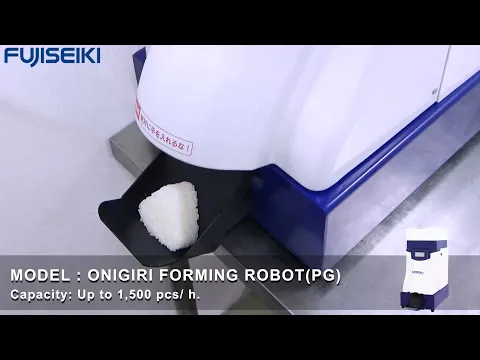
Companies like Fuji Seiki and Suzumo state that their machines utilize programming systems that allow for fine-tuning of rice density, compaction force, and filling size, ensuring consistency batch after batch.
Furthermore, modern lines can integrate remote monitoring, allowing engineers to track performance indicators in real time.
Economic Impact
The ready-to-eat meal market in Japan generates tens of billions of dollars per year, according to reports from Statista and data from the Japan Franchise Association. Onigiri represents a significant portion of this segment.
Its popularity has also expanded internationally. Japanese onigiri production machines are exported to the United States, Europe, and Southeast Asia, following the globalization of Japanese cuisine.
Tradition Shaped by Engineering
What started as manually molded rice over a thousand years ago has become a high-tech product.
The seemingly simple triangular shape is the result of calibrated molds, optical sensors, and synchronized lines down to fractions of a second.
In a country known for its ability to transform tradition into precision industry, onigiri symbolizes this convergence between culture and automation. The food remains simple in appearance, but behind each unit lies food engineering, meticulous logistics, and industrial production capable of sustaining billions of portions per year.