Portuguese
  Spanish


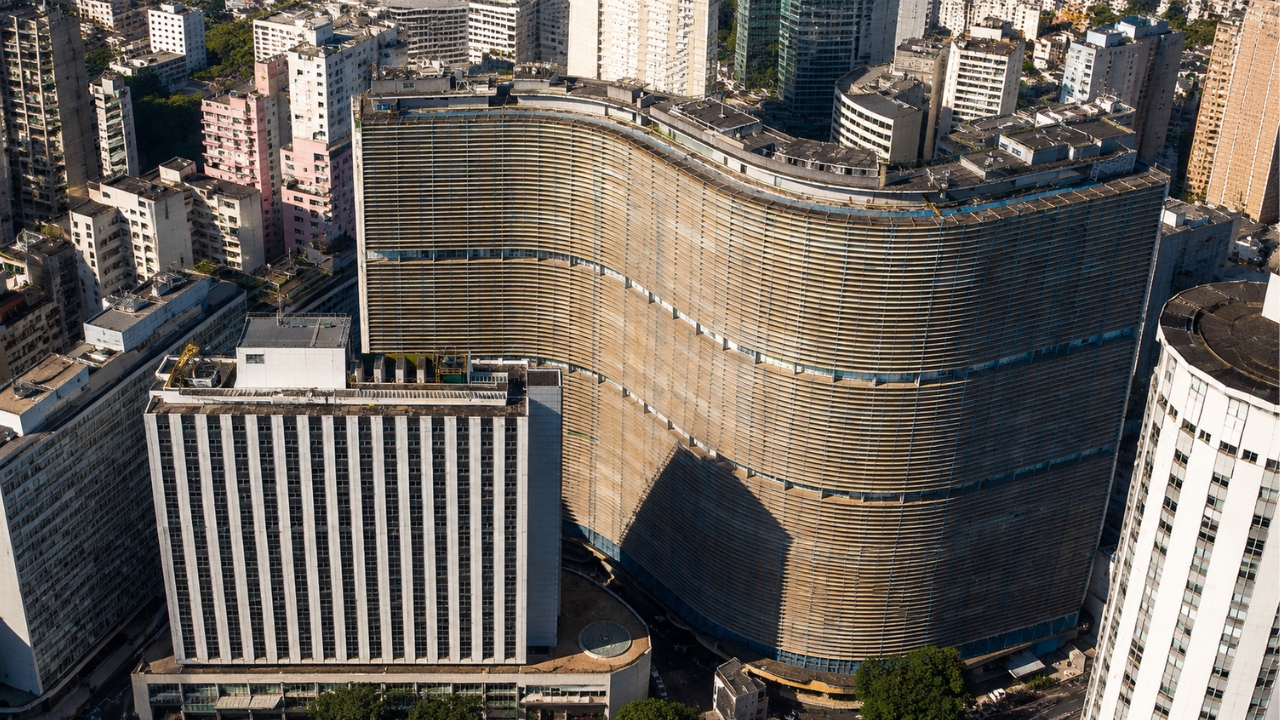

With a curved “S” shaped facade and bustling internal life, the historic building on Avenida Ipiranga brings together residents, shops, employees, and services in a structure that helps explain the strength of vertical occupation in São Paulo.
In the center of São Paulo, the Copan Building draws attention far beyond its curved facade. The building designed by Oscar Niemeyer houses 1,160 apartments, 72 shops, 32 floors, 22 elevators, and its own routine within a single address at Avenida Ipiranga, 200.
The strongest data comes from IBGE. According to the institute, Copan has more than 120,000 m² of built area, employs 104 staff, and houses about 5,000 inhabitants, a population larger than that of some Brazilian municipalities.
The result is a building that functions almost like a small vertical city within the capital of São Paulo. There are residents, commerce, intense circulation, services, and a complex administration to maintain one of the most well-known buildings in Brazil.
-
Rare 1747 Lutheran Bible from Germany, Preserved in Southern Brazil, Showcases Unique Engravings and Handcrafted Techniques

-
Before Japan Became a Football Powerhouse, Zico Transformed the Amateur League, Boosted the J.League, and Was Honored with a Statue at Kashima Antlers
-
House Left Isolated in the Middle of New Chinese Highway as Owner Refuses Compensation Deal, Construction Continues Around the Property

-
Venetian Factory Luigi Bevilacqua Crafts Velvet by Hand on 18th-Century Looms, Producing Just 30 Centimeters a Day


A building that became an urban symbol in the center of São Paulo
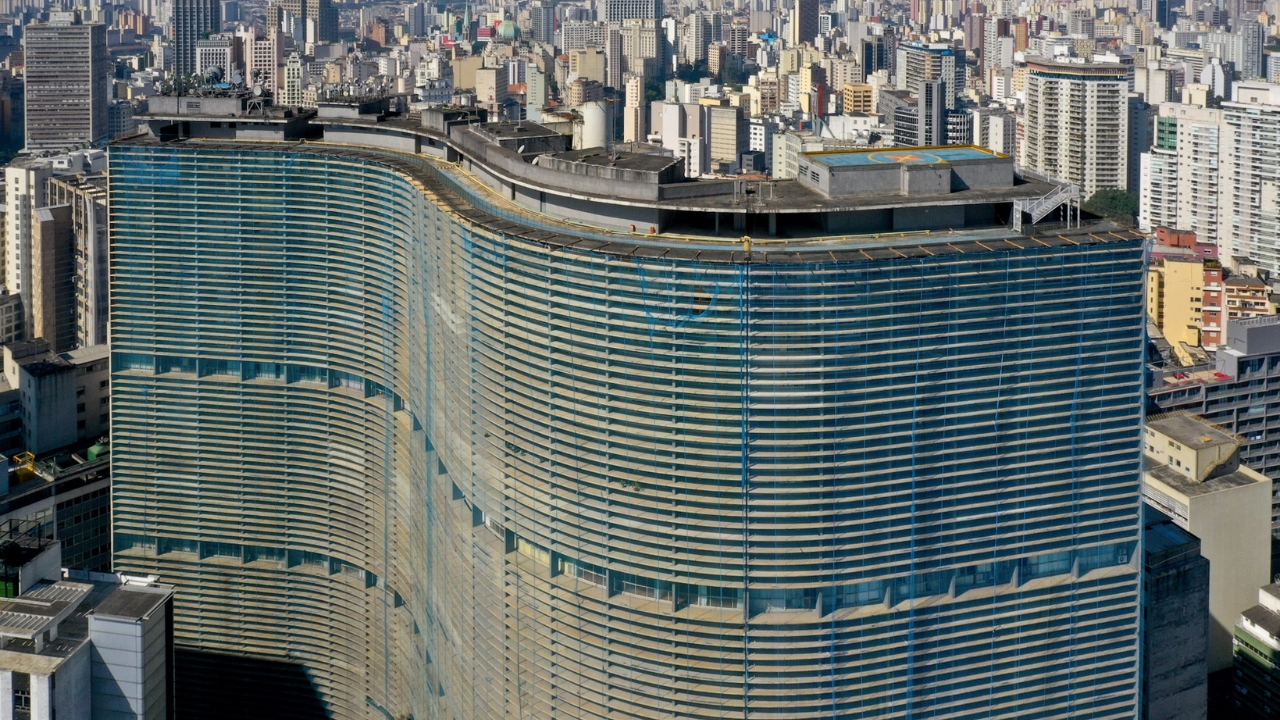
Copan is located in the Republic region, in the heart of the city, and has become one of the most recognized symbols of modern Brazilian architecture. The wavy “S” shape made the building stand out among the straight and dense constructions of downtown São Paulo.
According to IBGE, the building was constructed with masonry and reinforced concrete, with pronounced curves and folds. The facade does not only serve as a visual mark. It helped transform Copan into an image immediately associated with the landscape of São Paulo.
The project was born in the context of the city’s urban expansion in the 1950s, linked to the IV Centenary of São Paulo. According to Instituto Pedra, the development was commissioned by the Pan-American Hotel and Tourism Company, the origin of the name Copan.
More than a thousand apartments and dozens of shops at the same address
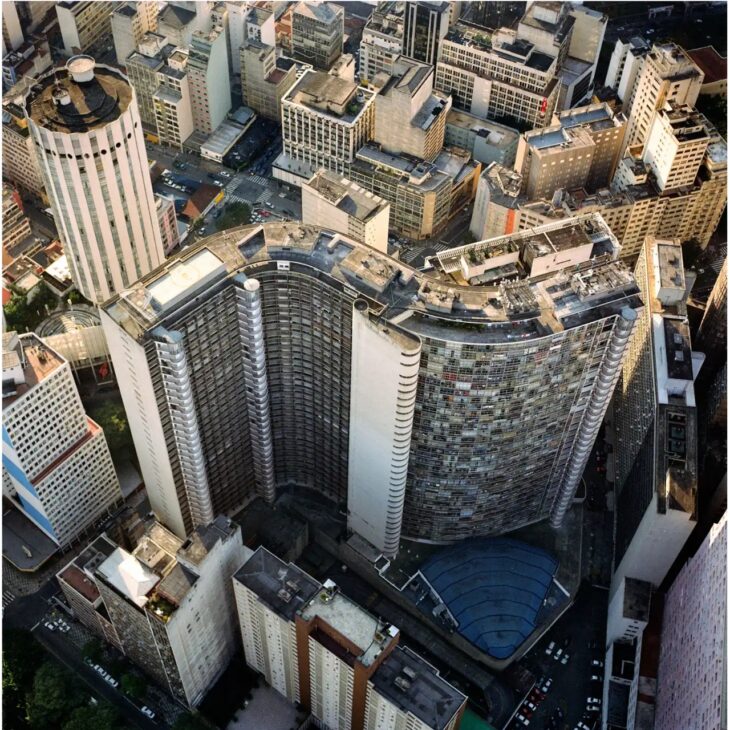
The size of the Copan explains why it is often described as a city within a building. The IBGE records 1,160 apartments, 72 stores, 32 floors, and 22 elevators. The structure requires a daily operation that goes beyond a common condominium.
The Jornal da USP also presents the building as the largest residential apartment complex in Latin America, a title associated with the Guinness Book. The publication reports that the apartments are distributed across six blocks, with units ranging from 29 m² to 214 m².
This variety helps explain the internal diversity of the Copan. The building houses different profiles of residents, routines, and ways of occupying the center. The Jornal da USP highlights precisely this social mix as one of the building’s strongest characteristics.
Internal commerce reinforces the idea of a vertical city
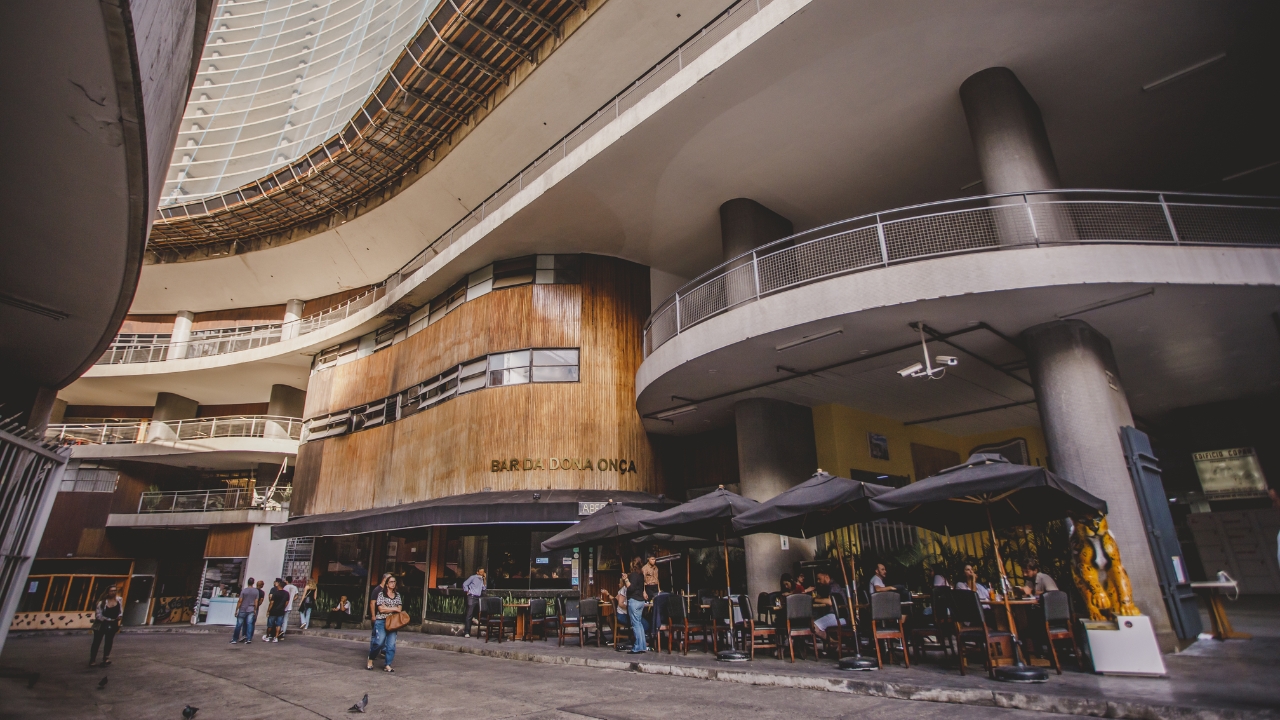
The Copan is not just a large residential complex. At the base and in the commercial areas, the building concentrates services that reinforce the sense of its own life. According to the IBGE, among the stores are restaurants, a stationery store, a bookstore, a laundry, a Pilates studio, and even a video rental store.
This commerce creates a particular dynamic. Part of the routine of residents and visitors happens without leaving the complex. At the same time, the building connects directly with the intense life of downtown São Paulo, where residents, workers, and visitors cross the same space every day.
The presence of 104 employees, also mentioned by the IBGE, shows the size of the machinery needed to keep this structure functioning. Instead of a common building, the Copan operates as a compact urban system, with housing, services, circulation, and permanent maintenance.
Niemeyer, project changes, and a work completed in 1966
The history of Copan also carries tensions. The project was conceived by Oscar Niemeyer and included the collaboration of Carlos Alberto Cerqueira Lemos, according to the Instituto Pedra. However, the construction faced technical and financial problems and was only completed in 1966.
The Jornal da USP states that the project underwent significant changes during its execution. These changes caused Niemeyer to distance himself from the work for many years, although he later acknowledged its importance and participated in the preservation process.
This detail makes Copan even more interesting. The building did not become an icon for being a simple or linear work. It went through changes, construction difficulties, adaptations, and even so, it established itself as one of the strongest images of Brazilian architecture.
Historic facade entered restoration process
The historical weight of Copan also appears in its official protection. The São Paulo City Hall informs that the building was listed by Conpresp in 2012, within a set of modern buildings recognized for their historical, architectural, urban, and landscape value.
In recent years, the facade has become a restoration topic. According to the City Hall, an incentive linked to the Clean City Law was authorized to enable the restoration, with temporary advertising on the protective screen during the works.
The same source states that the planned advertisement would be 71 meters long by 28 meters high, totaling 1,988 m². The number shows that even the restoration of Copan’s facade gained monumental scale, compatible with the symbolic size of the building.
Old cinema reinforces Copan’s cultural side


Another point that expands the building’s history is the old Cine Copan. According to A Vida no Centro, the space was inaugurated in 1970, operated until 1988, then became a theater, and between 2000 and 2008, it was occupied by a church.
The current project plans to reopen as Nu Cine Copan, with cinema, theater, café, bar, and event spaces. Nubank reported that the first phase of occupation occurred between February and April 2026, while civil works and installations are expected to continue until June 2027.
The proposal includes about 440 seats, a 17-meter LED screen, and a Dolby Atmos sound system. If confirmed within this plan, the reopening repositions Copan also as a cultural point in downtown São Paulo, not just as a residential address.
A building that summarizes the complexity of São Paulo
The Copan impresses with its numbers, but its impact goes beyond them. The 1,160 apartments, the 72 stores, the 32 floors, and the thousands of residents reveal a rare form of urban occupation, where housing, commerce, memory, and circulation meet in the same place.
In the end, the building shows how São Paulo can fit within a single construction. The Copan is not just a famous building in the center. It is a vertical portrait of the city itself, with its curves, contradictions, services, stories, and daily movements stacked in concrete.