






 Portuguese
  Spanish


In Cornwall, the couple Abi and Morveth Ward sold their own house and moved into a trailer to transform a granite electrical substation tower from 1910 into an award-winning 11-meter dwelling. The house has only a 25 m² base and today houses the family with their daughter Posy.
Few people would look at an abandoned electrical substation tower and see a home. However, the couple Abi and Morveth Ward did exactly that in Cornwall, in the southwest of England. They bought a granite tower built in 1910, which once distributed energy to the region, and transformed it into an award-winning 11-meter high house. The story was told by the magazine Homebuilding & Renovating.
The gamble was as big as the tower. To fund the renovation, the couple sold their own house, pooled their savings, and moved into a fixed trailer on the land, next to the construction site. It was from this improvised base that they watched, day after day, the old electrical building turn into the home where they now live with their daughter, Posy.
They named the result Trevolt, a name that tells the story in two syllables. In the Cornish language, Cornish, “tre” means home or property, while “volt” is a direct homage to the building’s electrical past. The house combines, in its name, what it was and what it has become.
-
Sustainable Building Solutions Enhance Durability, Long-Term Savings, and Comfort in Home Construction and Renovation

-
Brazilian Fishing Couple Spends 4 Years Building Solar-Powered Floating Home on the Paraguay River, Now a Navy-Approved Vessel with Leisure Area and Tour Demand

-
While the World Opens New Airports and High-Speed Trains, Brazil Rushes to Complete Projects Stalled for 40 Years
-
Brazil Invests in Massive Waterway to Transport Soybeans by Barge, Reducing Costly Truck Reliance


The substation tower that became a house
The starting point was a building unlikely to become a home. The construction is a narrow and tall tower, made of local granite stone, erected in 1910 to house an energy substation in a rural area of western Cornwall. With 11 meters in height and only 25 square meters of base, it resembles more a chimney than a house.
It was precisely this strangeness that captivated the couple. “The uniqueness of the tower was what sold us the idea. It was imposing and in ruins, but we could visualize it finished,” Morveth told Homebuilding. Where most saw a problem, they saw a home with a unique personality.
The location helped close the deal. The tower is situated on a high point, on a narrow peninsula in Cornwall, from where it is possible to see both the north and south coasts of the region at the same time. It’s the kind of view that no ordinary house offers, and that turned the abandoned substation into a coveted address.
The couple who sold their house and moved into a trailer
Buying the tower was just the beginning of the sacrifice. To fund the transformation, Abi and Morveth Ward made a radical decision: they sold the house they lived in, put all their savings into the project, and moved into a fixed trailer installed on the property. They traded comfort for years of work.
The division of tasks kept the project afloat. Abi, who is an interior designer, took charge of the aesthetic part and the design of the spaces, while Morveth worked as a laborer on the project, hands-on from start to finish. Together, they managed a renovation much larger than anything they had ever done.
They knew they were taking a big risk. “We had done renovations before, but nothing on this scale,” admitted Morveth. Betting the house, savings, and routine on a tower in ruins was a leap into the unknown, the kind that only pays off when it works, and in this case, it did.
Living in the trailer, next to the construction site, gave the couple a daily relationship with every detail. Being close to the work, even in the tight space of a trailer, allowed them to adjust decisions in real-time and save where possible. It was a tough period, but they see it today as an essential part of the achievement.
What the substation was: a piece of electrical history
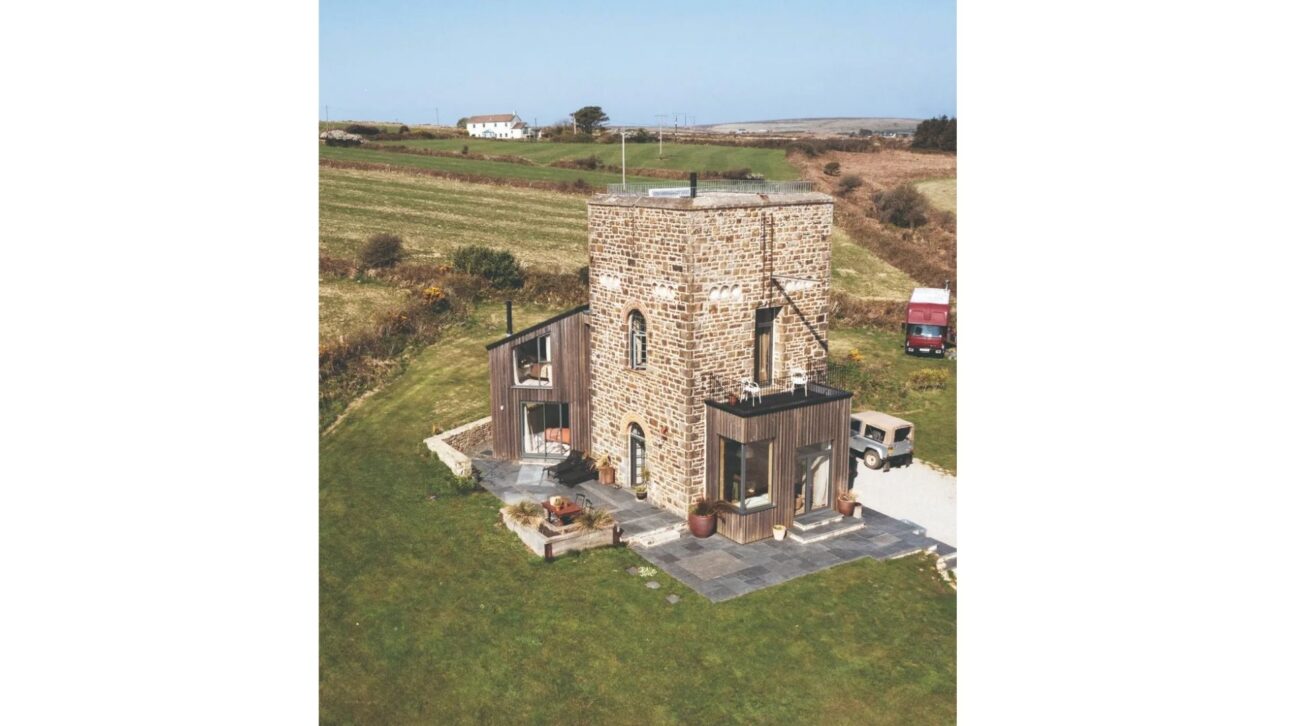
Before becoming a home, the tower played an important role in the life of the region. Built in 1910, it functioned as a power substation, helping to bring electricity to the surrounding towns and villages, at a time when electric light was still reaching the countryside. It was cutting-edge infrastructure for the time.
Like so many industrial structures, it had a limited useful life. With the modernization of electrical networks, the substation was deactivated around the 1960s and, from then on, was abandoned for decades. Without use, the granite building became a skeleton in the middle of the field, serving at most as an occasional shelter for farmers’ cattle.
It’s worth remembering the context of the time. In the early 20th century, electricity was still new outside major cities, and bringing energy to the countryside required a network of substations that adjusted the voltage for local use. A tower like this, from 1910, was a symbol of progress, equivalent, in a way, to an internet antenna reaching an isolated village today.
Rescuing this building is, in a way, preserving memory. Each substation tower like this tells a chapter of the country’s electrification, a heritage that usually ends up demolished or forgotten. By transforming the old substation into a home, the couple gave new life to a piece of energy history, instead of letting it fall.
11 meters high, 25 m² base: living vertically
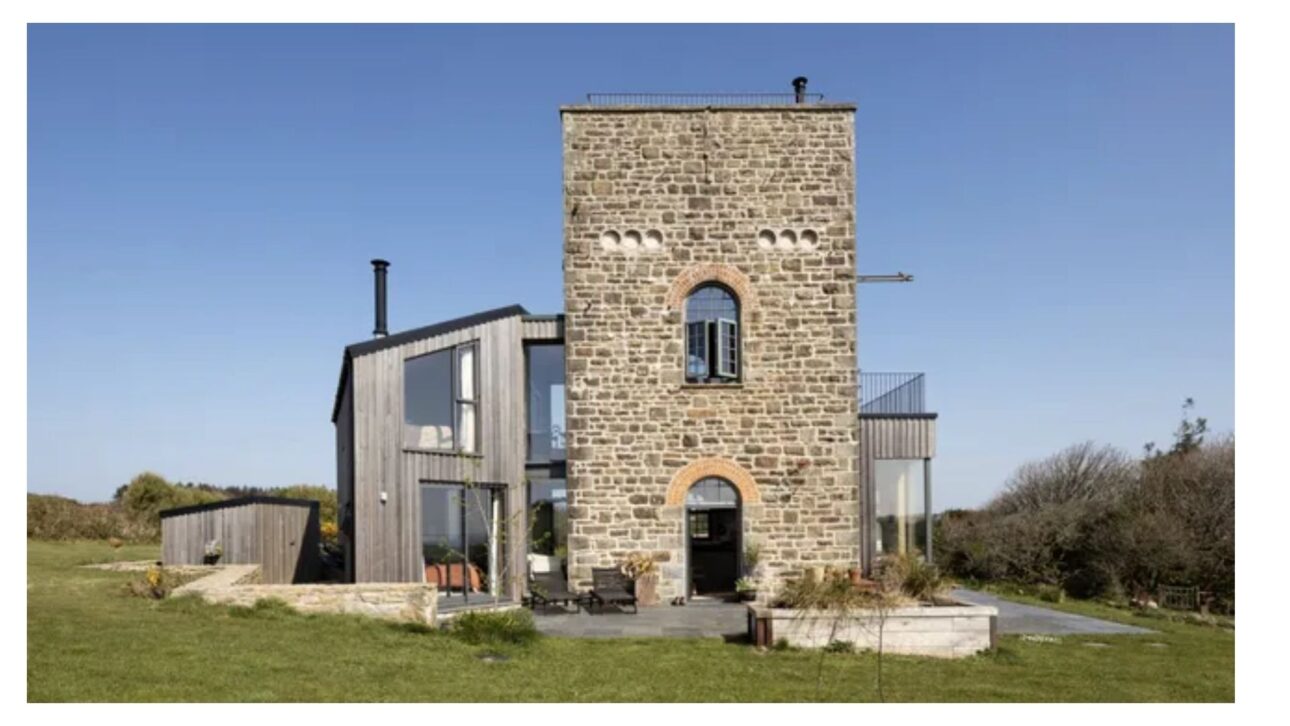
The main challenge of the project was fitting a house inside a tower. With only 25 square meters of base, there was no way to expand sideways, so the solution was to live vertically, stacking the rooms along the 11 meters of height. The house grew upwards, not sideways.
The layout was ingenious. According to Homebuilding, the residence is organized into three levels plus a mezzanine: on the ground floor are the kitchen with dining room, a bedroom, and a half bath; on the first floor, the living room with a balcony; on the second, a bedroom with a bathroom; and, at the top, a mezzanine that functions as another bedroom. Each floor has its clear function.
To gain space, the couple also invested in an annex. A two-story extension with a larch-clad wooden structure was built adjacent to the tower, which expanded the usable area without altering the original construction. The old tower and the new annex coexist side by side, each with its own style.
The internal result surprises those who imagine a cramped space. “There is a lot of space, with fantastic light,” summarizes Abi about the environment she designed. Living in a tower, in this case, became synonymous with high ceilings, natural light, and views that few single-story houses can offer.
The renovation: granite, fidelity to the past, and the name Trevolt
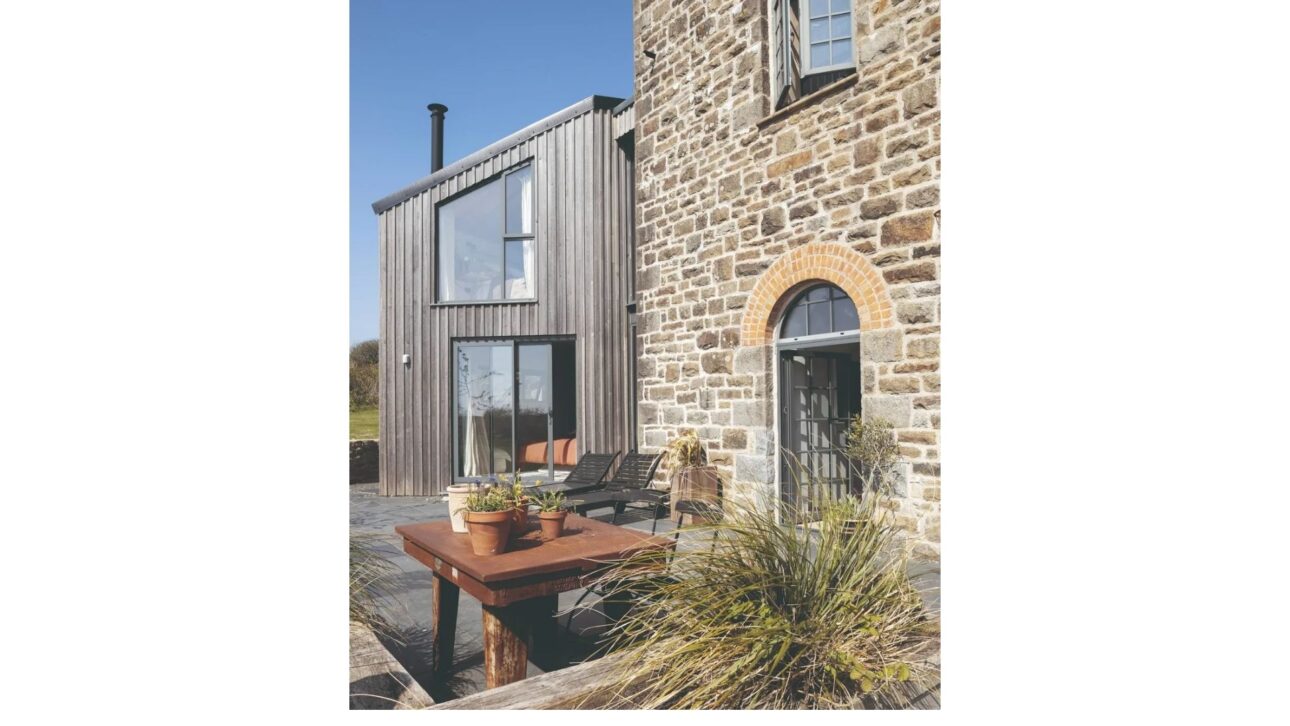
(Image credit: Simon Burt Photography)
Working with a building from 1910 requires respect for the material. The thick granite walls, which ensured the tower’s survival for over a century, were maintained and treated, preserving the original rustic appearance and solidity. The granite, which once protected electrical equipment, now houses a family.
The work had the hand of a trusted friend. The architectural project was signed by Jacob Down, Morveth’s childhood friend, which helped align the couple’s vision with the necessary technical solutions. The complete renovation cost about 400,000 pounds, equivalent to more than 2.5 million reais, a high investment funded by the sale of the old house and the couple’s savings.
A design decision clearly defines their philosophy: not to pretend. Instead of trying to imitate the old granite in the new annex, the couple preferred to make clear what was old and what was new. “We never wanted it to match, because that would seem dishonest,” explained one of them, defending the contrast between the historic tower and the modern part as a choice of architectural honesty.
Not everything was simple in dealing with the stone. Centuries-old granite walls tend to retain moisture, and one of the biggest challenges of the renovation was controlling this moisture and adapting the tower to accommodate modern water, light, and heating installations without damaging the original structure. Fitting a comfortable home inside a 1910 industrial building, floor by floor, required custom solutions in every detail.
The Award-Winning Home and TV
The entire effort was eventually recognized by experts. The transformation of the substation earned the couple the Cornish Buildings Group award in 2023, a distinction that values the best constructions and renovations in Cornwall. Moving from a ruined tower to an award-winning home is proof that the risky bet paid off.
The story also made it to the screens. The project was featured in the series Remarkable Renovations, by architect and presenter George Clarke, aired on the British channel Channel 4, which explores unusual renovations across the UK. In front of the tower, the presenter summed up the general astonishment by saying that being able to imagine someone living there was, in itself, something remarkable.
This recognition gives the case a significance that goes beyond the family. When an unlikely dwelling becomes a reference and appears on television, it inspires others to look at abandoned buildings with new eyes. The Trevolt tower went from being a local curiosity to becoming an example of repurposing.
Life Today in the Tower, with Daughter Posy
Today, what was a dead substation is a house full of life. Abi and Morveth live in the tower with their daughter, Posy, and have transformed the old electric building into a real home, with a kitchen, bedrooms, living room, and even a balcony spread across the floors. The family of three found comfort where there were once only ruins.
The feeling of living there is described with affection by the owners. “I love the feeling of freedom the building gives,” says Abi, speaking of the space, the light, and the views the tower provides. Living high up, with the countryside and the sea around, gave the family a routine different from anything imagined when thinking of a common house.
The tower also became part of the family’s identity. More than an address, Trevolt is a life project that united the couple around a dream, built a house from scratch within a ruin, and still preserved a piece of history. It’s the kind of home that carries a story in every granite wall.
Unlikely Homes: The Fever of Reusing the Unusual
The case of Trevolt is far from unique in the world. More and more people are transforming unusual structures into homes, from water towers to old churches, including silos, bunkers, train carriages, and, as here, electrical substations. The unlikely home has become a global trend, driven by creativity and the search for something unique.
The reasons for this wave are both practical and emotional. Repurposing an old building can be cheaper than building something from scratch in certain situations, and it avoids the demolition of solid, history-filled constructions. There’s also the appeal of living in a place that no one else has, with a character that is impossible to copy.
Examples are multiplying around the world. People have transformed deactivated lighthouses, old train stations, chapels, hangars, and even century-old barns into homes, always opting for character-filled addresses over demolition. Each of these projects reinforces the idea that a building without a function is not necessarily a building without a future.
The secret, in these cases, is often to see potential where others see a problem. That’s what Abi and Morveth did with the substation tower: they traded the fear of the ruins for the vision of a home. Each successful unlikely home proves that discarded structures can gain a surprising second life.
What Does Brazil Have to Do with This
Here, the idea of reusing the unusual is also gaining ground. In Brazil, water tanks, industrial warehouses, containers, and even train carriages have been turned into homes, following the same logic of transforming the uncommon into a home. The country has plenty of old buildings that could follow the path of the Trevolt tower instead of becoming rubble.
The story also speaks of energy heritage. Just as England has its old substations, Brazil is full of deactivated industrial and electrical structures, from old plants to utility warehouses, which are often abandoned. Converting them into homes, museums, or cultural spaces is a way to preserve the memory of industrialization and the arrival of energy.
There is also an economic and environmental opportunity. Renovating and repurposing an existing building usually uses less material and generates less waste than demolishing and building anew, which aligns directly with the sustainability agenda. In Brazilian cities full of idle properties, the so-called retrofit, which modernizes old buildings for new uses, is a path of enormous potential.
In the end, the message is about looking differently at what seems unused. The substation tower in Cornwall shows that, with creativity and a willingness to take risks, a condemned building can become an award-winning home. It’s a lesson that fits any Brazilian city that still sees ruins where there could be homes.
And You, Would You Live in a Tower Like This?
The story of Abi and Morveth Ward proves that home is where the imagination reaches: they sold their house, moved into a trailer, and transformed a 1910 granite electrical substation tower in Cornwall into an award-winning 11-meter dwelling, where they now live with their daughter Posy. A ruin turned into one of the most original addresses in the United Kingdom.
And you, would you have the courage to sell everything and live in a trailer to transform an abandoned building into a home, like this couple did with the electrical substation? Tell us here in the comments which unusual structure in your city you think would make a great improbable home.


