Portuguese
  Spanish


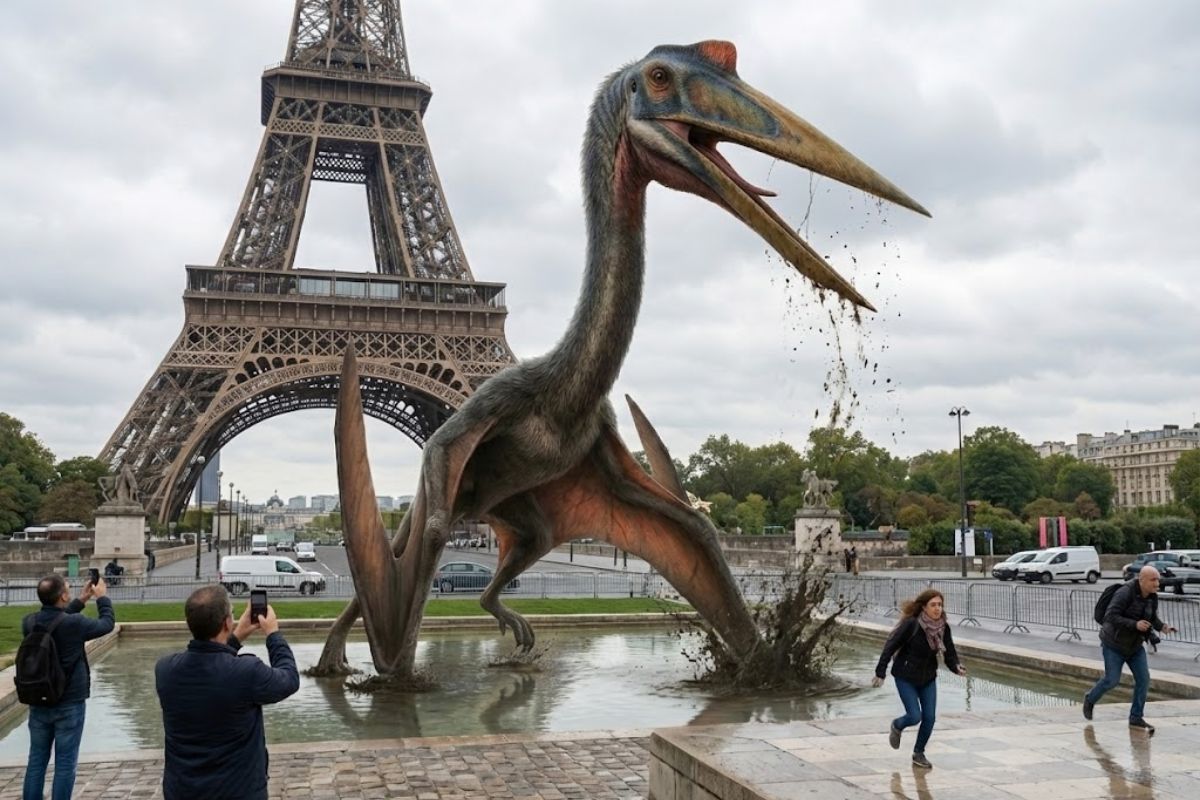


With a Wingspan of 11 Meters and Light Airplane Proportions, the Largest Flying Animal in History Lived in Texas Swamps, Hunted Like a Heron, Swallowed Whole Fish and Amphibians, and Used a Peculiar Takeoff Leap to Cover Long Distances, According to Recent Studies on the Behavior of This Giant Pterosaur in Sustained Flight.
A scientific report gathered decades of research on Quetzalcoatlus northropi, the largest flying animal in history, a pterosaur with a wingspan of about 11 meters that lived in the swamps of what is now Texas, USA. Formally described in 1975, after the discovery of hundreds of bones in Big Bend National Park, it became one of the most emblematic animals when it comes to flight in large-bodied vertebrates.
Nearly half a century after the original description, researchers are still discussing in detail how an animal the size of a small airplane managed to feed, walk, and take off in flooded environments. Studies published in the Journal of Vertebrate Paleontology indicate that Quetzalcoatlus hunted in a manner similar to a giant heron, swallowed whole prey, and relied on an initial leap of about 2.5 meters before flapping its wings, balancing high mass with the condition of being the largest flying animal in history.
A Pterosaur With Light Airplane Wingspan

Quetzalcoatlus northropi is considered the largest flying animal in history because it combines an estimated wingspan of 11 meters with a body structure suitable for active flight.
-
Largest Mechanical Dredger in the Western Hemisphere Removes Nearly 80 Cubic Meters of Mud Per Cycle, Measures 77 Meters, and Operates Day and Night to Prevent Giant Ships from Getting Stuck in the Houston Ship Channel

-
California Opens Floodgates to Restore Wetlands and Create Natural Flood Protection in the Central Valley

-
US Mayor Goes Undercover as Homeless for a Week to Understand Rising Homelessness, Sparking Debate in His City

-
Teen from Brazil Turns School Snack Sales into Million-Dollar Confectionery Business Projected to Earn Nearly $1.9 Million in 2024


The wings reached the span of a light airplane, placing this pterosaur in an extreme category of gigantism among aerial vertebrates.
The fossils found at Big Bend National Park revealed a set of long, hollow bones, typical of animals adapted for flight.
The out-of-scale size forced researchers to revise equations of lift, muscle strength, and the relationship between mass and wing area.
The very existence of the largest flying animal in history has become a challenge to understanding how nature resolves aerodynamic engineering limits.
Besides Q. northropi, the same region preserved bones of smaller relatives, grouped in the species Quetzalcoatlus lawsoni.
These individuals had a wingspan comparable to that of a car, with differences in the skull and spine, but maintained the basic anatomy of a pterosaur.
The contrast between the giant form and the smaller form helps understand how the lineage occupied different niches in the same swampy environment.
Swamp Hunter That Fed Like a Heron
The feeding habits of Quetzalcoatlus are one of the points where the new interpretation diverges from older ideas.
Instead of a predator that tore apart large chunks of meat, studies highlight that the slender, elongated beak was too delicate to handle bulky carcasses.
The shape resembles a stiff “stick,” which does not align with violent bites into large prey.
Therefore, the hypothesis now considered most consistent is one of behavior similar to that of a heron.
The largest flying animal in history likely walked slowly in shallow areas of swamps, lakes, and channels, using its long neck to catch fish, invertebrates, small amphibians, and even aquatic reptiles.
Instead of chewing, it swallowed whole prey, utilizing the route of food through its narrow neck.
This mode of hunting is efficient in environments abundant with small aquatic organisms.
Instead of relying on rare events of large carcasses, the pterosaur exploited a steady supply of smaller prey.
The image that emerges is that of a gigantic heron, silent and patient, using its height and neck reach to dominate the top of the food chain in Texas swamps.
Debate About Flight: From Supposed “Dead Weight” to Takeoff Specialist in Leap


For many years, part of the scientific literature suggested that Quetzalcoatlus, despite its wings, might have been practically incapable of flight.
The enormous wingspan raised doubts about the possibility of flapping without the tips touching the ground during takeoff.
This idea would place the largest flying animal in history in a paradoxical situation, with wing structure not fully utilized.
More recent studies, however, point in another direction. Detailed analysis of limb proportions and muscle insertions supported the hypothesis of a two-phase takeoff.
First, the pterosaur would perform an explosive leap of about 2.5 meters in height, primarily propelled by its legs and front limbs, gaining enough space between its body and the ground. It would then initiate vigorous wing flaps to enter sustained flight.
Once airborne, Quetzalcoatlus would behave similarly to modern condors and vultures. The large wingspan favored gliding flight in ascending currents, reducing energy expenditure on long journeys.
The bulky head and long neck could also assist in maneuvers, contributing to wide turns and fine directional adjustments in mid-flight.
During landing, the procedure would be almost the opposite of an airplane takeoff.
The largest flying animal in history would need to gradually reduce speed, flap its wings to brake, and then touch the ground with its hind limbs, giving a small final jump before lowering its front limbs and resuming a quadrupedal posture.
Four-Legged Walking With Choreographed Step
On land, Quetzalcoatlus did not move like a modern bird, but like a typically quadrupedal pterosaur.
Marching reconstructions suggest a sequence of movements that are counterintuitive for a human observer.
To avoid tripping over its own wings, the animal would first lift its left front limb, advance its left leg in a full step, and only then place its foot on the ground.
Then, it would repeat the cycle with the right side, alternating front and hind limbs in a kind of mechanical choreography.
Although this may seem complicated when described, this quadrupedal march was likely automatic for Quetzalcoatlus, the result of millions of years of adaptation.
The combination of functional wings, long neck, and quadrupedal locomotion reinforces the uniqueness of the largest flying animal in history in the fossil record.
In shallow swamps, this way of walking would help the pterosaur maintain balance over irregular substrates, alternating broad supports and distributing body weight.
This was essential for an animal that needed to hunt discrete prey in the water while preserving the integrity of its wings, crucial for any attempt at flight.
What Science is Still Trying to Clarify About the Largest Flying Animal in History
Despite advancements in biomechanical models, several questions remain open.
Researchers are still discussing details of the wing membrane shape, the thickness of flight-associated musculature, and the exact bone density in different parts of the skeleton.
Small variations in these parameters can significantly alter the estimates of mass and aerodynamic performance of the largest flying animal in history.
Another point under study is how different growth stages affected behavior. Smaller relatives, such as Quetzalcoatlus lawsoni, show that the lineage could explore different size ranges in the same environment.
Understanding how these animals shared swamps and resources helps reconstruct the ecological structure of a Texas very different from the present.
As new analyses of fossils, computational models, and comparisons with modern birds and bats advance, Quetzalcoatlus remains one of the ultimate symbols of nature’s capacity to explore physical limits.
Every additional detail about its feeding, its march, or its leap takeoff adjusts, millimeter by millimeter, the portrait of the largest flying animal in history.
In light of this picture, what impresses you the most about Quetzalcoatlus: the leap takeoff that allowed the largest flying animal in history to take off the ground, or the fact that it hunted in swamps like a gigantic heron swallowing whole prey?