Portuguese
  Spanish


Rare rock found in the Sahara preserves signs of an ancient vanished planetary body and helps scientists investigate how rocky worlds formed in the first million years of the Solar System.
A meteorite found in the Sahara desert may contain evidence of an ancient vanished planetary body of the Solar System, according to a study published in the scientific journal Earth and Planetary Science Letters.
The rock, called Northwest Africa 12774, or NWA 12774, preserves crystals that, according to researchers, formed under pressures too high for the internal structure of a common asteroid.
The object weighs about 454 grams and was identified in 2019.
-
Xiaomi Unveils Smart Pressure Cooker That Cooks Meat Up to 40% Faster

-
Antarctic Mystery: Study Uncovers Over 500 Hidden Earthquakes 150 km Deep, Challenging Traditional Theories
-
Excavation for Solar Park in Germany Uncovers Rare Celtic “Princely Tomb” with Elite Warrior Buried with Gold, Weapons, Etruscan Jug, and Two-Wheeled Chariot in Bad Camberg

-
NOAA Scientists Discover Mysterious, Perfectly Aligned Holes on the Mid-Atlantic Ridge Seafloor, Origin Still Unknown



Although it is small, the mineral composition analyzed by the team indicates that it may have originated from a much larger celestial body, possibly comparable to the Moon and, according to the scenario considered in the study, close to the dimensions of Mars.
The scientists’ interpretation points to an embryonic planet, or protoplanet, that would have existed in the first million years after the formation of the Solar System, about 4.56 billion years ago.
This body no longer exists and may have been destroyed by collisions that occurred in the early phase of planetary evolution, a hypothesis treated by the authors as one of the possibilities to explain the origin of the fragment.
Meteorite NWA 12774 belongs to a rare group of space rocks
The NWA 12774 belongs to the group of angrites, an uncommon class of volcanic meteorites.
These fragments are among the oldest known igneous rocks in the Solar System and, for this reason, are used by researchers to investigate processes that occurred when planets were still forming.
The amount of known samples also limits this type of study.
According to the data cited by the team, out of more than 80,000 meteorites cataloged on Earth, only 68 are classified as angrites.
Each analyzed specimen, therefore, can offer specific information about the materials present at the beginning of the Solar System.
The chemical composition of this group of meteorites was already considered unusual by scientists.
Unlike Earth, Mars, and other rocky bodies, angrites contain little silica, a substance present in common minerals and associated with the formation of planetary crusts.
Because of this characteristic, the explanation adopted in previous studies was that these meteorites would have come from a relatively small asteroid.
The analysis of NWA 12774, however, led the authors to revise this scenario for the parent body of the angrites.
Meteorite crystals indicate pressure above expected
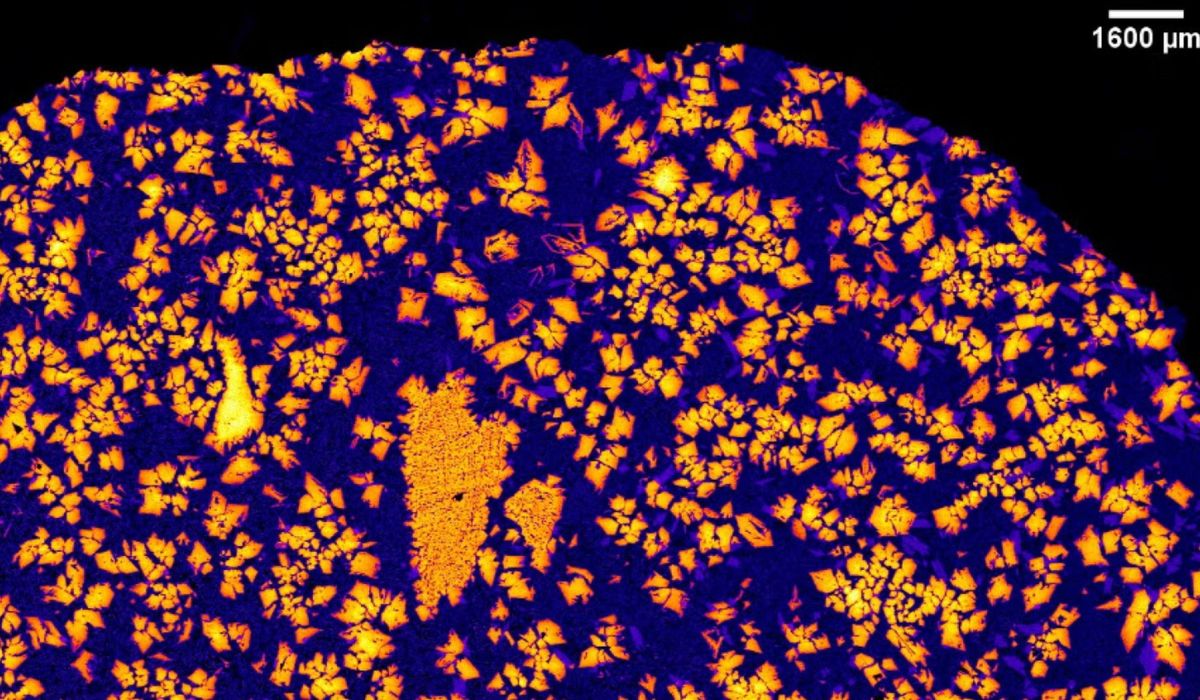
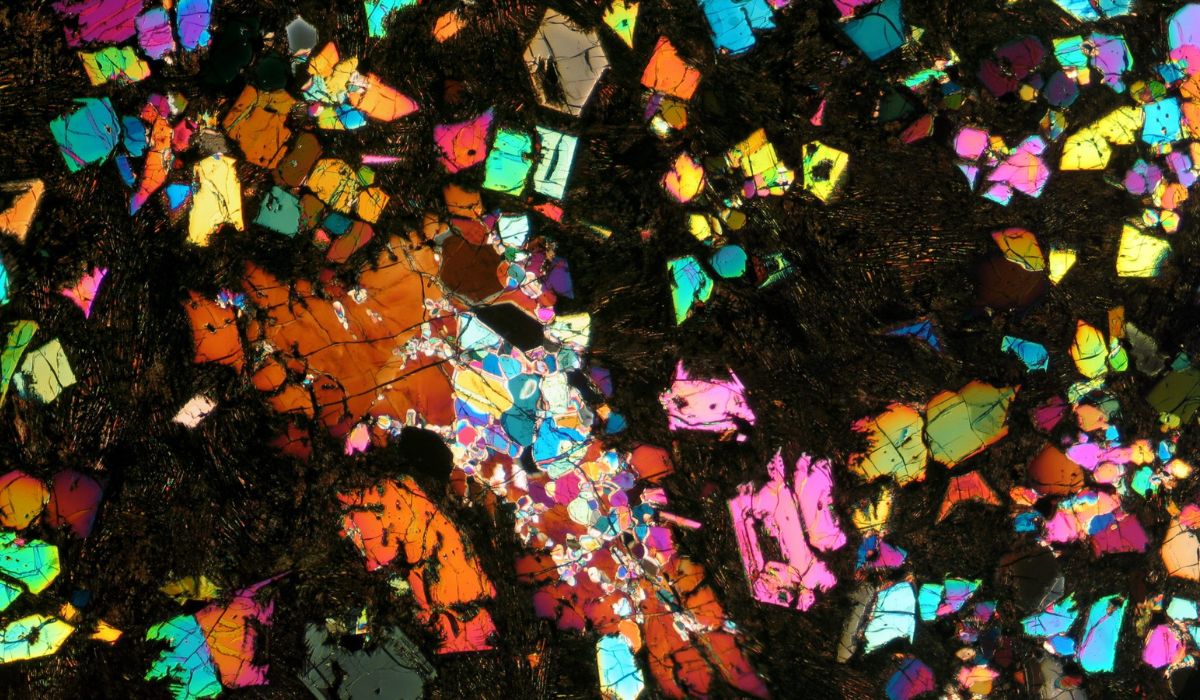
The team led by Aaron Bell, a researcher at the University of Colorado Boulder, identified crystals of clinopyroxene in the meteorite, a mineral also found in the Earth’s crust and mantle.
The decisive factor was the concentration of aluminum in these crystals, considered by the authors as an indication of formation under high pressure.
By reconstructing the conditions necessary for the origin of the minerals, the researchers concluded that they would require at least 17.5 kilobars of pressure.
This value is more than 17 times the pressure at the bottom of the Mariana Trench, the deepest point in Earth’s oceans.
For the authors, this level of pressure could not be produced inside a small asteroid.
A body with less than 200 kilometers in radius, previously considered compatible with the origin of the angrites, would not have enough mass to generate these internal conditions.
Another piece of data used in the analysis came from the preservation of the crystals themselves.
The structures maintain sharp edges and chemical patterns that, according to the study, would tend to disappear if the minerals had remained for long periods in deep, hot regions of a planetary interior.
Based on this reading, the researchers claim that the crystals may have formed at relatively shallow depths.
If this interpretation is correct, the original body would need to be larger to produce such high pressures closer to the surface.
Lost world may have been larger than a common asteroid
The calculations indicate that the parent body of the angrites would have at least 1,000 kilometers in radius.
In another scenario considered by the study, the ancient world could have exceeded 1,800 kilometers in radius, a dimension close to that of the Moon, which is about 1,737 kilometers in radius.
The comparison with Mars appears as a limit possibility within the modeling presented.
The red planet has a radius of about 3,390 kilometers, and the authors do not claim that the original body necessarily had this size, but point out that it could have been much larger than previously imagined as the source of angrites.
In a statement released by the University of Colorado Boulder, Bell stated that “it’s incredible to think that a world of this size once existed.”
The researcher also said that scientists only know of the existence of this body because some fragments reached Earth.
The same researcher declared that “the materials that formed the parent body of the angrites are fundamentally different from the ingredients of Earth and Mars.”
According to him, these meteorites preserved evidence of a distinct developmental path of the early planets.
Discovery changes the understanding of the origin of angrites
The study questions the interpretation that angrites originated only from small asteroids.
The presence of minerals formed under high pressure suggests that at least part of these meteorites may have come from a larger body, with enough internal activity to produce more intense geological conditions.
This conclusion also broadens the discussion about the diversity of the early rocky bodies of the Solar System.
Instead of a uniform formation, the data analyzed by the researchers indicate that some of these objects may have followed chemical and geological trajectories different from those observed in planets that have remained until today.
In this context, the NWA 12774 would not be just a fragment of an asteroid, but a possible sample of a protoplanet that had volcanic activity and a pressurized interior before disappearing.
The research does not determine, however, all the details of this process nor establish the exact moment when the original body would have been destroyed.
Collisions in the early Solar System may explain fragment
The fate of the body that gave rise to the NWA 12774 has not yet been defined by the authors of the study.
One possibility is that it was fragmented during large-scale collisions, frequent in the early stages of the Solar System.
During that period, planetesimals and protoplanets collided while some bodies grew and others were destroyed.
Some of the fragments generated in these impacts may have later been incorporated into rocky planets, including Earth, according to the hypothesis discussed by the researchers.
Within this scenario, the NWA 12774 would be a remnant of a larger body that did not survive the initial reorganization of the Solar System.
The rock remained preserved over billions of years until it was recovered in the Sahara and analyzed in a laboratory.
The discovery also indicates that other samples already collected may contain records of similar bodies.
Bell stated that there are many meteorites stored in collections that have not yet been studied in detail and that, therefore, there may be evidence of other protoplanets not yet recognized.
The analysis of the NWA 12774 shows how small fragments can record large-scale planetary processes, as long as they preserve minerals capable of indicating temperature, pressure, and geological origin.