Portuguese
  Spanish


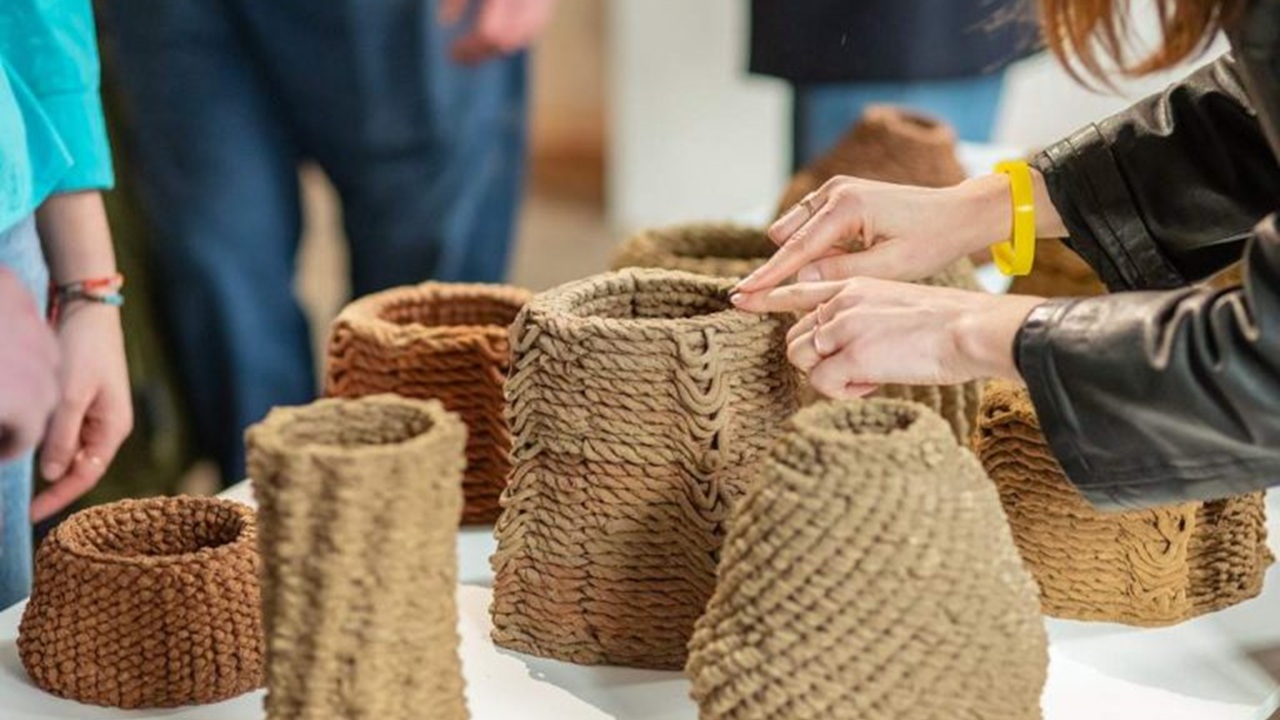
Researchers from the University of Colorado in Boulder developed a mixture to transform excavated soil into material for 3D printing. The solution uses algae, walls built layer by layer, and an amount of sodium alginate to improve performance and stability.
The compound, derived from seaweed, was incorporated into a combination of earth, sand, and clay. With only 0.12% of the additive, the material showed approximately 25% greater strength and allowed for about 33% faster printing.
The formulation also maintained inclined structures up to 60 degrees. The result indicates that waste normally removed during excavations can gain new utility within the construction site itself, reducing transport, disposal, and dependency on industrial materials.
Algae make earth walls easier to print
The research combines ancient earth construction techniques with modern digital manufacturing resources. For thousands of years, different societies used mud, clay, and soil in buildings, before the expansion of concrete and other industrialized products.
-
Drill Uncovers Freshwater Rivers Hidden Beneath the Ocean Floor

-
3,000-Ton, 81-Meter Attack Submarine Begins Sea Trials, Equipped with Heavy Torpedoes and Anti-Ship Missiles

-
Boat Made from 10 Tons of Plastic and 30,000 Discarded Flip-Flops Sails Along African Coast, Serving as a Floating Classroom on Ocean Pollution
-
Welder Discovers 16th-Century Diamond Ring in England After 7 Hours with Metal Detector; Gold Jewel Linked to Edward I Pattern Auctioned for £17,000




The inspiration also came from natural organisms. Termites, wasps, and other species build strong structures by combining mineral particles with biological compounds. This logic served as a reference to seek construction materials with lower environmental impact.
The researchers evaluated biopolymers used by the food industry, including guar gum, locust bean gum, cassia gum, xanthan gum, and sodium alginate. The latter, obtained from certain seaweeds, showed suitable characteristics for printing.
In food, alginate appears in ice creams, sauces, and other preparations, helping with texture and stability. In construction material, its function is not simply to glue the particles present in the mixture.
The compound modifies the electric charges of the clay particles. As a result, they begin to repel each other in a controlled manner, remain more evenly distributed, and flow more easily through the nozzles used by the 3D printer.
This behavior is important because walls and other elements need to be deposited in continuous layers. The mixture must exit the equipment without interruptions and, at the same time, maintain its shape after being applied.
Small amount generates gains in strength and speed
The tests used soil taken from a quarry. The addition of only 0.12% sodium alginate was enough to alter relevant properties of the material, without requiring large volumes of the algae-derived biopolymer.
The strength increased by approximately 25%, while the printing speed advanced by about 33%. The mixture also allowed for the production of inclined shapes up to 60 degrees, maintaining the necessary stability during the deposition of successive layers.
Currently, some 3D printing initiatives for houses, shelters, and buildings use cement-based mixtures. The study presents an alternative focused on utilizing resources available at the construction site itself.
In regions with available sand or clay, using nearby raw materials can reduce economic and environmental costs related to transportation. The approach can also be useful in social housing, reconstructions, and projects carried out in remote areas.
Excavated soil may no longer be discarded
Excavations for foundations, underground parking lots, and infrastructure works remove large amounts of earth. Often, this material needs to be transported to landfills or other designated waste reception points.
The proposal allows for the reuse of soil on-site to produce walls and 3D printed components. In this way, something treated as waste can return to the construction itself as raw material for new architectural elements.
The logic aligns with the circular economy, which seeks to transform waste into resources and reduce the extraction of new raw materials. Each reused volume represents less transportation and a reduced need for disposal locations.
The reduction in trips can also decrease impacts associated with cargo transportation. By replacing part of the cement mixtures, the method has the potential to reduce emissions related to one of the most used materials in modern construction.
Clay contributes to thermal comfort and humidity control
In addition to the possibility of reuse, natural materials have properties related to internal comfort. Clay can absorb and release water vapor according to environmental conditions, helping to regulate humidity inside buildings.
It also has high thermal inertia. This means it can store heat during the day and release it gradually when the temperature drops, reducing the need for heating or cooling in certain situations.
These characteristics have been utilized for centuries in traditional constructions in Mediterranean and semi-arid regions. Now, the use of digital fabrication can adapt ancient knowledge to projects designed and executed with automated equipment.
The combination of algae, earth walls, and 3D printing opens the door to bio-inspired formulations. Future materials may incorporate plant fibers, agricultural waste, algae biomaterials, or microorganisms aimed at improving resistance and durability.
The technology still needs to evolve to achieve broader applications. Even so, tests show that an ingredient already used in food can help make the soil more stable, resistant, and suitable for automated manufacturing.
The central point is leveraging what already exists under the construction sites. Earth removed during the construction, instead of being directly discarded, can return as part of the structures built on the same site, at scale.
What do you think about the possibility of transforming excavated soil and algae into 3D printed walls? Comment if this solution could gain ground in Brazilian cities and which types of constructions could better utilize local materials, reduce transportation, and reuse construction waste.
Via University of Colorado Boulder