






 Portuguese
  Spanish
  5 min of reading
  36 comments


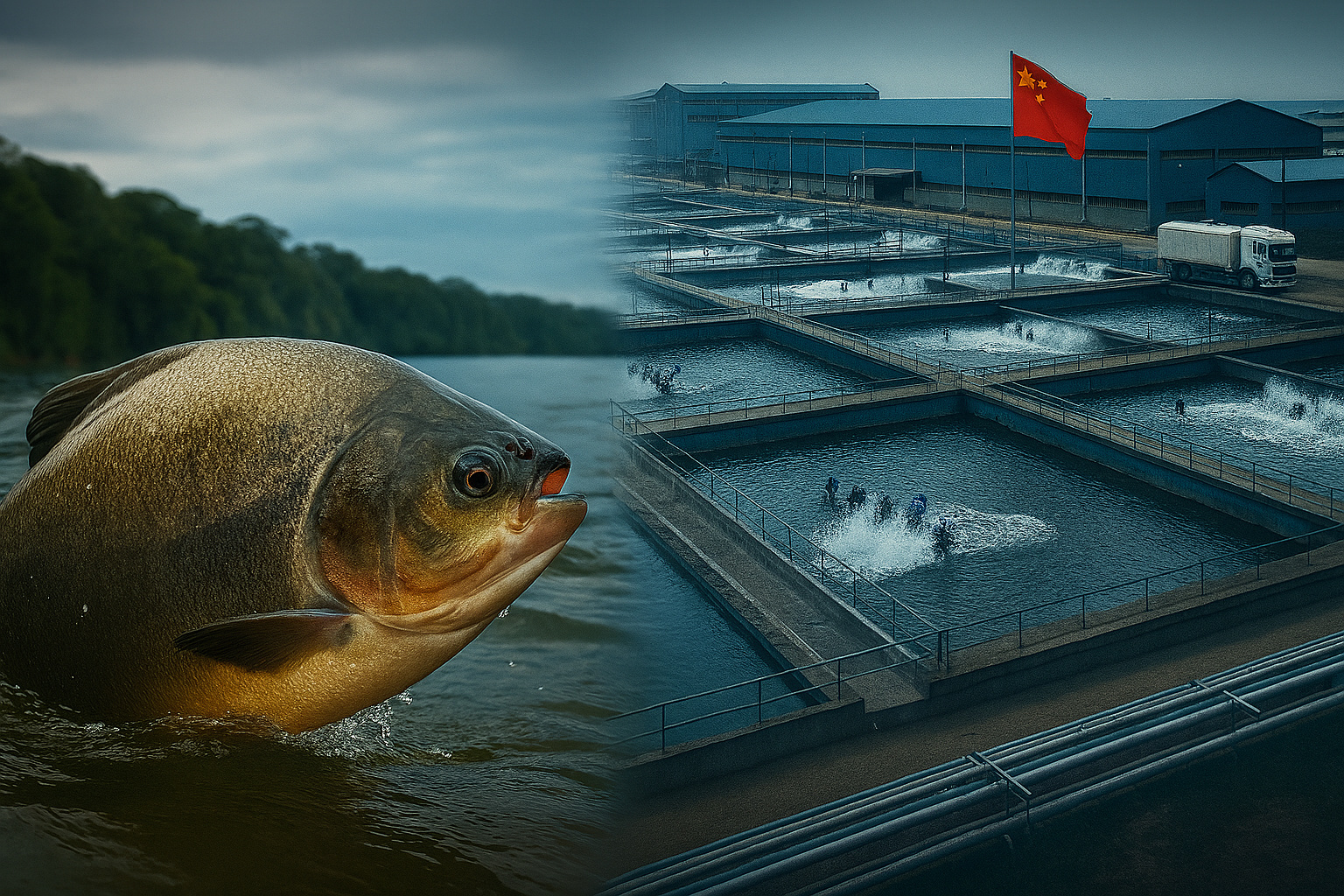


Originating in the Amazon, the Tambaqui Became a Global Commodity: China Leads Industrial Scale Production While Brazil Dominates Genetics and Technology of the Species.
For decades, the Tambaqui was seen as a typically Brazilian fish. Native to the Amazon basin, a symbol of fishing and aquaculture in the North of the country, it gained space in dug ponds, regional markets, and on the plates of domestic consumers. What few people realized is that, silently, this Amazonian fish crossed oceans and began to be produced on a large scale in Asia. Today, China occupies the world leadership in Tambaqui production and export, while Brazil, although still strategic, has fallen behind in absolute volume.
This change did not happen by chance. It is a direct result of industrial planning, genetic adaptation, scale mastery, and integration with global aquatic protein supply chains. The Tambaqui has ceased to be just a regional fish to become an international aquaculture commodity, with a Chinese lead.
What Is the Tambaqui and Why Has It Become So Attractive for Global Aquaculture
The Tambaqui (Colossoma macropomum) is a freshwater fish known for its rapid growth, hardiness, excellent feed conversion, and prized white meat. It tolerates variations in oxygen, adapts well to intensive systems, and reaches high commercial weights in relatively short cycles.
-
In Virginia, a family of small-scale farmers refused to swap the countryside for the city and transformed their milk production into award-winning artisanal cheese from Mantiqueira de Minas.

-
The alligator that was once illegal game has become a business in the Pantanal: Caimasul, the largest alligator slaughterhouse in the world, slaughters nearly 100,000 per year and exports alligator leather and alligator meat.
-
At 17, Andressa swapped the city for life in the countryside with her father on a farm in Minas Gerais, where they take care of 15,000 fish in aquaculture, cows, and other animals.
-
Organic grape juice from São Roque surprises experts, scores over 90 points in a blind test, and wins a national award after six years of agroecological research.




These characteristics have caught the attention of countries with a tradition of intensive aquaculture. For China, which constantly seeks efficient species to supply its massive internal market and exports, the Tambaqui fits perfectly into the industrial model.
How China Assumed World Leadership in Tambaqui Production
China incorporated the Tambaqui into its aquaculture matrix through controlled introduction programs, genetic improvement, and adaptation to intensive farming systems. In a short time, the fish began to be cultivated in dug ponds, semi-intensive systems, and highly technological structures.
- The Chinese differential was not only biological but industrial. The country operates with:
- large-scale production,
- integrated logistics chains,
- industrial processing of fillets and frozen products,
- continuous export capacity.
With this, China surpassed Brazil in total volume produced, turning the Tambaqui into yet another item in its portfolio of aquatic protein.
Brazil: Cradle of the Species, but Not the Largest Scale
Although it no longer leads the global ranking in volume, Brazil remains a technical, genetic, and scientific reference for the Tambaqui. The country houses the main genetic banks of the species, masters induced breeding techniques, larviculture, and fattening in a tropical climate.


Furthermore, Brazilian consumption is predominantly internal. Unlike China, which produces with scale and export in mind, Brazil directs much of its production to regional and national markets, especially in the North, Northeast, and Midwest.
This creates a paradox: the fish was born in the Amazon, but today it is produced in larger volumes outside of it.
Genetics, Research, and Brazilian Technological Mastery
Brazilian universities, research centers, and companies have been responsible for decisive advances in Tambaqui cultivation. Artificial reproduction techniques, sanitary control, and genetic selection emerged in Brazil before being adopted in other countries.
In practice, this means that much of the knowledge used today in Asia originates from research developed within Brazil itself. The country has not lost relevance; it has lost industrial scale.
Difference in Model: Global Commodity Versus Regional Market
The main difference between Brazil and China is not in technical capacity but in economic model. While China treats the Tambaqui as a global commodity, Brazil still largely sees it as a regional fish.
In China, the Tambaqui enters industrial processing, freezing, and export lines. In Brazil, it is still closely associated with fresh consumption, local markets, and regional venues, which limits volumes and standardization.
Impact on International Fish Trade
With China’s leadership, the Tambaqui began competing in international markets with other farmed species, such as tilapia and pangasius. Its competitive cost and nutritional profile made it an interesting alternative for countries importing aquatic protein.
This movement reinforces the trend of globalization of species previously considered “local.” The Tambaqui has ceased to be merely Amazonian to integrate into the global farmed fish market.
What the Case of the Tambaqui Reveals About Global Aquaculture
The trajectory of the Tambaqui is a clear example of how biological origin does not guarantee productive leadership. In modern aquaculture, those who master scale, logistics, processing, and international market win.
China applied to the Tambaqui the same logic it had used with other species: industrialization, standardization, and continuous expansion. The result was leadership in volume.
Can Brazil Regain Volume Leadership?
Technically, yes. Brazil has the climate, water, knowledge, and land available to expand production. The challenge lies in investing in scale, industrial integration, and access to external markets.
If the country progresses in this direction, it may again compete for positions in the global ranking. Otherwise, it will continue to be a technical reference but not the largest producer.
An Amazonian Fish That Became a Symbol of Food Globalization
The Tambaqui is now a clear symbol of food production globalization. It is born in the Amazon, researched in Brazil, mass-produced in China, and consumed in different parts of the world.
This trajectory shows that, in modern aquaculture, the geography of origin matters less than the ability to produce sustainably at scale.
Volume Leadership Is Not Everything, but It Changes the Game
China leads the world in Tambaqui production by volume, while Brazil maintains dominance in the genetic and technological aspects of the species. These are different forms of leadership, but with distinct impacts on the global market.
The Amazonian fish has definitely entered the radar of global aquaculture. And its story shows that in the 21st century, those who transform knowledge into scale take the lead—even when the species was born on the other side of the planet.





Biopirataria OBVIO
A China deveria experimentar e criar também o delicioso peixe pirarucu da Amazônia.
A única verdade nessa história é que outros países vêm pegar o que é nosso para crescer cada vez mais na ciência e tecnologia enquanto o Brasil e o povo brasileiro continua para trás!… aqui a única coisa que fazem e dançar e carnaval para facilitar a **** e cada vez piorando mais!…em vez do governo proteger as pessoas e incentivar o estudo eles protegem **** e incentiva cada vez mais dando bolsa preso entre outras coisas!