






 Portuguese
  Spanish


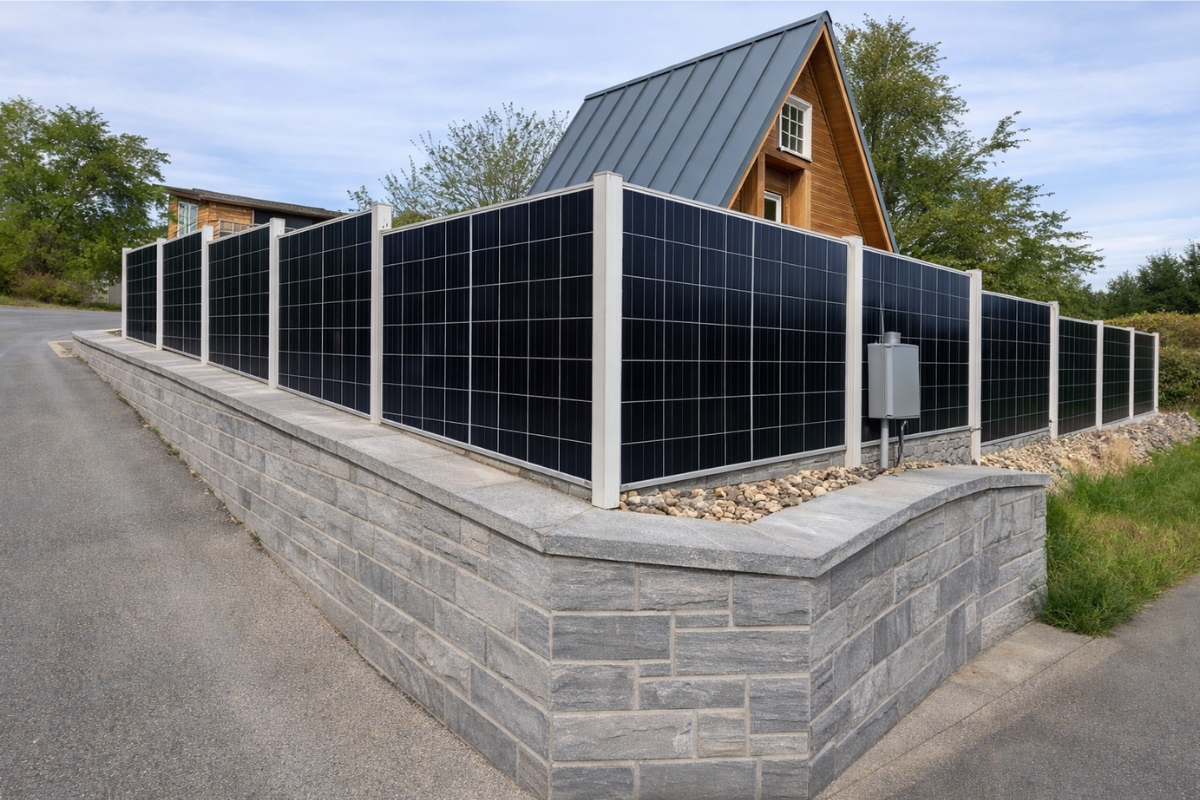


With Modules Nearing US$ 0.10 Per Watt in Some Markets and a Drop of About 50% Since 2022, Solar Panels Cease to Be a Luxury, Become Building Material, and Transform Walls and Fences into Small Silent Power Plants in the Backyard
What once seemed distant from reality now starts to make total sense: using solar panels as walls and fences. It is true that, in a vertical position, they capture less sun than on a well-sloped roof, but the price drop has completely changed this equation. When the system costs much less, even “non-ideal” surfaces can become viable.
For many years, solar energy was almost exclusively associated with rooftops and large power plants. Now, with cheaper and more accessible modules, a new phase emerges: solar energy ceases to be just a technical device and begins to integrate into the very construction. It is in this scenario that “solar walls” appear, structures that define a space and, at the same time, produce electricity.
The Main Reason for the Price Drop: Mass Production in China
The main driver of this transformation was giant-scale production. China expanded its industrial capacity at almost every stage of the solar supply chain, from materials and cells to finished modules. This significant increase in global supply, at many times exceeding demand, put intense downward pressure on prices.
-
World’s Largest Engie Solar Plant in Brazil Highlights Billion-Dollar Energy Waste Issue: Company Considers Batteries and Bitcoin Mining to Avoid Wasting Production

-
Air Products Cancels $2.9 Billion Clean Hydrogen Megaproject in Louisiana, Shuts Down Arizona Unit, Highlighting High Costs of U.S. Energy Transition
-
Over 60 Tractors Take to the Streets in Lopera as Solar Parks Compete with Olive Groves, Affecting 13,000 to 100,000 Trees According to Conflicting Reports

-
Green Hydrogen Projects in Northeastern Brazil Stalled for 18 Months Awaiting Government Decree, Delaying Billions in Investments


Between 2022 and 2024, the market registered very significant drops in international module prices, with reductions close to 50% during certain periods and wholesale values hovering around 0.10 dollars per watt in some markets. Simply put, what once represented the most expensive part of the system now costs only a fraction of what it did a few years ago.

How It Was Before and Why Solar Energy Seems More Accessible Today
When we look back, the difference is striking. In 2010, it was common to find modules above 1 dollar per watt, often well above that. By around 2017, prices were still around 0.40 dollars per watt in the international market. Today, that level has dropped drastically, opening up space for applications that previously did not make financial sense.
When panels were expensive, every watt needed to be in the most efficient position possible to justify the investment. With the current prices, the focus shifts from maximum production to considering the total cost of the project. This change is what makes walls, fences, and facades increasingly interesting options.
More Efficiency, More Power, and Ever More Advanced Modules
The price reduction has been accompanied by significant technological advances. Monocrystalline modules have become standard, efficiencies have increased, and more modern technologies have begun to replace earlier generations. At the same time, industrial standardization has allowed for larger scale manufacturing with better quality and lower costs.
Today, it is common to find residential panels in the range of 500 to 600 watts, with efficiencies exceeding 20% in many models. Ten years ago, these numbers were less frequent and generally associated with higher costs. In other words, besides being cheaper, today’s panels are also more powerful and efficient.
Why a “Solar Wall” May Be Cheaper to Install Than a Rooftop System
The cost of a solar system depends not only on the value of the panel. Installing on the roof involves working at height, additional safety measures, possible structural reinforcements, and greater assembly complexity. All of this increases installation time and labor costs.
In contrast, a vertical installation, such as a fence or wall, offers easier access and lower risk, which can significantly reduce installation costs. Although annual generation may be lower due to orientation, the total investment tends to be more competitive, maintaining an attractive financial return.
What to Consider Before Investing in Solar Walls

A solar wall will not perform the same in all locations. Orientation, shadow incidence, and geographical location directly influence energy production. Therefore, proper planning and positioning are fundamental to ensure a good result.
Additionally, the rapid growth of solar energy brings challenges related to grid connection and integration capacity in some regions. Even with cheaper equipment, these factors can impact the timelines and feasibility of new projects.
The New Phase of Solar Energy: From Roof to Wall
The combination of mass production, global competition, and technological advances has elevated solar energy to a new level. Today, it is not restricted only to rooftops, but begins to occupy walls, fences, and facades, transforming ordinary surfaces into sources of electrical generation.
With historically low prices and increasingly efficient technology, solar energy integrates naturally into everyday life. What was once a high investment has become an increasingly accessible solution, showing that in the new era of energy transition, even a simple wall can turn into a small silent power plant.
This article used data and analyses from the International Energy Agency (IEA) as a reference, especially the report on global solar energy supply chains, which details the expansion of mass production in China and its direct impact on the historic drop in prices of photovoltaic modules in recent years.






Unless this is intended as a high-profile demonstration piece, the ROI is unjustifiable; the module pricing simply cannot compensate for the high CAPEX and low energy yield of this specific setup.
Espectacular idea, cada vez el ingenio humano se supera con estos proyectos de avanzada para las tecnologías de energía renovables y aprovechamiento de generadores naturales, partiendo del principio, que la naturaleza cada vez demuestra que siempre hay soluciones, ****ánto daría por participar en un proyecto de esos para impulsar este desarrollo en mi país (Cuba), bien se sabe que los parques fotovoltaicos instalados, han sido posible por los inversores del gigante asiático (China), la esperanza para superar la crisis energética que nos atropella, está en los múltiples programas que china apoya como proveedor y las empresas cubanas como ejecutores y con equipos de trabajos en función del desarrollo del país.
Todo muy bien si alguien puede explicar como se puede adquirir un módulo para una vivienda