






 Portuguese
  Spanish


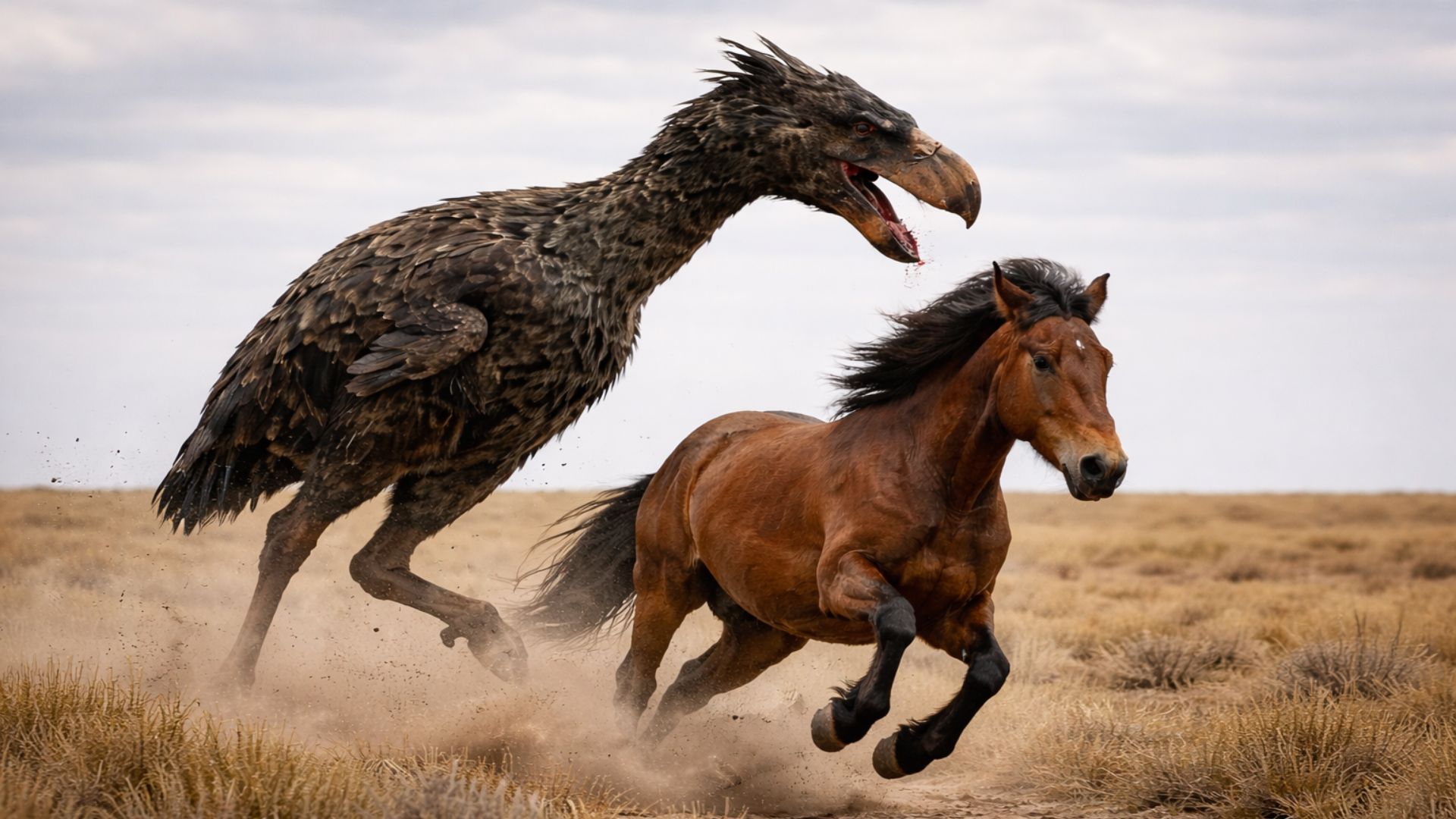


Giant Predators Dominated Isolated South America, Exchanged Flight for Strength and Speed, Hunted Large Mammals, and Left Living Heirs Who Still Repeat Ancestral Attack Techniques Preserved by Evolution Over Millions of Years.
For millions of years, the natural hierarchy in South America was different from what we know today.
Mammals did not occupy the top of the food chain. Instead, they lived under the constant pressure of giant birds, unable to fly but highly specialized in hunting.
Reaching up to about 3 meters in height, with legs adapted for running and a beak designed to strike bones, these birds became known as terror birds.
-
Scientists warn that melting ice is triggering an alarming chemical transformation in preserved areas, and the first signs are already concerning researchers worldwide.

-
China placed 198 robotic legs under a 7,600-ton school and made the building walk 62 meters in 18 days, rotating the historic structure as if a concrete structure had gained feet to escape demolition.

-
Distributor confirms the premiere of ‘Dark Horse’, Bolsonaro’s film, in 650 cinemas with 99% of copies dubbed.
-
9-year-old boy who could only hold a plank for 6 minutes in physical education class trained alone for 6 months, without needing encouragement from his parents, until he broke the world children’s record with 61 minutes and 5 seconds.


They dominated vast regions of the continent, as detailed in reconstructions released by the Extinto Doc channel.
Isolated South America Shaped Unique Predators
For much of the Cenozoic era, South America remained isolated from the rest of the planet.
Without a stable land connection to North America, the continent functioned as a closed evolutionary environment.
The absence of large placental predators from other continents left ecological niches empty.
In this context, according to the approach presented by Extinto Doc, birds descended from the theropod lineage assumed this role.
Over time, they lost the ability to fly.
In return, they invested in body mass, dense bones, and powerful musculature.
The result was the emergence of bipedal predators that came to control entire environments, from the south to the north of South America.

Terror Birds Beyond Patagonia
For decades, the dominant image associated terror birds with the cold regions of Patagonia in Argentina and areas of present-day Uruguay.
This view began to change, according to the original text, starting from discoveries revealed in 2024.
Fossils found in the Tatacoa Desert in Colombia would indicate the presence of a giant terror bird in the Middle Miocene.
The implication of this finding, highlighted in content from Extinto Doc, is that these animals were not restricted to cold steppes.
They would also have occupied tropical forests and wet environments in the north, acting as top predators in practically the entire South American territory where there was dry land.
Santa Cruz Formation and the Largest Bird Skull Ever Found
Among the most well-known records are those from the Santa Cruz Formation in Argentine Patagonia.
There, paleontologists found a diversity of species, ranging from smaller and more agile forms to gigantic individuals.
One of the most impressive examples mentioned in the text is Kelenken guillermoi, discovered near Comallo in the province of Río Negro.
The recovered skull, measuring over 70 centimeters in length, is described as the largest bird skull ever identified.
According to the reconstruction presented, the animal’s head alone would surpass, in size, the trunk of an adult human.
Extreme Speed and Attack by Explosion

The superiority of terror birds over the mammals of the time is attributed to their skeletal structure, especially in their legs.
The long tibia compared to the femur appears as a classic indicator of animals adapted for fast running.
Digital simulations suggest that species like Andalgalornis could reach speeds between 60 and 70 km/h.
These movements were short and explosive.
It was not about endurance, but about maximum acceleration.
As explained by Extinto Doc, for many herbivores of the period, the mere sight of a terror bird already represented an extreme risk.
Beak as a Vertical Execution Weapon
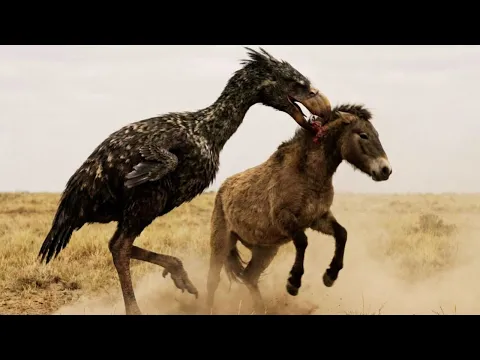
For a long time, it was believed that these birds killed their prey by biting and shaking them laterally.
Later studies in applied engineering on the fossils indicated another reality.
The skull of these birds was highly resistant to vertical forces, but vulnerable to lateral twists.
For this reason, the described strategy involves fast and precise attacks.
The beak acted like an axe.
The animal would run, strike from above aiming for the skull or spine, and retreat.

The process was repeated until incapacitating the prey.
This attack pattern is often detailed in analyses by Extinto Doc.
Brazilian Record Reveals Most Robust Predator
In Brazil, the Taubaté Basin in São Paulo is cited as the occurrence site of Paraphysornis brasiliensis.
This terror bird would have reached about 2.40 meters in height.
The text points out that this species was more robust and heavier than its Argentine relatives.
This constitution suggests a strategy less dependent on long chases.
The focus would be on ambushes in dense vegetation environments.
Yet, the principle remained the same. The legs served to immobilize.
The beak was used to deliver fatal blows.
Other Giants and the Beginning of Decline

The terror birds coexisted with other large South American predators.
Among them, the giant caiman Purussaurus and the snake Titanoboa, cited as dominant presences in rivers and forests.
In open plains, however, supremacy was attributed to the birds.
The decline of this dominance is associated with the emergence of the Panama Isthmus.
This event allowed for the so-called Great American Biotic Interchange, which began around 3 million years ago.
Predators from the north began to occupy the continent.
According to Extinto Doc, there was not an immediate extinction but a gradual process of wear.
Among the cited factors are the vulnerability of nests on the ground and climatic changes that favored social hunting mammals in groups.
The Exception That Moved North
The text highlights Titanis walleri as a notable exception.
This species would have crossed Panama and lived in North America.
Fossils found in Florida and Texas support this hypothesis.

This movement is presented as evidence that terror birds were efficient competitors, capable of facing predators in new territories.
A controversial fossil in Uruguay is also mentioned, initially dated to about 17,000 years ago.
This find raises the possibility of survival much more recently than previously thought.
Seriema Maintains Ancestral Behavior
The connection to the present appears in the seriema, a common bird in the Brazilian Cerrado.
According to the text, genetic analyses indicate that it is the closest living relative of the terror birds.
Its behavior of killing prey by hitting them against the ground repeats the same biomechanical pattern described for its giant ancestors.
The difference lies in size, not technique. This relationship between past and present is frequently highlighted by Extinto Doc.
If a predator capable of dominating an entire continent left living descendants and preserved behavior patterns, what else may be hidden in the fossil record about the real duration and reach of this dominance?





Muito bom👏🏻👏🏻👏🏻