Portuguese
  Spanish


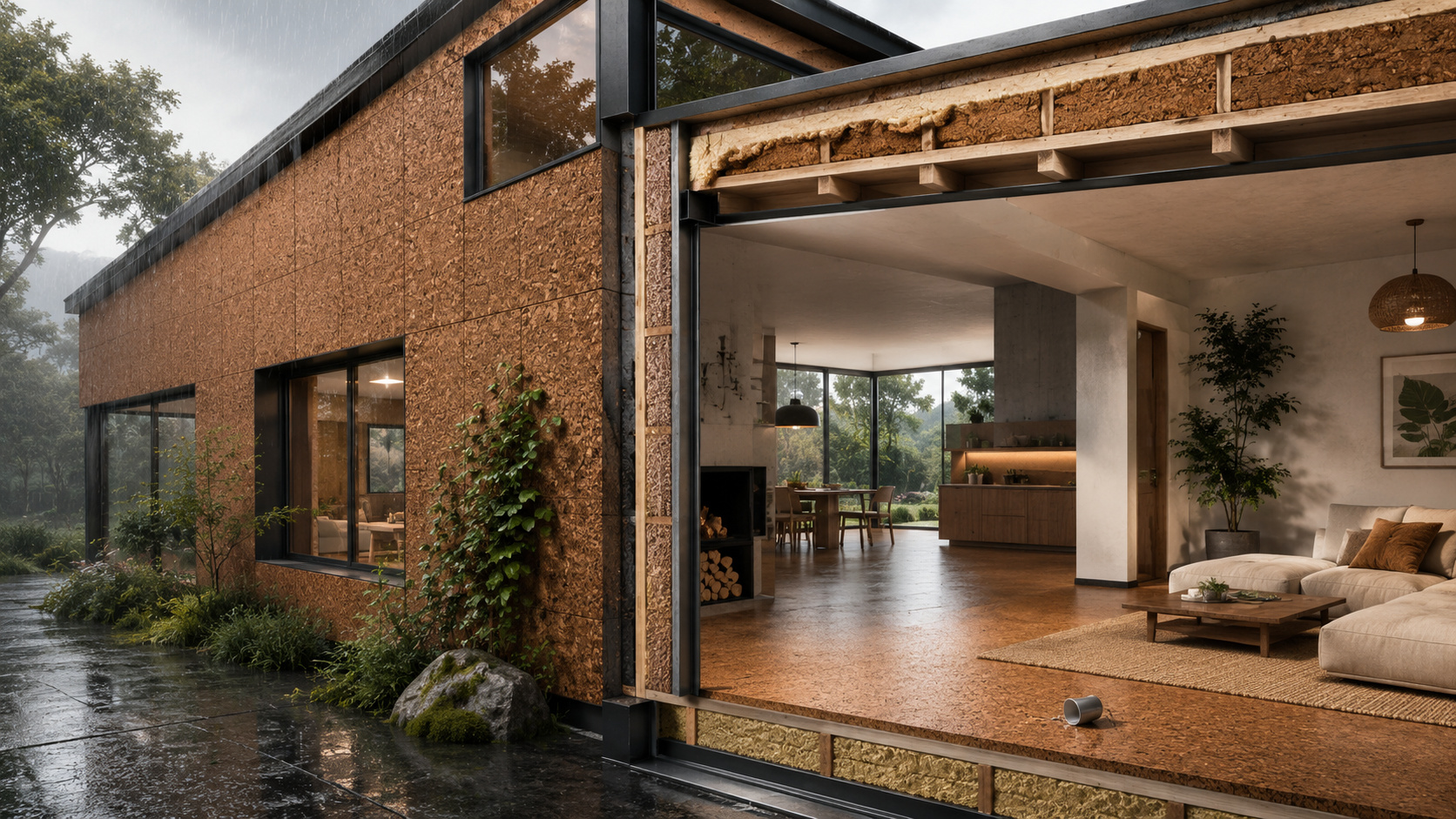

Cork used in facades, floors, and coverings insulates heat, reduces noise, resists moisture, absorbs impact, and even stores carbon for decades.
According to Casa da Cortiça, cork is extracted from the bark of the cork oak, the Quercus suber, in an operation that neither cuts down the tree nor damages the trunk. The extraction is done manually every 9 years, when the cork oak has already completely regenerated the previous layer. A mature cork oak lives between 150 and 200 years and can be stripped 15 to 18 times throughout its life. This makes cork one of the few building materials that naturally renews itself while the tree continues to capture CO₂ from the atmosphere.
The internal structure of cork has about 40 million cells per cubic centimeter, and each cell functions as a microscopic chamber sealed with air. It is this trapped air that explains the thermal insulation, acoustic absorption, vibration resistance, and impact cushioning capability.
Cork in civil construction combines thermal insulation, acoustic insulation, and moisture resistance
Cork stands out because it combines properties that many synthetic materials deliver separately. It insulates heat, reduces noise, absorbs vibration, resists water, and maintains dimensional stability for long periods.
-
Key Infrastructure Projects for Brazil’s Next President: Expanding Railways to Cut Transport Costs, Reduce Truck Traffic, Create Jobs, and Boost Industries Nationwide

-
While China Builds Undersea Rail and Mexico Connects Two Oceans, Brazil Struggles with Grain Transport Due to Lack of Railways

-
Students Build Kansas’ First Hemp-Insulated Social House for a Needy Family: 85% Less Concrete, Solar Roof Returns Energy to Grid, Carbon Negative in Under 20 Years

-
China to Drill 90 Kilometers Under the Sea to Connect Two Cities Currently Linked Only by Ferry


Materials like fiberglass, expanded polystyrene, and polyurethane may have good thermal performance, but they generally rely on additives, complementary barriers, or moisture protection. Cork delivers multiple functions in a single natural structure.


For this reason, the material is gaining ground in facades, floors, coverings, and internal walls. In projects seeking performance and environmental certification, cork appears as a sustainable alternative to petroleum-derived or high-energy industrial insulators.
Cork’s cellular structure explains the performance that synthetic insulators do not replicate
Each cork cell is filled with air and coated with suberin, a waxy compound that makes the cell walls impermeable to liquids and gases. This natural protection prevents the material from rotting, easily absorbing water, or promoting fungi.
Suberin also helps maintain performance for decades, without significant chemical reaction with acids or bases in normal concentrations. It is a molecular shield that explains the durability of cork in both indoor and outdoor environments.
The air trapped in the cells creates thermal insulation. As these cells are rigid and elastic, cork can absorb impact and recover its original shape without collapsing like some synthetic foams.
Expanded cork agglomerate is used in facades, walls, floors, and coverings
In construction, cork appears mainly in three forms: expanded black agglomerate, white agglomerate, and decorative coatings in slats or tiles. Each serves a different technical function in the construction.
The expanded black cork agglomerate, also called ICB, is the most used for insulation. It is produced by expanding the granules with steam, without adhesives or additives, and can be applied to facades, internal walls, coverings, and floors.

This material has thermal conductivity between 0.038 and 0.045 W/mK, performance comparable to that of glass wool. The difference is that cork does not lose stability with moisture, thermal variation, or common compression from use.
Cork in floors reduces impact noise and improves thermal comfort
In floors, cork functions as a resilient layer under floating flooring. It reduces impact noise between floors, absorbs vibrations, and improves the thermal sensation when walking.
This application is useful in apartments, offices, hotels, and houses with laminate, vinyl, or wood flooring. Cork helps to reduce the sound of footsteps, furniture dragging, and repeated impacts on the floor.
It can also be used in radiant floor systems because it combines thermal insulation and dimensional stability. The result is a quieter, more comfortable floor that is less prone to performance loss over time.
Ventilated facade with cork eliminates plaster and improves thermal efficiency
The most technical application of cork is the ventilated facade. In this system, cork panels are fixed onto a metal substructure set apart from the original wall, creating a ventilated air chamber between the panel and the masonry.

This configuration thermally insulates the facade from the outside, the most efficient position because it reduces thermal bridges in slabs, pillars, and beams. It also removes moisture through ventilation, reducing the risk of condensation and wall deterioration.
An 8 cm ICB facade in an ETICS system can achieve insulation equivalent to a 50 cm brick wall. With 10 cm in a ventilated facade, cork delivers high thermal performance and additional protection against moisture.
Cork in facades maintains natural texture and requires no heavy maintenance
The cork used in facades has a natural texture and color that varies from beige to dark brown, depending on the degree of granule expansion. This finish can replace paint, plaster, or synthetic coatings in sustainable projects.
Suberin helps the material resist water and dirt differently from common plaster. This reduces the need for frequent maintenance and avoids some of the problems of stains, peeling, and surface cracks.
In ventilated facades, the material also acts as a mechanical protection layer. In addition to insulating heat and noise, cork protects the structural wall against light impacts and external thermal variations.
Cork captures carbon in the cork oak and stores CO₂ within the material
Cork has an important environmental advantage: it sequesters carbon in two stages. The first occurs during the growth of the cork oak, which captures CO₂ from the atmosphere while producing the bark.
After stripping, the tree intensifies the regeneration of the bark and continues to absorb carbon throughout the next cycle. According to the base text, stripped trees can absorb three to five times more CO₂ than unstripped trees during this process.
The second stage happens in the installed material itself. Cork keeps carbon trapped in its cellular structure for decades or even centuries, as long as it remains in use in construction.
Portugal dominates global cork production and supplies the Brazilian market
Portugal dominates about 50% of global cork production. Brazil imports the material mainly from Portugal and Spain, with distribution concentrated in suppliers specialized in sustainable coatings.

The Brazilian demand has been growing as architects, builders, and consumers seek alternatives to fiberglass, EPS, and synthetic materials used in thermal and acoustic insulation.
Even so, cork is still little known in the national market. Many professionals associate the material only with wine stoppers, without considering its application in facades, floors, roofs, and high-performance walls.
Cork price still limits large-scale adoption in Brazil
The main obstacle for cork in Brazil is the initial cost. ICB boards for wall insulation can range between R$ 80 and R$ 180 per square meter, depending on thickness and specification.
For comparison, equivalent fiberglass can cost between R$ 30 and R$ 60 per square meter. This difference leads many projects to replace cork with cheaper materials during the budgeting phase.
The comparison, however, does not always consider lifespan and maintenance. Cork does not compress easily, does not absorb moisture like some insulators, and tends to maintain performance for decades, reducing future costs.
Lack of technical knowledge prevents greater use of cork in Brazilian constructions
Another obstacle is low technical familiarity. Cork still does not appear in the training of many professionals with the same strength as drywall, fiberglass, EPS, PVC, or conventional facade systems.
When it appears in a project, it is common for engineers, estimators, or builders to replace the material with more well-known alternatives. This happens even when cork would perform better in humidity, acoustics, or sustainability.
The problem is not availability, but specification. Cork is already in the Brazilian market, but it still needs to be treated as a technical construction material, not just as a decorative item or curiosity associated with wine.
Cork can replace fiberglass, EPS, and polyurethane in sustainable projects
Cork does not replace all insulators in any construction, but it is competitive when the project requires thermal insulation, sound reduction, moisture resistance, low maintenance, and lower environmental impact.
It can be used in ventilated facades, internal walls, roofs, floating floors, offices, rooms, hotels, and buildings seeking environmental performance. It also meets projects that need to reduce noise and improve thermal comfort without resorting to synthetic materials.
The advancement of sustainable construction tends to expand its use. The material that the world knows as a wine stopper can also function as a thermal, acoustic, and lightweight structural insulator in facades, floors, and roofs that need to last for decades.