Portuguese
  Spanish


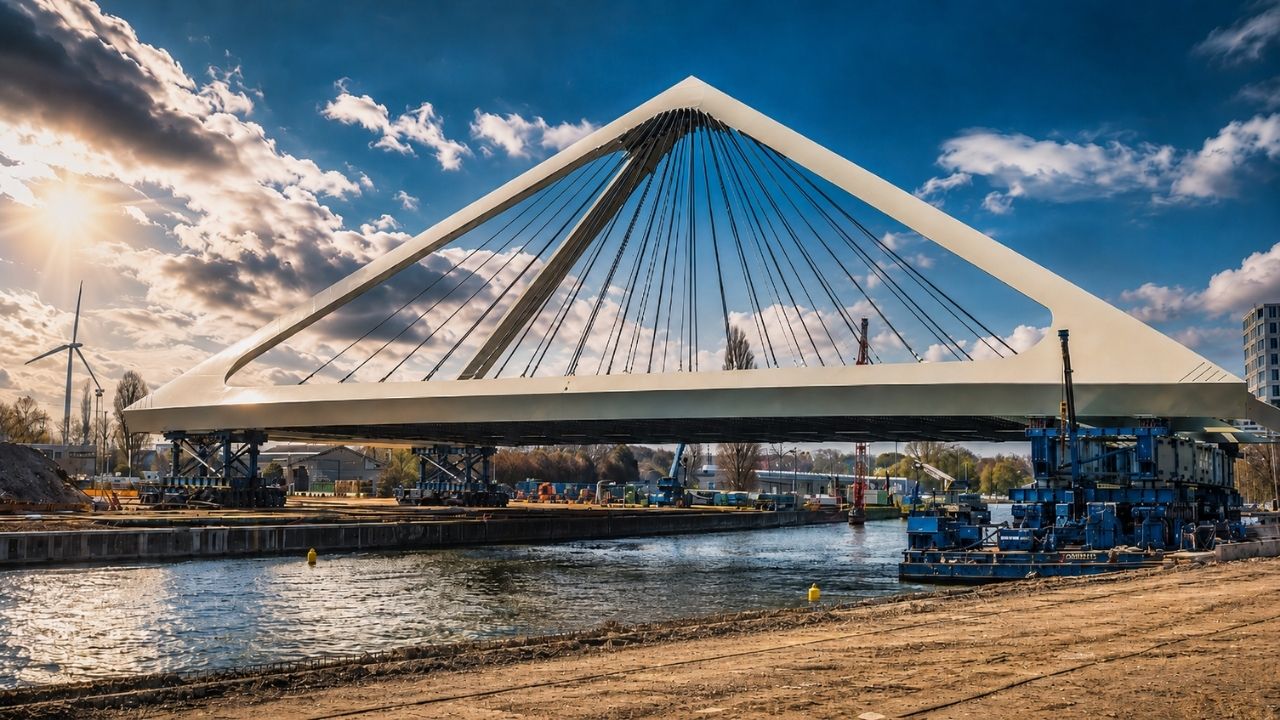

The bridge installed in Ghent over the Ringvaart Canal required Sarens, 120 axle lines, twin barges, and extreme control to preserve road safety, reduce travel, support bike lanes, improve crossings, and transform a narrow crossing into a decisive work for the urban mobility of the Belgian city in the coming years integrated locations.
A 106-meter-long, 2,600-ton, pyramid-shaped bridge was transported and installed in Ghent, Belgium, in an operation conducted by Sarens and announced on April 22, 2026. The structure departed from Evergem and proceeded to the Ringvaart Canal before taking its final position.
According to information released by Sarens, the transport drew attention for the precision required: in some sections of the canal, the available margin was only 30 to 40 centimeters. The new Pyramid Bridge KWN02 was designed to improve mobility between the banks, reduce travel time by about 15 minutes, and increase road safety in the region.
Pyramid bridge required transport by land, water, and out-of-standard calculations

The operation began with an uncommon structure for urban standards: a 2,600-ton, 106-meter, pyramid-shaped bridge. The project was architecturally designed by Laurent Ney, while the manufacturing was carried out by Victor Buyck Steel Construction in Evergem.
-
Brazil’s Largest Port to Accommodate Bigger Ships by October as Ibama Approves Non-Explosive Removal of Hidden Rocks and Sediments

-
Mexico Develops 3D-Printed Concrete from Corn Waste, Cutting Emissions by 70% and Reducing Construction Waste by 90%
-
Traditional Mortar to Decline by 2026: ACIII-E Solution for Large Porcelain Tiles Offers Better Adhesion and Reduces Risk of Loose Pieces in Floors and Facades

-
72-Year-Old Man Spends Six Years Building a Rotating House for His Wife, Completing a Full Turn in 22 Seconds


To remove the piece from the factory and take it to Ghent, Sarens used 120 axle lines SPMT K24, self-propelled modular vehicles used for loads that cannot be moved by conventional trucks. Then, the structure proceeded along the canal on the twin barges Karel and Victor.
Narrow canal left only 30 to 40 centimeters of clearance during the crossing

The most delicate part of the operation occurred during the transport through the Ringvaart Canal. At certain points, there was only 30 to 40 centimeters of clearance between the load and the route limits, which required millimetric control to avoid damage to the structure, local infrastructure, and the surrounding environment.
The logistics involved ballast pumps, winches, and bracing systems to maintain the bridge’s stability during navigation. With a piece of this size, any tilt, displacement, or calculation error could compromise the entire operation.
Pyramidal shape changed the challenge of lifting and installation
Besides the weight, the pyramidal shape of the bridge made the work more complex. The distribution of the center of gravity and the support points required specific engineering studies before installation, as the structure did not behave like a conventional straight bridge.
In the final phase, Sarens used a CS1000 hydraulic jack system with four towers, along with 340T-MB modular beams. This setup allowed the structure to be positioned precisely in its final location, over the Ringvaart Canal, within a short execution window.
Installation was concentrated in a single weekend to reduce impacts
The installation of the bridge was organized to occur in just one weekend. The decision was directly related to the impact that a prolonged interruption would cause on road and river traffic in the Ghent region.
To meet the deadline, teams worked in continuous shifts. The operation needed to progress without long pauses, but without leaving room for improvisation, as the project involved heavy transport, navigation in a narrow canal, and large-scale structural installation.
New bridge is part of a larger urban redevelopment in Ghent

The Pyramid Bridge is not an isolated intervention. It is part of a broader urban redevelopment project in Ghent, which includes the remodeling of 22 crossings and intersections, as well as the creation of 27 kilometers of cycling infrastructure.
The proposal also aims to better separate the flows of vehicles, bicycles, and pedestrians, especially through grade-separated crossings. In practice, the bridge should help reduce traffic conflicts and improve the safety of those traveling in the area.
The project also promises to reduce travel, emissions, and barriers for wildlife


According to project data, the new bridge is expected to shorten the travel time between the canal banks by approximately 15 minutes. The estimate also indicates a reduction of about 12% in CO₂ emissions per vehicle in this section.
Another relevant detail is the presence of two green corridors dedicated to wildlife passage. The idea is to restore connections for local species, mainly small mammals and amphibians that were previously more isolated by the barrier formed by the Ringvaart Canal.
Heavy engineering shows how a bridge can change more than just traffic
The installation of the Pyramid Bridge in Ghent shows that a mobility project can bring together heavy engineering, urban planning, road safety, and environmental concern in the same project.
The transport of the structure was as important as the installation itself, because it revealed the level of precision needed to move a 2,600-ton piece through a narrow canal.
Now, the bridge becomes part of a larger transformation in the Belgian city. The question remains: should projects of this scale, with complex logistics and direct impact on mobility, be more common in large cities? Do you think such projects justify the cost and complexity of execution? Share your opinion.