Portuguese
  Spanish


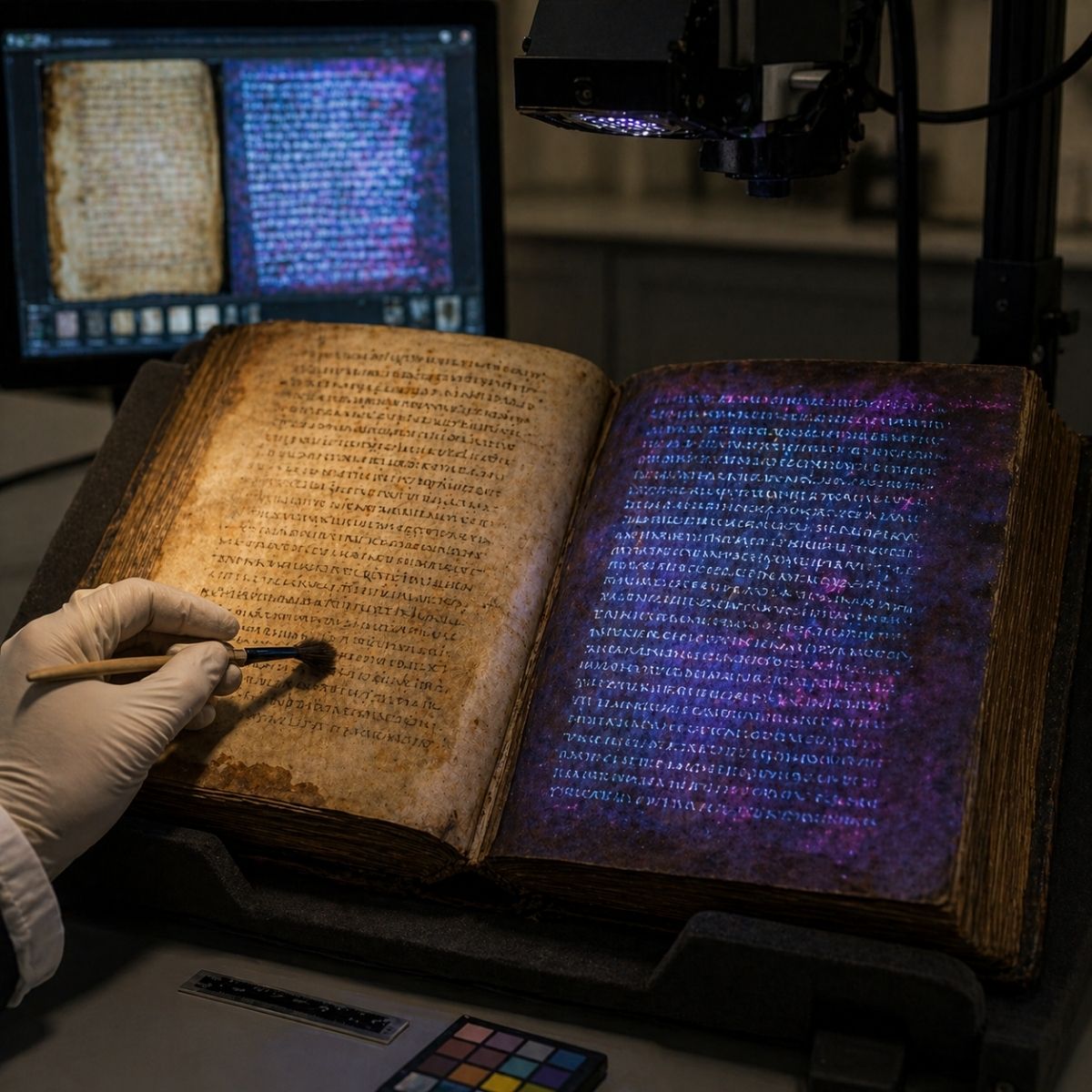

Researchers led by Garrick Allen from the University of Glasgow recovered 42 New Testament pages belonging to Codex H, a 6th-century manuscript with Letters of Saint Paul disassembled in the 13th century on Mount Athos, using multispectral imaging to reveal traces of invisible text called “ghost text.”
Forty-two New Testament pages that had been missing for centuries have been recovered by researchers using technology capable of seeing what the human eye cannot. The manuscript known as Codex H is a 6th-century copy of the Letters of Saint Paul, texts considered fundamental to the formation of the Christian tradition that form a central part of the New Testament, and its pages disappeared when monks at the Great Lavra Monastery, located on Mount Athos in Greece, disassembled the codex in the 13th century to reuse the leaves as binding material and protection for other books. The original texts were covered with new ink, which practically erased the previous writing and turned New Testament pages into disposable material for eyes that had no way of knowing what lay beneath.
The recovery was led by Professor Garrick Allen, from the University of Glasgow, Scotland, and involved a partnership with the Early Manuscripts Electronic Library (EMEL) and specialists in Paris responsible for carbon dating that confirmed the parchment’s 6th-century origin. The surviving fragments of Codex H were scattered across libraries in Italy, Greece, Russia, Ukraine, and France, a dispersion that for centuries made it difficult to reconstruct a New Testament manuscript whose importance for biblical studies was known but whose complete content seemed irrecoverable. The project received funding from the Templeton Religion Trust and the Arts and Humanities Research Council, with cooperation from the Great Lavra Monastery itself.
How technology revealed the invisible New Testament pages

The technique that made the recovery possible is multispectral imaging, a method that captures photographs at different wavelengths of light to identify traces that human vision cannot perceive. When applied to the leaves that had been rewritten by medieval monks, the technology was able to distinguish superimposed layers of ink and reveal the characters of the original New Testament text that were buried beneath the later writing. The process works because inks from different eras have distinct chemical compositions, and each composition responds uniquely to certain wavelengths, allowing the multispectral camera to visually “separate” what the eye sees as a uniform smudge.
-
400 km² of Greenhouses in Almería, Spain, Astonish American Visitor by Producing Millions of Tons of Produce for Cold-Weather Markets

-
Antarctic Volcano Emits Microscopic Gold Particles That Travel Up to 1,000 Kilometers Across the Continent
-
Little-known Japanese factory is the world’s largest zipper manufacturer, producing 7 billion pieces annually and closing half the world’s pants.

-
Brazilian Factory Recycles One-Third of the Country’s Styrofoam Waste, Matching European Levels with 51,000 Tons Reused Since 2007


The most surprising find came from where no one expected. Allen and his team discovered that the ink used in the medieval rewriting had left marks on the opposite pages, a kind of reflection of the ancient New Testament text that researchers dubbed “ghost text.” These residual impressions allowed the recovery of passages that no longer physically existed on the original leaves themselves, because the content had transferred by contact between pages over centuries of compressed storage within bindings. The “ghost text” functioned as an accidental copy that the passage of time created without anyone planning it.
What the 42 recovered pages reveal about the New Testament

The recovered texts do not contain previously unknown passages from the Bible, and it is important to make this clear to avoid mistaken expectations. What the 42 pages of Codex H offer is a deeper understanding of how the New Testament was organized and interpreted in the early centuries of Christianity, information that for historians and theologians is as valuable as any unknown passage. Among the most significant findings are the oldest chapter lists ever identified for the Letters of Saint Paul, and these divisions are considerably different from those that appear in Bibles read today, indicating that the structure of the New Testament underwent transformations over 1,500 years that altered how readers find and organize content.
The fragments also document the work of scribes who copied and kept these texts alive. Handwritten corrections, marginal notes, and text adjustments show that the pages of the New Testament were not treated as untouchable objects, but as working documents that scribes adapted according to need, tradition, or the interpretation of the time. This material evidence contradicts the idea that sacred texts were mechanically reproduced without alteration: Codex H shows that copying the New Testament involved human decisions that influenced how the texts arrived at contemporary versions.
Why Medieval Monks Destroyed New Testament Pages


The decision to dismantle Codex H in the 13th century was not an act of vandalism, but a common practice at a time when parchment was a scarce and expensive material. When manuscripts aged, suffered damage, or were considered redundant because newer copies already existed, their parchments were repurposed to bind and protect new books, a recycling logic that prioritized immediate utility over historical preservation. The monks of the Great Lavra Monastery likely had more recent copies of the Letters of Saint Paul and considered that Codex H had already served its purpose, a decision that from a medieval point of view was rational but from a contemporary point of view resulted in the dispersion of one of the most important New Testament manuscripts.
The repurposing of the pages is, paradoxically, what allowed their survival. If the parchments had been discarded instead of reused, they would have decomposed centuries ago. By incorporating them into the bindings of other books, the monks unintentionally protected the New Testament leaves within covers that preserved them from humidity, light, and direct handling. The fragments that researchers found in libraries in five different countries survived precisely because they were hidden inside books that no one opened with the intention of looking for what was beneath the cover.
What the Manuscript’s Recovery Changes in New Testament Studies
For the academic community studying the formation of Christian scriptures, recovering 42 pages of Codex H is a rare event that significantly expands the material available for analysis. The New Testament as a text has reached the present day through chains of manual copies made over centuries, and each ancient manuscript that is recovered provides a point of comparison that allows for evaluating what changed between versions and what remained stable over millennia of transmission. Codex H, being a 6th-century copy, occupies a chronological position that places it closer to the original texts than most complete surviving manuscripts, which makes each recovered page especially relevant.
The University of Glasgow has already made a digital version of the material available for free, and a print edition will be published soon. The decision to make the content freely accessible reflects the understanding that discoveries about the New Testament are of interest not only to academics but to billions of Christians around the world who read texts whose origins and transformations Codex H helps to illuminate. The 42 pages that medieval monks considered disposable have returned from oblivion to tell a story that none of them would have imagined anyone would be able to read again.
And you, did you know that New Testament pages were repurposed as binding material? What did you think of the technology that revealed the invisible text? Leave your opinion in the comments.