Portuguese
  Spanish


Cyclists say they notice an improvement in odor, more animals, and a safer environment as cleaning, dredging, and sewage actions advance on the Pinheiros River.
The environmental recovery of the Pinheiros River in São Paulo is already attracting the attention of those who use the bike path and leisure areas near the river.
Visitors report, mainly, a reduction in the strong smell, an improvement in the landscape, and an increase in the presence of animals, such as birds and capybaras.
According to the Government of São Paulo, these reports align with indicators of improved water quality. Between 2024 and 2026, three of the four monitored points in the main channel recorded a decrease in the concentration of organic matter.
-
Amazonas Updates Flag After Over 40 Years to Represent All 62 Municipalities in Historic Legislative Decision

-
Going to travel and leave your pet alone? Brazilian city creates strict rule, targets temporary abandonment, and can fine dog and cat owners up to R$10,000.
-
Traffic jammed between BH and Nova Lima may get significant relief with the Viaduto Ferradura, a R$ 48 million project that promises to connect MG-30 and MGC-356 without passing through the Belvedere junction.

-
Heavy metals in the sea, fishermen without income, and concerned residents: chemical contamination in São Tomé de Paripe leads Salvador to declare an environmental emergency for 90 days and mobilize municipal agencies.


In the first five months analyzed, the reduction reached 55% at Pedreira Dam, 29% at Socorro Bridge, and 26% at São Paulo Plant.
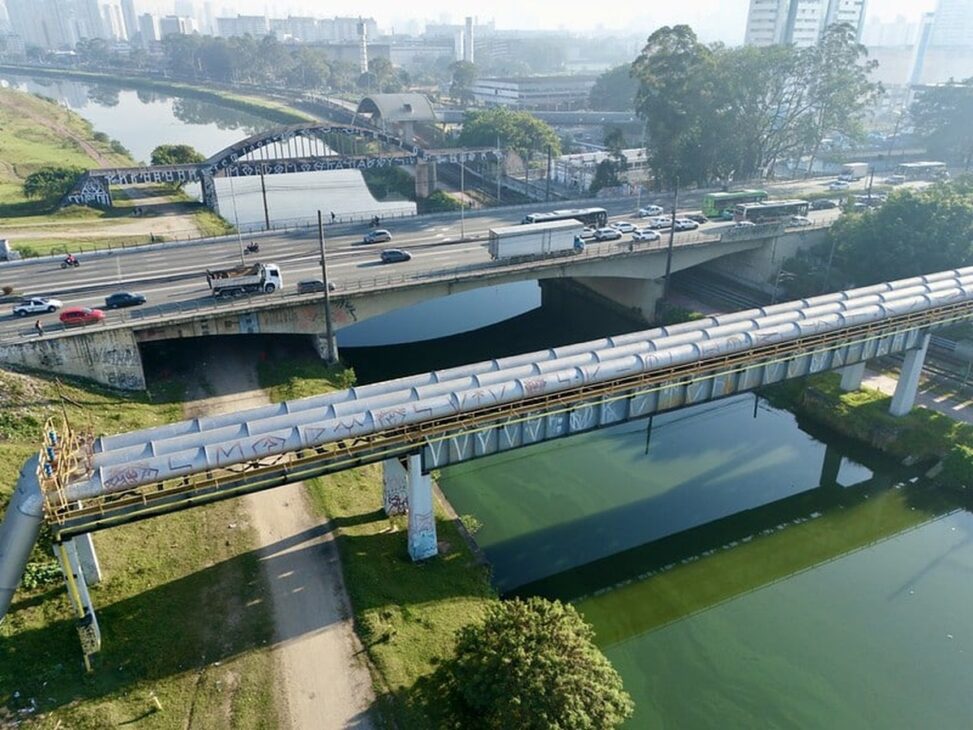
Cyclists report change in smell and more animals
Doctor Marcelo Giordano, a user of the bike path for five years, noticed the transformation more strongly in the last two years.
According to him, the odor has decreased, the landscape has changed, and animals appear more frequently around the river.
Marcelo also relates the improvement to the population’s quality of life. For him, advances in water, sewage, and cleaning directly help public health.
Teacher and cyclist Lilian Faria Ferreira, who also frequents the bike path for five years, reports a similar perception.
According to her, the smell decreased mainly in drier periods. In addition, birds and capybaras appear more frequently.
Lilian also highlights improvements in lighting, controlled vegetation, and policing. Thus, the depollution increases the feeling of safety.

Bruno Covas Linear Park and bike path will have new improvements
The Government of São Paulo continues the work of requalifying the banks of the Pinheiros River.
The Bruno Covas Linear Park and the bike path will receive infrastructure improvements, enhanced security, modernized lighting, new signage, and landscape requalification.
In addition, teams will also carry out environmental recovery actions.
The initiative involves the São Paulo Secretariat of Environment, Infrastructure and Logistics (Semil) and the Metropolitan Water and Energy Company (Emae).
The region will also be included in the Muralha Paulista program, in partnership with the Public Security Secretariat.
With this, the public authorities will expand monitoring for users of the bike path and state urban parks.
Cleaning of the Pinheiros River will be reinforced with new vessels
The advancements are part of the IntegraTietê Program, an initiative by the São Paulo Government to recover the Tietê River and its tributaries.
Among the ongoing efforts, the program reinforces the removal of floating debris from the Pinheiros River.
The operation will receive three new vessels. Thus, the fleet will increase from eight to 11 boats operating daily along the 25 kilometers of the river.
With the expansion, the teams will be able to remove up to 900 additional tons of debris per month.
In 2025, the operation removed 43.9 thousand tons of floating debris from the Pinheiros. The volume exceeded by 23% the amount recorded the previous year.
In the first quarter of 2026, the teams removed 12.3 thousand tons. The number represents an increase of 19.4% compared to the same period in 2025.
Since 2023, the operation has already removed more than 134 thousand tons of trash from the water source. Investments in this effort have already exceeded R$ 214 million.
Dredging and sanitation complete actions on the Pinheiros River
The dredging of the Pinheiros River is also advancing as an important stage of the program.
Since 2023, the teams have removed more than 1.57 million cubic meters of sediments from the riverbed.
By April 2026, investments in this action totaled R$ 189 million.
Additionally, the program also includes structural sanitation works.
According to Sabesp, the company has connected more than 1.1 million households to the sewage network since 2023.
The goal aims to reach 1.5 million new connections by 2026. After that, the objective exceeds 2.2 million connections by 2029.
The expansion strengthens sewage collection and treatment in the Metropolitan Region of São Paulo and in Alto Tietê.
Depollution changes the population’s relationship with the Pinheiros River again
The improvement perceived by cyclists and visitors shows that the recovery of the Pinheiros River already surpasses technical indicators.
At the same time, the numbers for cleaning, dredging, and sanitation show continuity of environmental actions.
Thus, the river returns to occupy a place in the routine of leisure, mobility, and urban coexistence in São Paulo.