Portuguese
  Spanish


The New Russian Nuclear Reactor of 1200 MW Promises Over 100 Years of Continuous Operation.
Russia has made progress in its largest nuclear project in Africa. The state-owned Rosatom has completed the welding of the upper half of the reactor vessel VVER-1200, a key component of the second unit of the El Dabaa nuclear power plant in Egypt. This project is strategic: it marks Russia’s return to the African continent since the end of the Soviet Union.
What Is the VVER-1200
The VVER-1200 is an updated version of the VVER-1000 reactor, featuring cutting-edge technology and new safety measures.
Classified as a III+ generation power plant, the model offers significant advances. It produces 1,200 MW of electricity and 3,200 MW of thermal energy.
-
Brazil’s Angra 3 Nuclear Plant Reaches 66% Completion; Government Faces 2026 Deadline to Decide on $24 Billion Project’s Future

-
American company drills a 1,830-meter hole in Kansas using oil well technology, places a nuclear reactor inside, and claims it will generate electricity without any cooling tower.
-
Canada invests more than 2 billion dollars to upgrade an old nuclear laboratory and try to rival the world’s major atomic energy powers.
-
Nuclear company backed by Bill Gates partners with Hyundai for next-generation 345 MW nuclear reactor


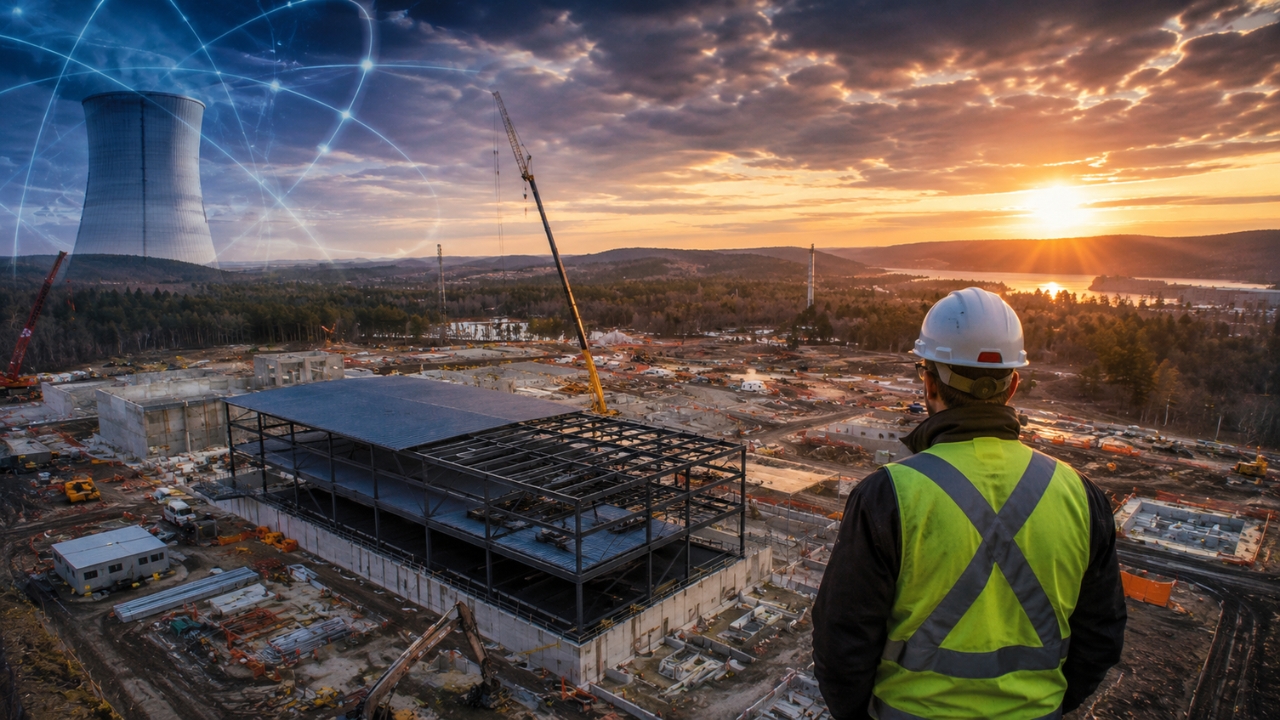

Among its differentiators is a lifespan of 100 years. Additionally, it can operate for 18 months without refueling.
Rosatom emphasizes that the VVER-1200 has a lifespan twice as long and generates 20% more electrical energy compared to the VVER-1000. It also features advanced safety systems and a coefficient of performance (COP) of 35.9%.
Technology and Innovation in the Reactor
The VVER-1200 operates with a dual-circuit steam generation system. It uses pressurized water as a coolant and neutron moderator.
The system includes four cooling circuits, steam generators, and a pressurizer. It also has an emergency cooling system (ECCS) to prevent accidents.
Other innovations include a spent fuel pool within the containment and a core catcher made of special material for extreme situations. Additionally, there is a passive heat removal system, which operates without external power.
The El Dabaa Nuclear Power Plant
The El Dabaa project is of great importance to Egypt. With four VVER-1200 reactors, it will be the country’s first nuclear power plant. It will also be the first construction of its kind in Africa in nearly 40 years, since the Koeberg plant in South Africa.
The agreement between Russia and Egypt was signed in 2015. In addition to building the reactors, Rosatom will supply nuclear fuel for the entire lifespan of the plant.
The Russian state-owned company is also responsible for training the Egyptian team and for maintenance during the first 10 years of operation.
Another important aspect of the project is desalination. Four nuclear desalination plants are planned, which will help alleviate the water crisis in Egypt.
Progress of Construction
The construction of the plant is progressing rapidly. The construction of the first unit began in July 2022.
In November of the same year, the second unit was started. In September 2024, the first level of internal containment for Unit 2 was installed. The other two units are also under construction.
The El Dabaa plant will be crucial for the Egyptian energy matrix. In addition to diversifying energy sources, it will reduce dependence on fossil fuels. The project is also expected to generate thousands of jobs and train local professionals.
Strategic Importance for Russia
This project is more than an engineering feat. It is a strategic move by Russia in Africa. Since the collapse of the Soviet Union, the country has lost influence in the region. With El Dabaa, Russia regains an important position in the African energy sector.
Furthermore, the VVER-1200 reinforces Russian nuclear technology in the global market. Similar models are already in operation in countries like Belarus, consolidating Rosatom as a benchmark in cutting-edge nuclear energy.
With information from interestingengineering.