Portuguese
  Spanish



Pioneering Project Expands Access to Natural Gas to the Interior of Sergipe, Bringing Clean and Efficient Energy to Municipalities Far from the Pipeline Network, Boosting Regional Development.
Providing clean, efficient, and accessible energy to all regions of a state is undoubtedly a challenge that many companies and governments face.
In the case of Sergipe, a state in northeastern Brazil with a strong industrial and agricultural presence, the interiorization of natural gas has proven to be a fundamental strategy for promoting regional development.
Therefore, Sergipe Gás S/A, known as Sergas, stands out for an innovative project that allows the supply of natural gas to the interior of Sergipe, especially to municipalities that still do not have access to the traditional pipeline network.
-
Oil production grows in Rio, but reserve replacement raises a warning sign

-
Petrobras is expected to complete the drilling of the Morpho well in the Foz do Amazonas in August 2026, the first well in the Equatorial Margin, an oil frontier that the ANP estimates at more than 30 billion barrels and could redraw the map of Brazil.

-
Oil returns to the center of concerns with tension between the US and Iran

-
IEA reduces forecast for global oil demand in 2026 after impacts of the Middle East crisis


Additionally, this movement meets a growing demand for more sustainable and economical energy that can serve not only large cities but also rural areas and small municipalities in the state.
Thus, the interiorization of natural gas represents an essential pathway to reducing inequalities in access to energy. Enabling different regions to develop with improved quality of life and competitiveness.
What Is Natural Gas and Its Importance
Natural gas is a fossil fuel energy source, but it has significant advantages over other traditional fuels such as diesel oil or coal. It emits fewer polluting gases, which contributes significantly to reducing environmental impact.
Moreover, natural gas has versatility for electricity generation, heating, and fuel in industries, vehicles, and homes.
In Brazil, natural gas has gained traction in recent years, particularly with the expansion of infrastructure for its distribution. With the development of the pre-salt layer along the Brazilian coast, natural gas production has increased, enabling more regions to access this energy source.
However, transporting natural gas to areas farther from the main networks still involves logistical and technological challenges.
Another relevant point is that natural gas also contributes to the country’s energy security by diversifying the energy matrix and reducing dependence on more polluting and less efficient sources. Therefore, the cleaner burning of gas helps reduce the greenhouse effect, which is essential for Brazil to meet environmental targets and international sustainability commitments.
The Interiorization of Natural Gas in Sergipe
Sergipe is the smallest state in Brazil by area, but it has a diversified economy, with activities ranging from agribusiness to oil and gas production.
The capital, Aracaju, and its metropolitan region concentrate a significant part of the energy distribution infrastructure, including piped natural gas.
However, interior municipalities, such as Lagarto, a traditional town in the Sergipe hinterland, face difficulties accessing natural gas, as they still do not have a connection to the pipeline network.
To solve this problem, Sergas developed a pioneering project for the interiorization of natural gas.
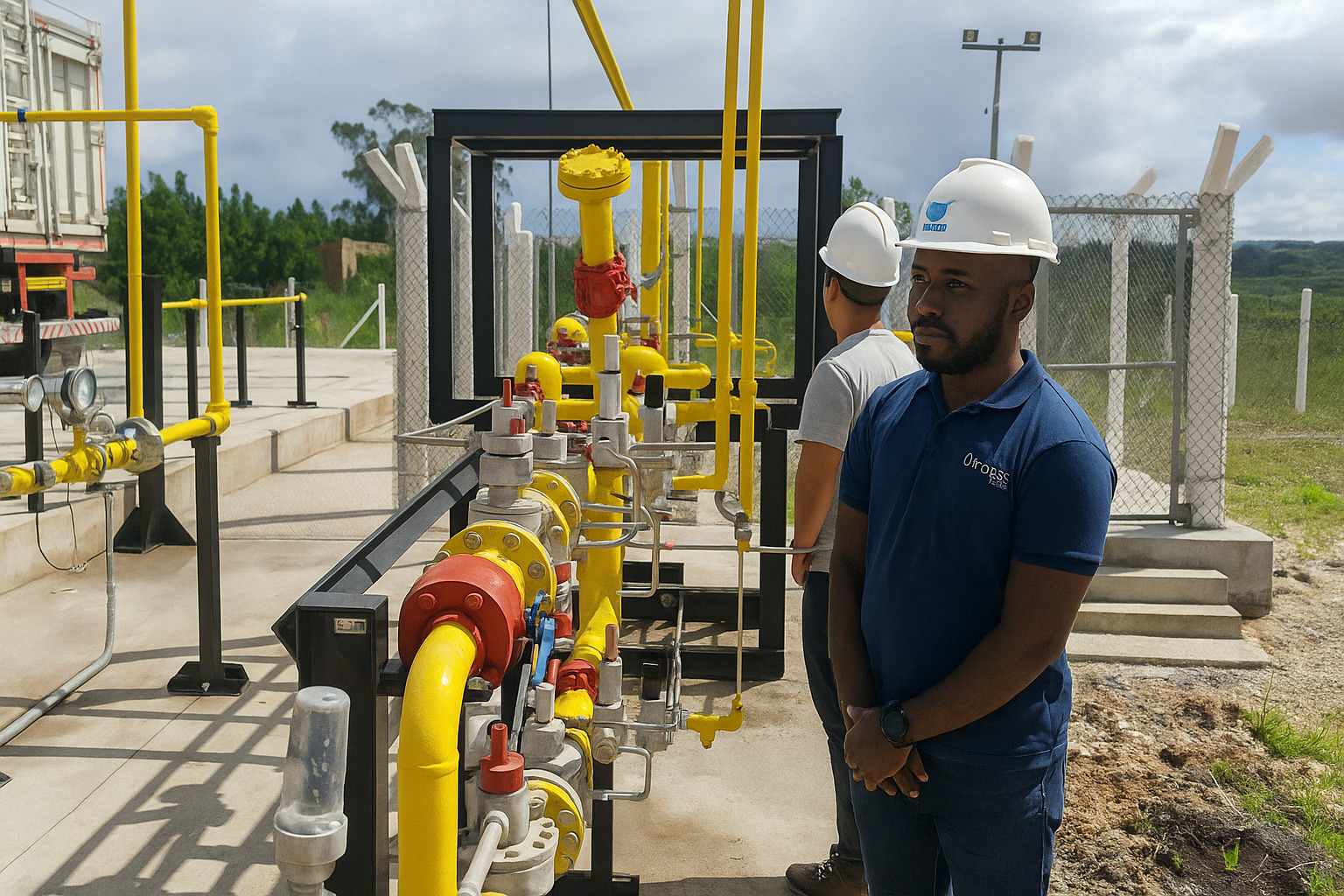
The solution utilizes Compressed Natural Gas (CNG), which allows gas to be transported in trucks to remote locations, where it is stored and decompressed to supply industries and other sectors.
Thus, this logistical model has proven to be efficient and economically viable, especially for regions where building pipeline networks would be too costly.
Furthermore, the project can create a new economic dynamic in these areas, as access to natural gas stimulates the installation of small and medium industries, improves the performance of existing companies, and generates a series of direct and indirect jobs.
Therefore, access to energy is often a decisive factor for investments in less developed areas.
Success Case in Lagarto
One of the most notable examples of the Sergas project occurs in the municipality of Lagarto. Although it is far from the main network, Lagarto now receives natural gas to supply Maratá, an important food industry in the region.
For this, Sergas transports compressed gas in trucks to a base set up in the municipality, where the team decompresses the gas and injects it directly into the local network, ensuring a continuous and safe supply for the industry.
This model brings various benefits.
Firstly, it allows companies and industries in the interior to access a cleaner and more economical energy source.
This encourages competitiveness and can attract new businesses to the region.
Additionally, the project contributes to job creation and local economic development, strengthening the social fabric of Sergipe’s interior.
Undoubtedly, the success of the project in Lagarto can serve as a model for other Sergipe cities that still do not have infrastructure for natural gas.
Therefore, replicating this initiative can transform the energy landscape of the state, bringing historically distant regions closer to economic and technological centers.
Economic and Social Impacts of Interiorization
The interiorization of natural gas not only brings technical advantages but also significant economic and social impacts.
By expanding access to cheaper and more sustainable energy, Sergas’s project stimulates business growth and modernization of productive sectors in the interior.
In this way, small businesses, hospitals, gas stations, and residential condominiums also benefit from this expanded supply.
Furthermore, replacing more polluting fuels with natural gas reduces environmental costs.
With fewer greenhouse gas emissions and local pollutants, the interior cities improve air quality and the health of the population.
This represents an important advancement for regional sustainability and contributes to national and international environmental goals.
Another important social aspect is the improvement in the quality of life of the local population.
With the arrival of natural gas, families reduce the use of firewood and coal for cooking and heating, which helps preserve forests and health by reducing respiratory diseases caused by smoke.
Thus, clean energy promotes greater comfort and safety in homes and public spaces.
Historical Context of Energy in Sergipe
Historically, Sergipe sought to develop its energy sources to keep pace with economic growth.
The state has reserves of oil and natural gas, but for a long time concentrated distribution infrastructure in areas closest to the coast.
However, the challenge of bringing energy to the interior, where rural communities and small towns are located, has always represented an obstacle.
With technological advancements and increasing concern for sustainability, alternatives arose to expand energy access.
Thus, the Sergas project of interiorizing natural gas results from this context, combining technological innovation with public policies aimed at regional development.
Additionally, the initiative aligns with the national effort to expand the use of natural gas as a strategic energy source.
The energy history of Sergipe is linked to the growth of the oil sector since the second half of the 20th century, but only in recent years has the concern for energy decentralization gained traction, following a global trend that values democratizing access and sustainable development.
The Technology Behind CNG
The use of Compressed Natural Gas as a means of transporting and distributing gas has been gaining ground in Brazil and worldwide.
CNG stores gas under high pressure, reducing its volume to facilitate transportation in specialized vehicles, such as trucks.
This eliminates the need to install extensive physical networks in remote areas.
Upon reaching the destination, the compressed gas passes through a decompression base, where the team reduces the pressure so that the industry or other consumers can use it normally.
This flexibility is essential for expanding the reach of natural gas and ensuring its supply in locations that do not have immediate conditions for connection to the main network.
This technology, although seemingly simple, represents a significant logistical advance.
It opens possibilities for natural gas to reach previously inaccessible places, reducing costs and accelerating the interiorization process.
Over time, it is expected that this methodology can be combined with other forms of clean energy, creating a robust regional energy mix.
Challenges and Future Prospects
Although Sergas’s project represents a significant advance, there are still challenges to expand natural gas to the interior of Sergipe.
Indeed, infrastructure needs to expand to serve more municipalities, and it is necessary to continue investing in technology and logistics to maintain a safe and efficient supply.
On the other hand, the prospects are quite positive.
The global trend points to growth in the use of natural gas, both for its efficiency and for its lower emissions of pollutants compared to other fossil sources.
Additionally, the interiorization of gas contributes to reducing regional inequalities, promoting energy inclusion.
In Sergipe, the continuation and improvement of projects like Sergas’s can consolidate the state as an example of sustainable development in northeastern Brazil.
The supply of natural gas to the interior is, therefore, a powerful tool for stimulating the local economy, improving people’s quality of life, and protecting the environment.
Natural Gas to the Interior of Sergipe
Bringing natural gas to the interior of Sergipe is a fundamental step for the regional, social, and environmental development of the state.
Sergas, with its pioneering project utilizing CNG, demonstrates how innovation can overcome logistical obstacles and expand access to clean energy.
The case of Lagarto is just the beginning of a process that can transform the Sergipe interior, bringing opportunities for industries, trade, and the population.
With the advancement of this interiorization, Sergipe could have a more diversified and sustainable energy matrix, contributing to the future of the state and the country.
Therefore, investing in natural gas is an intelligent strategy to ensure that all regions have access to an efficient, competitive, and less polluting energy source.