






 Portuguese
  Spanish


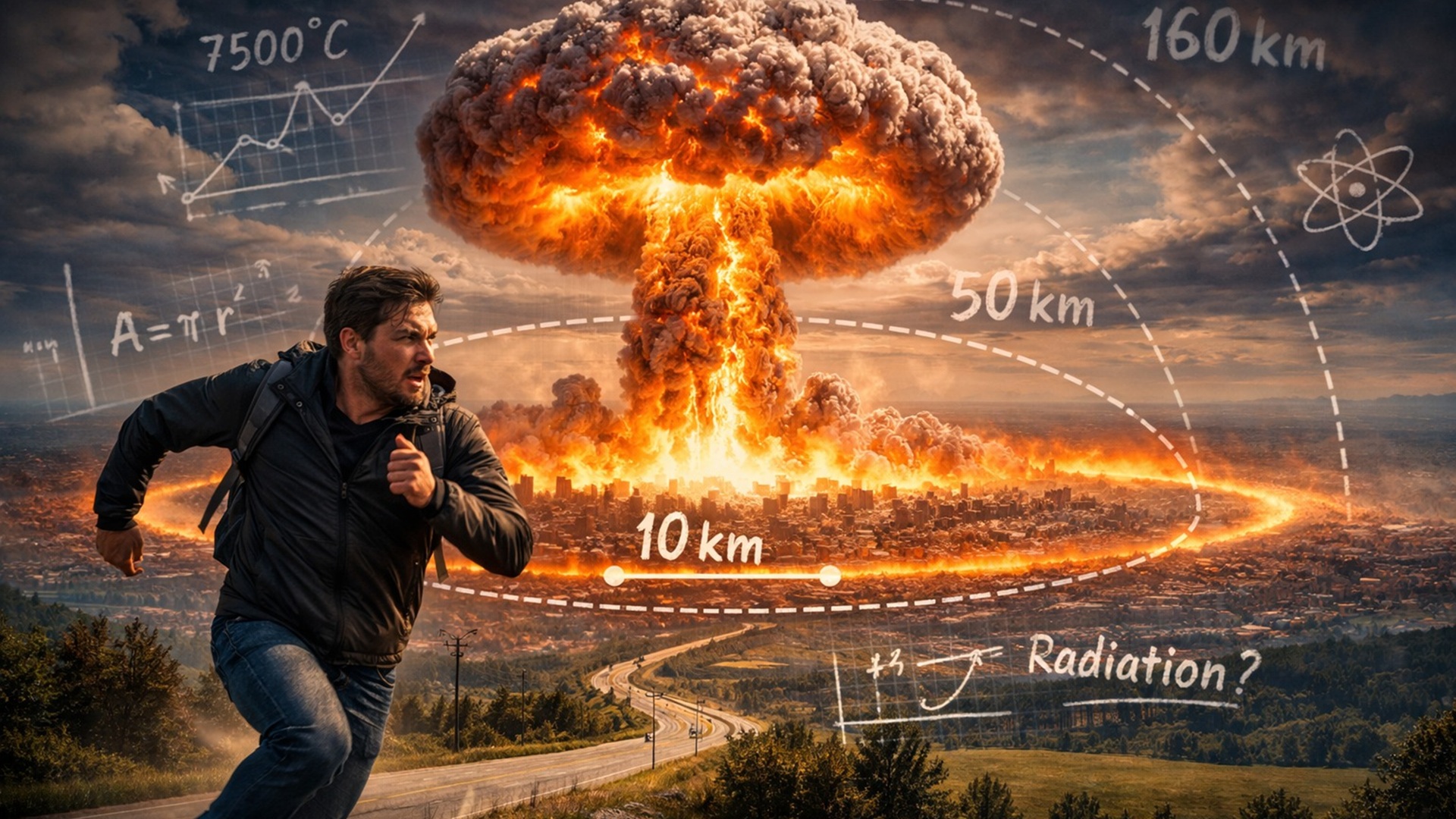
Simulations Based on Historical Explosions and Current Nuclear Models Show How the Destructive Range of a Nuclear Bomb Has Evolved Since Hiroshima, Indicating Zones of Total Destruction, Severe Burns, and Radioactive Dispersion Capable of Reaching Areas Located Over 160 Kilometers from the Impact Point
A nuclear bomb has returned to the center of global discussions amid recent conflicts involving Iran, Israel, and the United States, rekindling questions about human survival in the face of such an attack and the minimum distance required to escape the immediate and subsequent effects.
Hiroshima and Nagasaki Defined the Initial Impact of a Modern Nuclear Bomb
The debate about survival from a nuclear bomb begins in August 1945, when the United States dropped two atomic bombs on Japan, hitting Hiroshima and Nagasaki during the final moments of World War II.
The bomb dropped on Hiroshima had a yield equivalent to 10 kilotons of TNT. The explosion generated temperatures nearing 7,000 degrees Celsius and destroyed an area estimated at 32 square kilometers.
-
In Somaliland’s Desert, Greenhouse Uses Sun and Seawater to Grow Lettuce, Cucumbers, and Tomatoes Without Rain: 1-Hectare Project Cools Crops, Desalinates Water, and Converts Brine into Commercial Salt

-
Trump Unveils $400 Million Boeing 747 Donated by Qatar as Temporary Air Force One Amid Boeing Delays, Sparking Debate on National Security, Costs, and Foreign Influence
-
Chinese Company Unveils Robotic Toilet That Comes to You, Featuring Lidar Sensors, Voice Command, Bidet, Hot Air Drying, UV Light, and Self-Cleaning Waste Disposal
-
Rotterdam Develops Floodable Square to Absorb Nearly 2 Million Liters of Rainwater, Doubling as Sports, Theater, and Leisure Space When Dry to Combat Urban Flooding




The two explosions caused more than 320,000 immediate deaths and radiation-related fatalities. Even considered weak compared to current armaments, the bombs were sufficient to devastate entire cities.
These attacks marked the beginning of the nuclear bomb era and established the first real parameters for destructive range, extreme heat, and direct human effects caused by a nuclear explosion.
Nuclear Tests Drastically Increased the Destructive Power of the Nuclear Bomb
After 1945, other powers began developing nuclear arsenals. In 1961, the Soviet Union tested the so-called Tsar Bomba, considered the most powerful ever detonated.
The device had a yield of 50 megatons and was tested in the Arctic. The explosion produced a fireball comparable in size to Paris and generated a magnitude 5 earthquake.
The heat released burned the air for hundreds of kilometers, demonstrating the exponential increase in the destructive power of a nuclear bomb compared to the models used in Japan.
Subsequently, French nuclear tests were conducted in Polynesia during the 1990s, under the leadership of Jacques Chirac, generating international criticism and radioactive exposure for the local population.
Today, French warheads have a yield of approximately 300 kilotons, while the United States has bombs with yields of up to 1,200 kilotons.
Simulation Shows Zones of Total Destruction in Attack with 1,200 Kiloton Nuclear Bomb
Simulations conducted by the Nukemap system indicate that an American B83 nuclear bomb could destroy around 175 km² of the Paris region.
Within the so-called red radius, located at the center of the explosion, total destruction would occur with nearly 100% casualties, covering the entire urban area of the French capital.
In the blue radius, buildings would suffer structural collapse, and widespread fires would affect cities such as Boulogne-Billancourt, Saint-Denis, and Ivry-sur-Seine.
The orange radius would reach areas like Versailles, Créteil, and Villepinte, where light damage and third-degree burns caused by the thermal wave would be recorded.
These zones demonstrate that the immediate effects of a nuclear bomb far exceed the exact point of detonation, affecting entire metropolitan regions.
Radiation Increases Risks Even Dozens or Hundreds of Kilometers from the Explosion
The impacts of a nuclear bomb do not end with the initial explosion. Radioactive fallout represents one of the most dangerous factors for survivors located outside the areas of direct destruction.
An example cited is the Japanese ship Daigo Fukuryu Maru, which was sailing 160 kilometers from an American nuclear explosion in 1954 and still had its entire crew exposed to radiation.
Radioactive contamination can affect water, crops, and soil, causing diseases like cancer across generations.
Cases like Chernobyl and Pripyat, after the Reactor Number 4 accident in 1986, demonstrate that contaminated regions can remain uninhabitable for decades.
Some Pacific islands remain uninhabited due to nuclear tests conducted during the 20th century, highlighting the persistence of radioactive effects.
Safe Distance Remains Uncertain in Face of the Unpredictable Spread of the Nuclear Bomb
Even people located dozens of kilometers from the impact may face severe risks after the detonation of a nuclear bomb, especially due to the atmospheric dispersion of radiation.
The exact extent of contamination depends on factors still considered unpredictable in a real attack in an urban environment.
According to the analyzed material, no one can accurately determine how far radiation could spread after a nuclear explosion in a large city.
This uncertainty is identified as the main variable associated with survival, turning the minimum safe distance into a question without a definitive answer in a real nuclear bomb scenario.





Be the first to react!