Portuguese
  Spanish


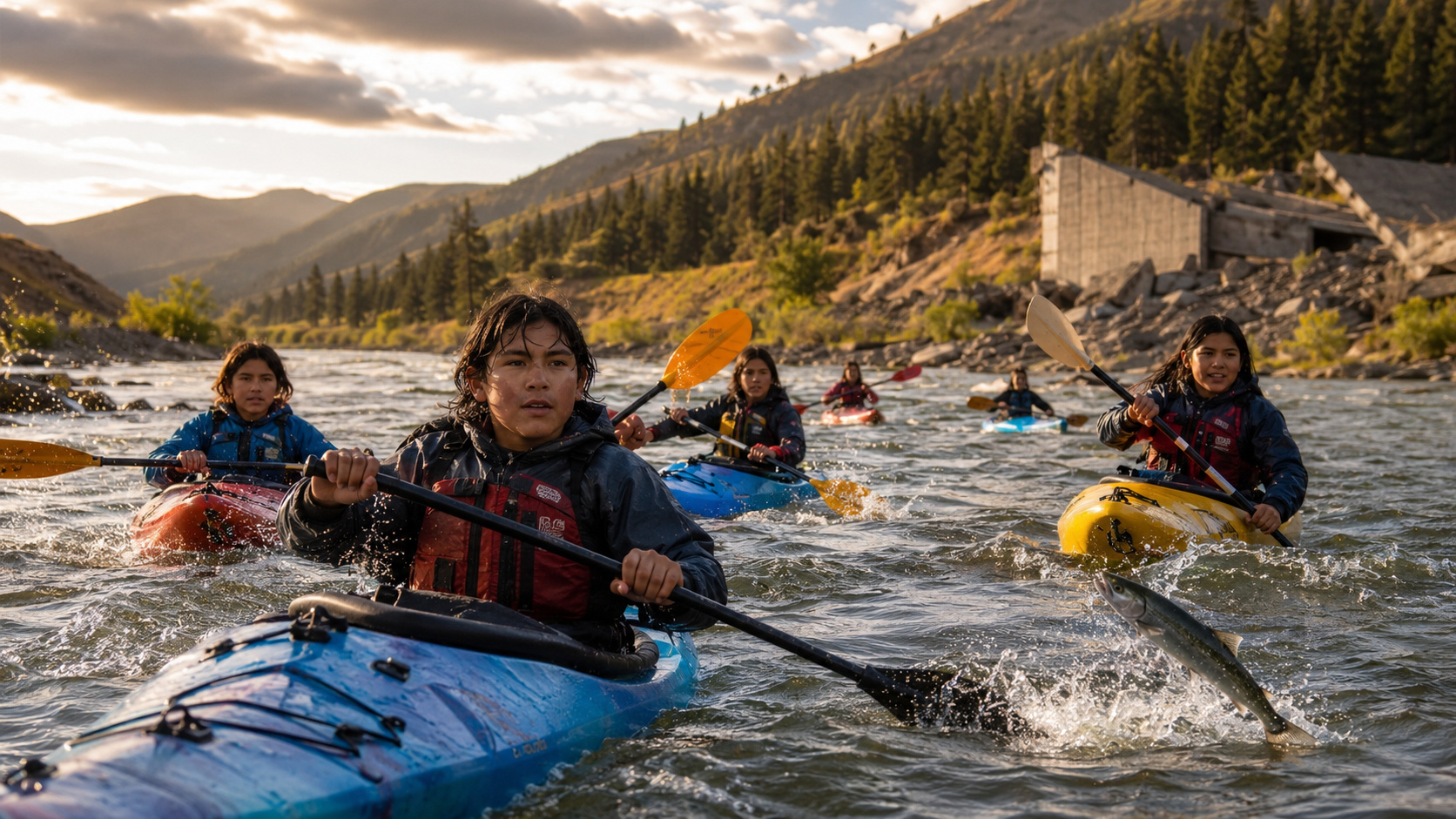

The crossing on the Klamath River brought together indigenous youth, kayaks, salmon, and the largest dam removal in the United States on a journey of nearly 500 km to the Pacific, after decades of blockage in the natural waterway.
Indigenous teenagers paddled nearly 500 km by kayak along the Klamath River after 4 old dams were demolished between California and Oregon. The journey ended in the Pacific Ocean and symbolized the reopening of a path that had been blocked for over a century.
The information was published by AP News, a news agency with international coverage. The trip brought together young people from tribes such as Yurok, Karuk, Hoopa Valley, and Klamath, in a crossing that mixed adventure, indigenous memory, environmental recovery, and a rare project, aimed at removing concrete from the river.
The impact was direct on the watercourse. With the removal of the dams, the Klamath once again had free stretches for navigation and for the return of salmon, fish that depend on the river to ascend to breeding areas.
-
Brazilian Construction Worker Moves to France, Earns Up to €2,500 Monthly with Home Renovations, Gains Social Media Attention

-
US Navy Sinks USS Oriskany with 230 kg of C-4, Creating World’s Largest Artificial Reef in 37 Minutes

-
U.S. Dumped Tanks, Jeeps, and Coca-Cola into the Pacific in 1945 After British and French Lowball Offer, Creating “Million Dollar Point”
-
WHO Warns of Unnecessary Interventions in Natural Births Worldwide, Advocates for More Human-Centered Care, Reigniting Debate on Medicalization




Indigenous youth entered kayaks and transformed the Klamath River into a symbol of resurgence
The most powerful scene doesn’t start with machines or explosions, but with teenagers putting kayaks in the water and following a river that once again had an open path. The descent covered 310 miles, about 500 km, to the mouth of the Klamath in northern California.


The arrival at the Pacific occurred on July 11, 2025. The end of the journey was celebrated on the beach, after a journey marked by cold water, currents, camping, and the symbolic weight of navigating a river previously interrupted by old structures.
For the indigenous youth, the crossing held a value greater than sport. The Klamath is part of the life, diet, and culture of the peoples living in the region. Paddling it after the removal of the dams became a form of reconnection with a territory blocked for generations.
Four old dams were removed to restore flow to the river and passage for salmon
The 4 dams removed were old structures related to energy generation. They blocked the passage of salmon, which need to swim upstream to complete their life cycle. In simple terms, this means the fish are born in freshwater areas, go to the sea, and then try to return to the river to reproduce.
For more than a century, this path was interrupted. The dammed water also harmed the river’s balance, especially in sections where the fish depended on cooler, flowing water.
The removal of the structures opened about 420 miles of habitat, approximately 676 km, for the salmon. Habitat is the natural environment where animals live, feed, and reproduce.
This fact explains why the removal of the dams gained so much attention. It was not just a demolition project. It was a physical change in the river, with a direct effect on fish, indigenous communities, and navigation.
AP News detailed the removal that became the largest operation of its kind in the United States
AP News, an international news agency, detailed the key points of the crossing and removal of the dams on the Klamath. The removal became known as the largest dam removal in United States history.
The case draws attention because it reverses the common logic of large projects. In many projects, machines arrive to erect concrete, dam water, and create giant structures. On the Klamath, engineering appeared to dismantle barriers and allow the river to flow more freely.
The removal of the dams occurred after years of pressure from indigenous peoples, environmentalists, and communities connected to the river. The goal was to restore the passage of salmon and reduce the damage caused by blocking the natural flow of water.
For the Brazilian reader, the story shows that infrastructure can also be discussed in terms of what needs to be removed. In some cases, removing an old structure can have as much impact as building a new one.
Salmon returned to the center of the story because they sustain culture, food, and indigenous memory
Salmon are an essential part of the lives of the indigenous peoples of the Klamath basin. They represent more than just fishing. They also carry cultural, spiritual, and nutritional value for communities that have lived with the river for many generations.
When the dams closed the path of the fish, the impact extended from the environment to the daily lives of these populations. Less salmon in the river meant less food, less cultural continuity, and more pressure on a way of life connected to the water.
The reopening of the passage for the fish does not solve everything at once. Rivers need time to recover. Even so, the opening of hundreds of kilometers of habitat created a new chance for the salmon to swim up the Klamath and reach areas previously blocked.
The kayaking journey made this change visible. Instead of just talking about environmental recovery, the young people showed the river in motion, with people navigating where there were once barriers.
The largest dam removal in the United States became a reverse construction
The case of the Klamath draws attention because it seems like a reverse construction. Instead of raising concrete walls, the work removed structures that blocked the river. Instead of creating a reservoir, the change restored movement to the water.
This difference helps explain the interest in the story. The same word engineering usually brings to mind bridges, tunnels, power plants, and buildings. In the Klamath, it is associated with restoration, a way to repair damage caused by old structures.
The removal also reignited an important question. When a dam ages, causes environmental damage, and no longer compensates for its effects, maintaining the structure may no longer be the best choice.
In the case of the Klamath, the removal of the 4 dams became a milestone because it united the river, indigenous peoples, salmon, and technical decision-making in the same process. The result was felt in the water and also in the way communities reconnected with the territory.
Crossing nearly 500 km showed that the river regained its path to the Pacific
The kayaking descent ended as a powerful image: indigenous teenagers reaching the Pacific after crossing nearly 500 km through a newly liberated river. The journey celebrated the return of navigation and the end of a historical barrier in part of the Klamath.
More than an adventure, the journey showed the practical impact of the dam removals. The river gained free stretches, salmon regained access to previously closed areas, and the young people could travel a path that had long been interrupted.
The story also leaves a simple reflection. Not every major transformation is born from a new construction. Sometimes, what changes the fate of a river is precisely removing what prevented the water from flowing.
If a river can breathe again after the removal of old dams, how many other constructions around the world should be reconsidered before the damage becomes permanent? Share your opinion and share this story.