Portuguese
  Spanish


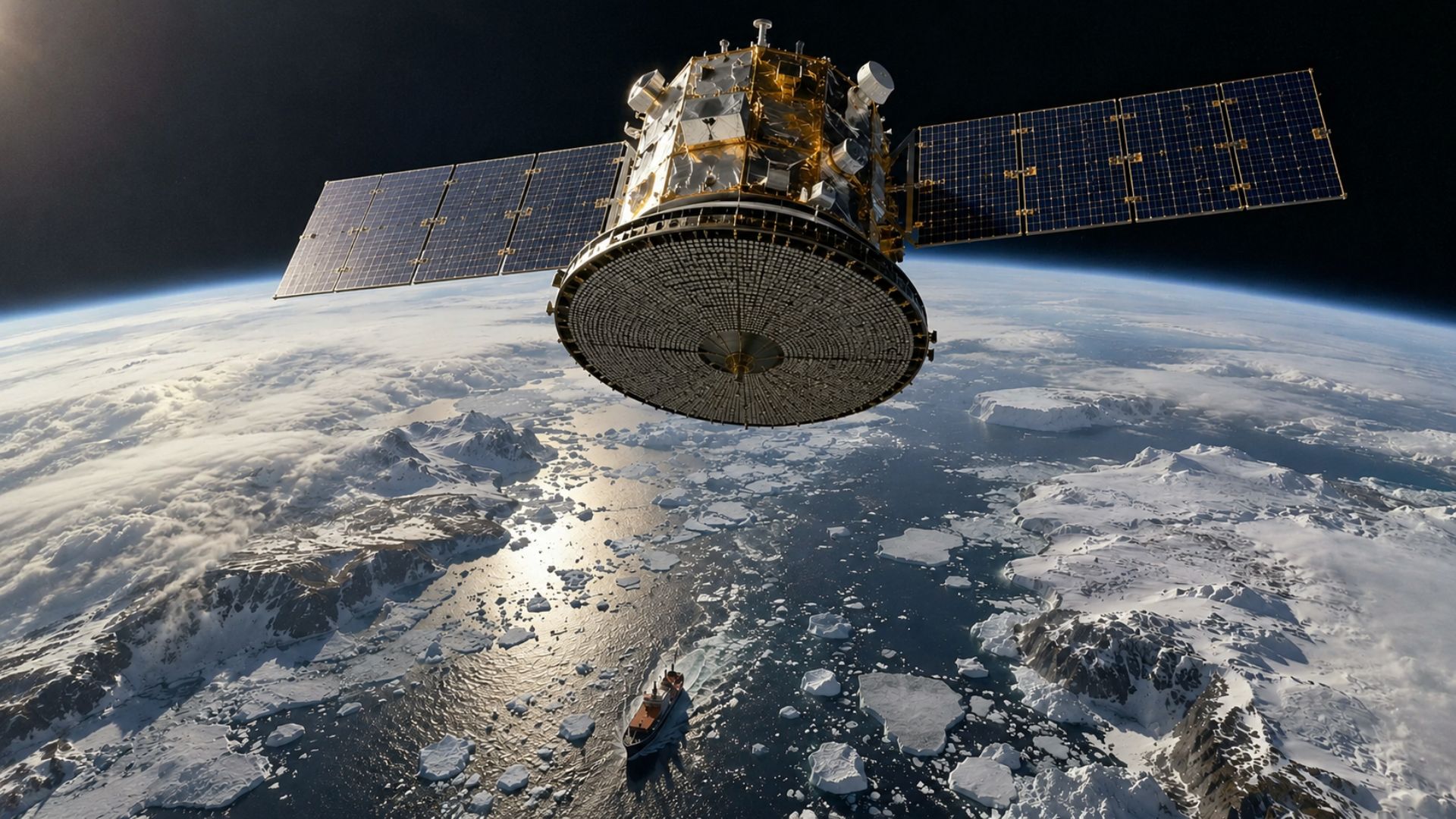


Orbital radar technology expands Russia’s capability to observe remote areas, covered by ice or clouds, even without sunlight, in a mission linked to terrestrial monitoring and strategic interest in the Arctic maritime routes.
Russia has placed the Kondor-FKA No. 2 into orbit, the second radar satellite in the series aimed at remote Earth sensing, in a mission launched from the Vostochny Cosmodrome in the Russian Far East on November 30, 2024, Moscow time.
The equipment was sent by a Soyuz-2.1a rocket with a Fregat upper stage and, according to Roscosmos, reached the intended orbit with the launch systems functioning normally.
The new satellite expands Russia’s ability to observe continents, oceans, and areas covered by ice even when conventional optical cameras cannot operate efficiently.
-
Venice Deploys 78 Massive Steel Gates to Shield City from Extreme Adriatic Tides

-
China Uses 432 Robots to Move a 7,500-Ton Historic Building in Shanghai, Preserving Architecture While Creating Space for Underground Center
-
World Cup Ball Chip Uses Technology to Detect Invisible Touches, Confirms Offside, Secures Portugal’s Victory Over Croatia

-
36-Meter Hydrogen-Powered Superyacht Arrives in Brazil to Debut German Engines and Showcase Future of Clean Navigation




The difference lies in the use of synthetic aperture radar, known by the acronym SAR, a technology capable of forming surface images without relying on sunlight or clear skies.
The mission has direct interest in monitoring the Northern Sea Route, a navigation corridor in the Arctic that Russia considers strategic for transportation, economic exploration, and logistics in high latitudes.
According to the Russian state agency RIA Novosti, the Kondor-FKA No. 2 is among the systems used to monitor ice conditions on this route.
How the Kondor-FKA radar satellite observes the Earth
Optical satellites record the light reflected by the Earth’s surface, which limits image capture during the night, under dense clouds, or in regions subject to long periods of darkness.
Radar, on the other hand, emits its own signals and measures the return of these waves after interaction with soil, water, ice, or structures.
This operation allows for more regular observation of remote areas, even in adverse weather conditions.
Therefore, the Kondor-FKA series is presented as a tool for mapping, environmental monitoring, natural resource surveying, and monitoring of ice-covered maritime regions.
In practice, the satellite does not “photograph” the Earth like a common camera.
The system constructs images from radar signals, making it possible to record surface changes even when the observed region is under clouds or without natural lighting.
This feature is especially important in the Arctic, where observation conditions can change rapidly.
Extreme cold, storms, sea ice, and polar night reduce the predictability of operations and increase the need for frequent orbital data.
Launch strengthens the Russian orbital radar series
The Kondor-FKA No. 2 was launched at 00:50:25 Moscow time, according to the Earth Operational Monitoring Scientific Center, part of the Russian space structure.
The payload was carried by the Soyuz-2.1a rocket and the Fregat stage, which delivered the satellite to the designated orbit.
NPO Lavochkin, manufacturer of the Fregat stage and part of Roscosmos, reported that the satellite separated from the upper stage about one hour and five minutes after liftoff.
The company also confirmed that the equipment was successfully placed in the target orbit.
The construction of the satellite is attributed to NPO Mashinostroyeniya, a Russian aerospace organization involved in the development of complex systems.
International technical sources also identify the platform as a Russian civil radar mission for Earth observation, equipped with an S-band SAR instrument.
The first satellite of the Kondor-FKA series was launched in May 2023, also by a Soyuz-2.1a from Vostochny.
With the second equipment in orbital operation, Russia now has a more robust configuration to obtain radar images in different observation windows.
Why the Arctic is central to the mission
The Northern Sea Route crosses Russian Arctic waters and connects sections between Europe and Asia by a shorter path on certain routes.
The logistical potential of this route depends, however, on difficult environmental conditions, marked by ice, low visibility, and long periods without sunlight.
In this scenario, radar satellites offer a clear operational advantage: they can monitor the surface even when optical sensors would see little or nothing.
The information obtained helps to map ice, identify changes in coastal areas, and support navigation planning in regions with complex access.
The Xinhua agency, based on a statement from Roscosmos, associated the Kondor-FKA series with supporting vessels on ice-covered routes, including the Northern Sea Route during polar nights.
This application reinforces the role of orbital radar in environments where updated maps and images reduce logistical uncertainties.
In addition to use in icy waters, the technology can meet demands for environmental and natural resource monitoring.
Forests, coastal zones, oceans, and high-latitude areas are examples of regions where frequent radar observation helps build data series on surface changes.
Space autonomy and strategic data
The launch of Kondor-FKA No. 2 occurs in a context of competition for technological autonomy in space observation, navigation, communication, and resource monitoring.
For countries with large territorial extensions, own satellites reduce dependence on foreign systems and enhance control over sensitive data.
Roscosmos and Russian state vehicles present the mission as part of an infrastructure aimed at continuous Earth remote sensing operation.
The ability to observe during the day, at night, and under clouds gives the system a utility that goes beyond image production, as it supports decisions in economic, environmental, and institutional areas.
There is divergence among open sources regarding some technical details of the satellite’s mass, with records close to 1,050 kg and others around 1,100 kg.
Therefore, the safest information is to treat Kondor-FKA as a medium-sized orbital radar platform, designed for long-term operation and medium to high-resolution observation.
Roscosmos also indicated that new satellites Kondor-FKA No. 3 and No. 4 are planned for 2029 and 2030, according to Interfax, which points to a continuation of the constellation in the coming years.
Until then, the two satellites already launched form the basis of Russia’s civil radar capability in this specific line.
The most direct image of the mission is that of equipment capable of observing dark, frozen, and covered regions without waiting for ideal visibility conditions.
In the Arctic, where climate, ice, and distance impose limits on human presence, this capability makes the orbital radar a relevant piece of Russian space infrastructure.