






 Portuguese
  Spanish
  4 min of reading
  0 comments


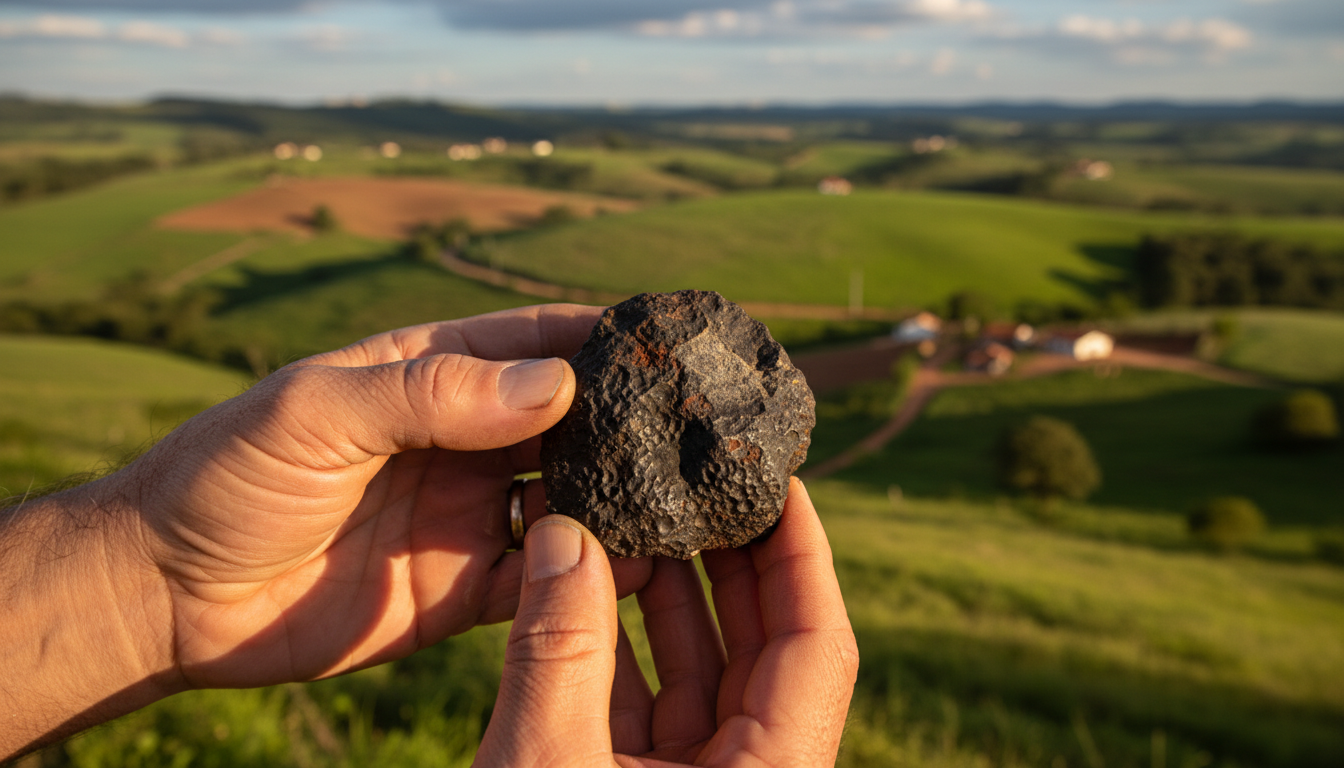
Found in 1956 by farmer Hildebrando Alves Pereira in the rural area of Descoberto, the 15 kg chondrite was taken by engineers, divided at the Smithsonian, and only scientifically rediscovered in 2010 by an astronomer from the National Museum
In 1956, a dark and heavy stone appeared on the property of Hildebrando Alves Pereira, a resident of the rural area of Descoberto, in the interior of Minas Gerais. The farmer did not know it, but he had just found a piece of space — a São João Nepomuceno meteorite, classified as an ordinary chondrite, composed of silicates and metal formed in the first millions of years of the Solar System. Hildebrando kept the largest fragment at home. The family had no idea that this strange rock would cross continents and decades before its story was told.
As journalist Luís Pontes published in the newspaper Voz de São João in April 2026, most of the meteorite was taken by two engineers around 1960. The main piece, weighing 15 kg, ended up at the Smithsonian Institution in Washington, where it was divided into two parts of approximately 6 kg each, along with smaller slices for scientific analysis.

The rediscovery: how an astronomer from the National Museum tracked the meteorite back to Descoberto
For decades, the São João Nepomuceno meteorite existed only in the records of the National Museum of Rio de Janeiro and the Smithsonian in the United States. No one outside knew that the Pereira family still kept fragments in Descoberto.
-
Helicopter Drops 180 Tons of Sand and Gravel on Swedish River to Revive Ecosystem Damaged by Decades of Exploitation

-
The War of Jenkins’ Ear: How a Severed Ear Sparked One of the 18th Century’s Most Unusual Conflicts

-
The True Story of Beavers Parachuted into Idaho: A Post-WWII Mission Using Planes and Special Crates to Relocate 76 Animals to a Remote U.S. Region
-
Trailblazing Brazilian Mother of Three Becomes First Woman to Drive BYD Electric Truck, Inspiring Her Daughter to Follow Suit



In 2010, everything changed. Heraldo Pereira, Hildebrando’s youngest son, sent a sample to Dr. Maria Elizabeth Zucolotto, an astronomer at the National Museum of UFRJ. The scientist traveled to Descoberto, interviewed Hildebrando and his wife D. Hilda, and filmed the testimony — recording for the first time the discoverer’s account of the fall and removal by engineers in 1960.
The new fragment had a mass comparable to the 15 kg of the original piece, opening access to the meteorite outside public institutions for the first time. After receiving contacts from sellers and collectors in Brazil and abroad, Heraldo accepted an offer — and the fragment permanently left Descoberto.

Brazil has a collection of meteorites that almost no one knows about
The story of São João Nepomuceno is not an isolated case. Brazil has one of the richest meteorite collections in South America, spread across museums, institutions, and — as in the case of Hildebrando — backyards of families who do not even know what they are keeping.
- Bendegó (Bahia, 1784) — 268 kg, the largest meteorite ever found in Brazil. Discovered in the Bahia hinterland, transported by Dom Pedro II in 1887 to Rio de Janeiro
- Sanclerlândia (Goiás, 1971) — 267 kg, found by a geology student from UnB
- Geraisitos (Minas Gerais) — more than 600 fragments of tektites scattered over 900 km, formed by a meteorite impact 6.3 million years ago
Thus, Minas Gerais concentrates some of the most important records of extraterrestrial impacts in the country. In addition to São João Nepomuceno, the state houses hundreds of glass fragments formed by ancient cosmic collisions. In Tocantins, the Serra da Cangalha preserves a 13 km diameter crater formed 220 million years ago that almost no Brazilian knows about.
Recently, an “extraterrestrial” object 6 million years old found in Brazilian territory was analyzed by Unicamp, raising hypotheses about micrometeorites that still challenge science.

Between science and the market: what is lost when meteorites leave the country
The sale of Hildebrando’s fragment to a private collector raises a recurring question in the scientific community. When meteorites leave public institutions and enter the private market, future studies are compromised — especially in countries like Brazil, where legislation on geological heritage is still ambiguous.
However, it is necessary to recognize that families like the Pereiras kept what science took years to value for decades. Without Hildebrando, the meteorite would have disappeared in 1960 along with the engineers. Without Heraldo, Dr. Zucolotto would never have reached Descoberto.
The story of the São João Nepomuceno meteorite is, above all, a story of memory. Of a farmer who recognized something strange in a dark stone. Of a family that kept a piece of the universe without knowing exactly what they had. And of an astronomer who, more than half a century later, crossed the state to record the testimony before it was lost forever. As noted by Veja, Minas Gerais holds evidence of cosmic impacts that most Brazilians do not even imagine exist.





Be the first to react!